Managing Up With Challenging Bosses – Transcript
transcript
Transcript
Online Networking Without the Cringe
Here to read instead of watch? Click through the headings to a section of the full transcript, or scroll away!
- What You See When Bosses Are Great
- What You See When Bosses Are Challenging
- Our Typical Reactions to a Challenging Boss (with a Reality Check)
- Case Study: Robyn’s Story
- The 5 Most Common Types of Challenging Bosses
- Challenging Boss #1 – The Micromanager (Their Impact & Strategies to Employ to Deal With Them)
- Challenging Boss #2 – The Gaslighter (Their Impact & Strategies to Employ to Deal With Them)
- Challenging Boss #3 – The Boundary Crosser (Their Impact & Strategies to Employ to Deal With Them)
- Challenging Boss #4 – The Bully (Their Impact & Strategies to Employ to Deal With Them)
- Challenging Boss #5 – The Under-Communicator (Their Impact & Strategies to Employ to Deal With Them)
- Case Study: Robyn & Her Challenging Boss
- How to Self-Manage – The 3 Phase Approach
- #1 – Pause (From Reaction to Response)
- The Emotional Distance Flywheel
- #2 – Communicate (From Conflict to Clarity)
- The Communication Flywheel
- #3 Manage (From Tension to Trust)
- Understand Your Boss
- Build Trust & Advocacy
- The Advocacy Flywheel
- Case Study: Developing a Strategy for Robyn
- What is Non-Violent Communication
- Non-Violent Communication with The Gaslighter (with Examples!)
- Case Study: How Robyn Used These Tools to Manage Up
- Summary & Key Takeaways
- 4 Steps of Non-Violent Communication
- Case Study: How Robyn Succeeded
- Reflection Tool: The Stay, Go, Grow Questionnaire
(Edited for length and clarity)
I am very, very excited to be with all of you this evening. We're going to talk about a topic that is near and dear to my heart, having worked with, and for some pretty complicated bosses in my career: Managing Up With Challenging Bosses.
I'm Mary Connelly. I am an executive coach. I specialise in organisational changes and complex work dynamics.
Little known fact, my partner and I owned a dog rehabilitation and training centre in the heart of New York City for a number of years, where we had an indoor heated pool for dogs, who came for things like torn ACLs, weight loss, neuropathy, and that sort of thing. We were one of a kind at that time.
I'm very privileged to say that I live on the land of the Munsee Lenape and the Muhheakunnuk people in New York City.
Let's dig in. Nobody shapes your career more than your boss. But what happens if the person who should enable your growth is actually the one blocking it?
What You See When Bosses Are Great
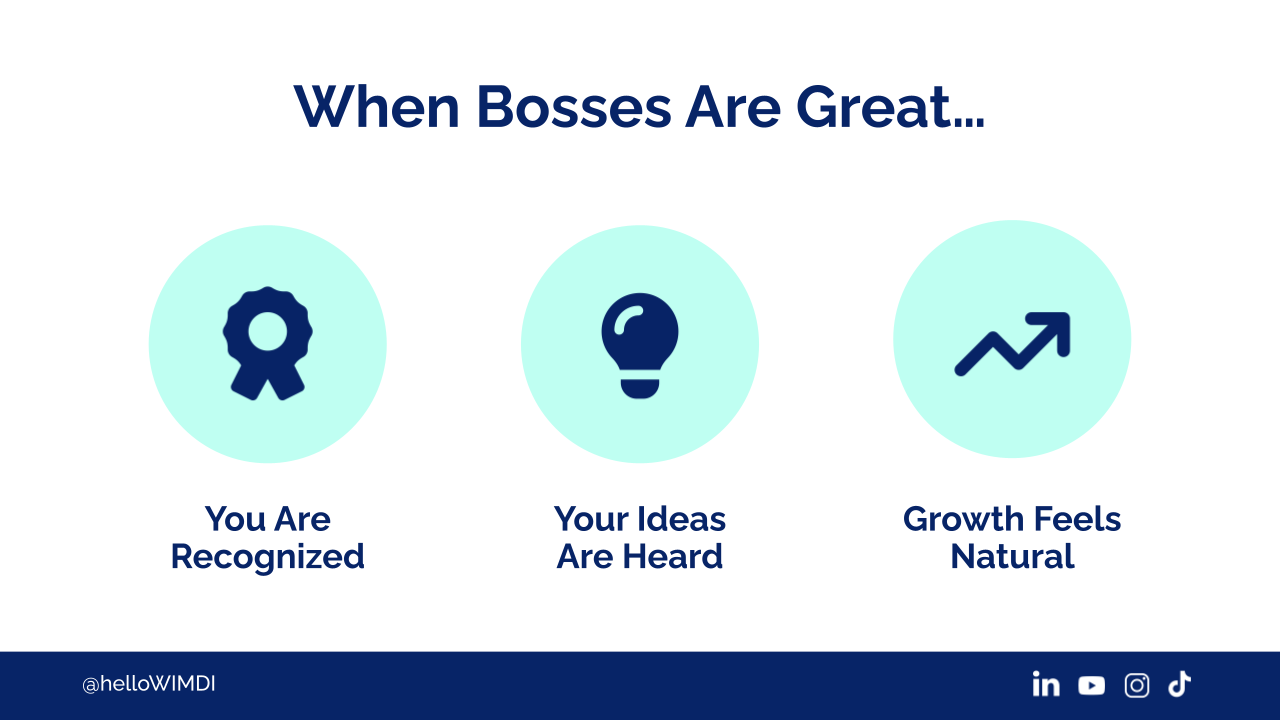
When bosses are great, you are recognised. You feel as if you have a seat at the table. They ask you your thoughts on something, your ideas are heard, and growth feels very, very natural. You feel as if your career is being taken care of.
What You See When Bosses Are Challenging
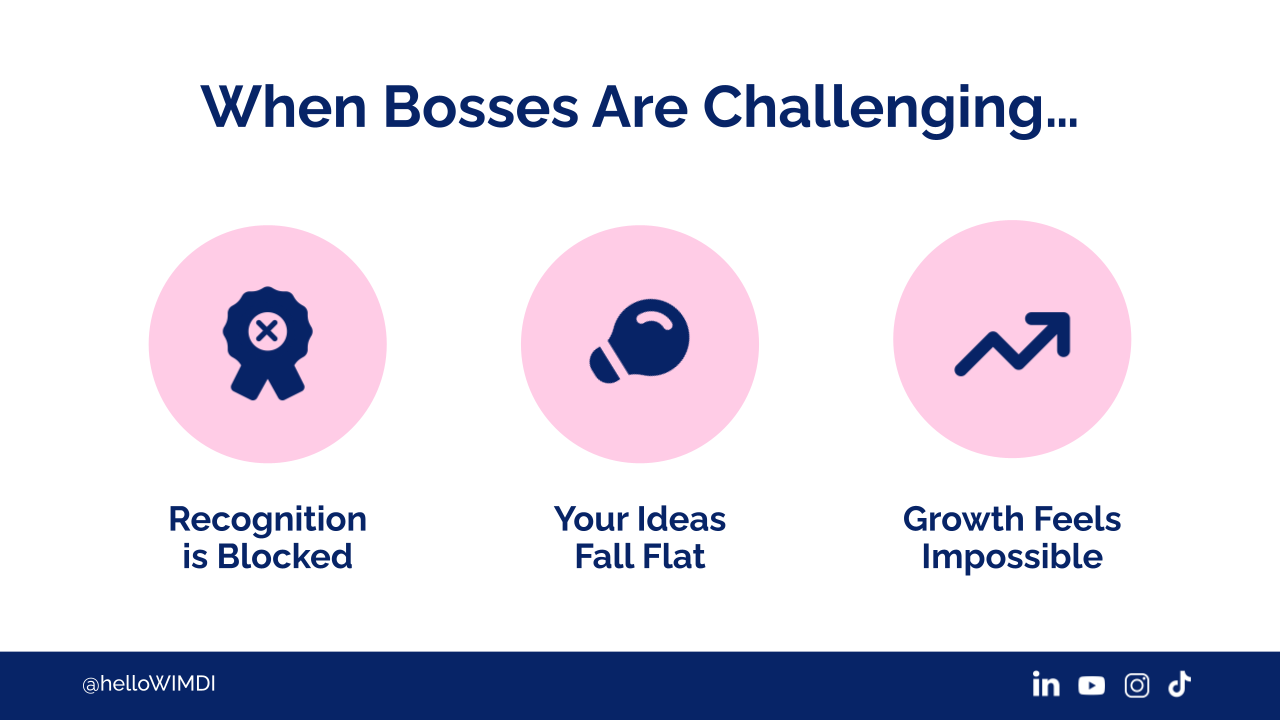
But when bosses are challenging, recognition is blocked, and it's easy to just kind of recede into the background when you're not being paid attention to, your ideas fall flat.
That could be a hit to the confidence, and over time, it can feel as if growth is really impossible.
Our Typical Reactions to a Challenging Boss (with a Reality Check)
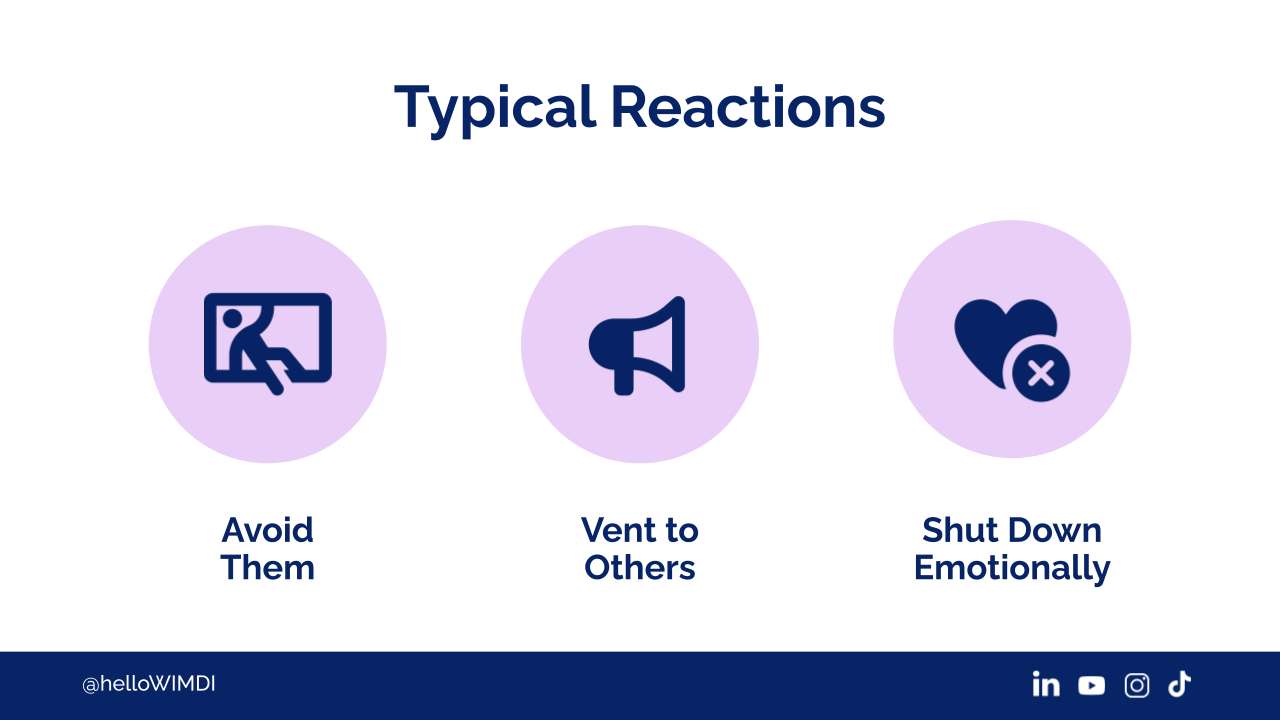
So, what do we usually do? All the wrong things, right? Typical reactions are we avoid them.
Maybe we're on premise, we're walking down the hall, they're coming toward us, we'd make a hard right just to not make eye contact with them.
Or maybe we're in a Zoom, and we keep our cameras off because we just want to fade into the background.
Often, we end up venting to others. We grab a colleague, and we go for a walk, and we tell them everything that triggered us from that morning. You kind of vent to each other.
And it becomes really complicated because you're reinforcing each other's negative bias. Ultimately, what that leads to is shutting down emotionally, which is really not going to help you.
The reality check is that avoidance won't work, but strategy will work. The late first lady of the United States from about a hundred years ago said this. She said,
"No one can make you feel inferior without your consent."
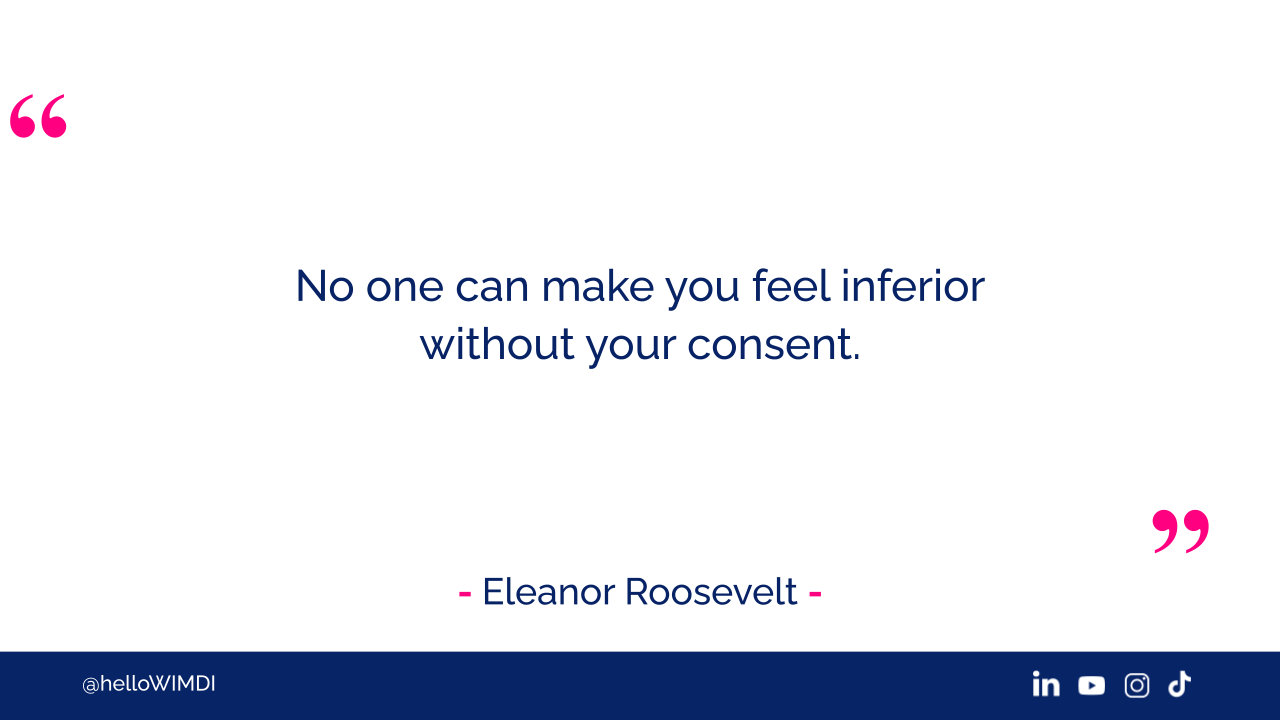
Eleanor Roosevelt was essentially a social justice warrior and an American diplomat, beyond being the wife of Franklin Delano Roosevelt.
I don't think I really understood the gravity of this statement till I was in my 40s, and I was working for somebody who was really tricky. It really challenged my confidence.
After having read this, I realised where I might have been complicit in allowing the way she was treating me and also treating my colleagues. It wasn't only me.
But it made me realise that I did have agency in the moment. And I didn't have to necessarily take in some of the things she was, you know, saying to me and saying to some of my colleagues. So, I thought this was a really important quote to bring up this evening.
Case Study: Robyn's Story
We're going to centre part of today's conversation around a true story. One of my former clients, who is anonymized for this presentation, and as is her title, and we're going to call her Robyn.
Robyn was the Director of Enterprise Enablement. Robyn contacted me a couple of weeks before starting a new job that she was very, very excited about.
She had interviewed with a number of people. She met her new boss. She thought he was very affable. He had a good reputation, seemed like a really, really nice guy.
And she was very excited to begin her role. About two weeks in, she contacted me, and she was really not in a good place.
When I asked her what was happening, she said, "You know, we have all these one-on-ones scheduled, and he abbreviates them. And what should be 30 minutes sometimes is only 15. He's even taken phone calls in the middle of our Zoom."
She's virtual, she wasn't on premise. The meeting would just end abruptly, and she just was left feeling as if she didn't know the best way forward for the work that she was being responsible for.
So that stalled projects, which made somebody as ambitious as Robyn... I mean, this is somebody who wants to be a COO someday. This was really, really difficult for her.
It also turned into having to rework a lot of deliverables, which made her feel really, really frustrated. She felt blocked in her ability to move forward.
She began to lose confidence. And when she contacted me, she said, "I think I made a mistake and that I should resign."
We're going to come back to Robyn in a little bit.
The 5 Most Common Types of Challenging Bosses
First we're going to talk about some different, very common challenging boss archetypes. There's probably well over a dozen different challenging boss archetypes. You can Google it.
You will find all different sorts of challenging behaviour in the boss, in the leadership space.
But I'm going to focus on these five because I find them to be five of the most common that my clients talk to me about frequently when they're having a tricky time at work.
Challenging Boss #1 – The Micromanager (Their Impact & Strategies to Employ to Deal With Them)
The first one is the micromanager. The impact of the micromanager, probably doesn't need a lot of explanation, but is very similar to feeling suffocated.
Even when you're not in the same room with them, because of the way they have a need to control, it feels like they're always looking over your shoulder.
You send them a document, it comes back completely redlined. They second guess some of your instinct and how you want to move things forward in a project.
They challenge the way you word details in an email, and they ask you to rework it.
What happens is innovation stalls because things are not moving forward. Over a period of time, not only do you risk burnout but so do your colleagues and your peers.
It just has a pervasive feeling that everybody feels as if they're being squashed. It's not a good feeling.
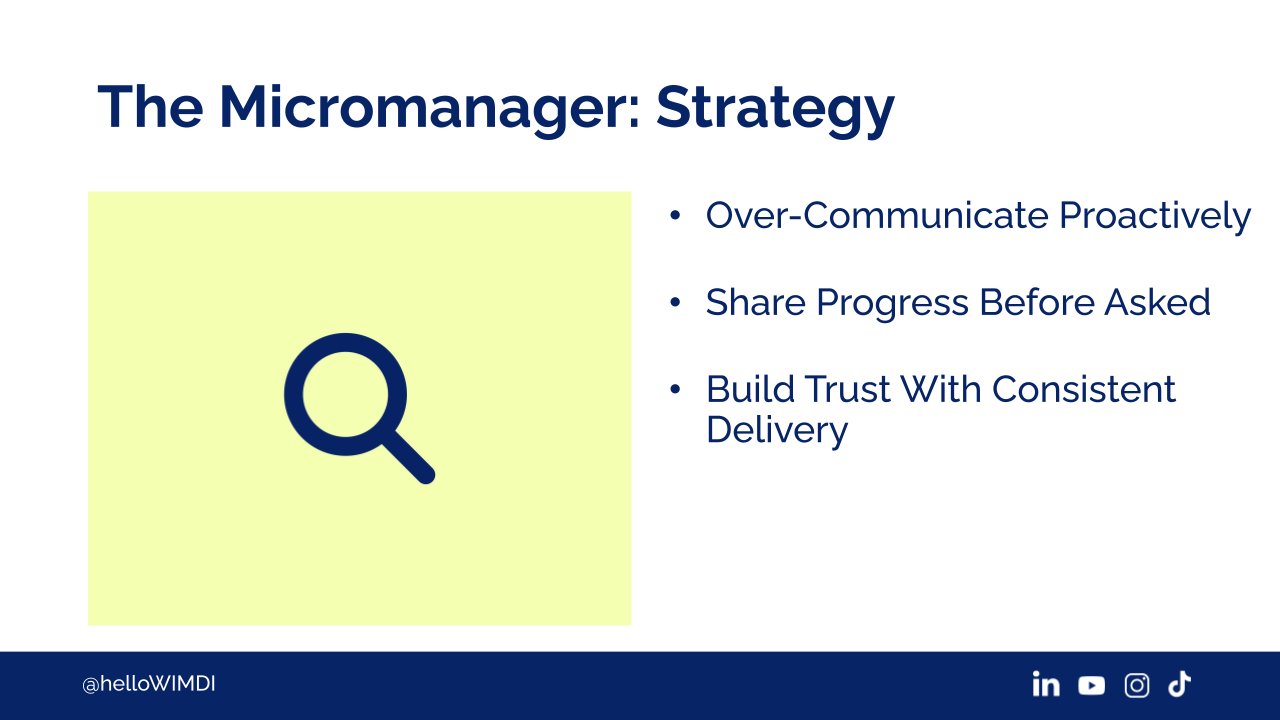
The strategy to handle a micromanager, is to over-communicate. Observe what matters to them.
Know that this is not about you, and that you need to manage up from the perspective of delivering information to them, so they take their foot off the gas pedal a little bit.
The more you share progress in advance, you will build trust with them, and you will find it'll diminish their need to try and control everything that you're responsible for.
It will not go away. In fact, with any of these archetypes, you will probably not change them. But what you can do is modify the impact that they are having on you by using some of these strategies.
So, with a micromanager, it's very much about over-communication. Because then they begin to trust that you're on top of things.
Know that with a micromanager, for them, it's really about not being in control. That is pretty standard.
Challenging Boss #2 – The Gaslighter (Their Impact & Strategies to Employ to Deal With Them)
The gaslighter, is really, really tricky. With the gaslighter, you begin to doubt your memory.
You're in their office, or you're having a meeting with them on a Monday, they say, "This week, Project A is the most important thing that we are focusing on."
And then you get together with everybody on Wednesday, and your boss says, "No, it's not Project A. We're focused on Project B."
And you're wondering, "Wait, I just spent 48 hours working on Project A. I was in your office on Monday. You said we're working on Project A."
What happens over time is you think you're misremembering, right? But gaslighters often change their mind and don't communicate what's happening, or where they've changed their mind.
That's one of the trickiest things about a gaslighter. Over time, your decision-making begins to feel shaky because you're second guessing yourself because it happens so frequently. They're generally always in the driver's seat.
So, refuting their memory is probably not going to serve you. What you can do is to shore up your ability to deliver information in a way that it can't be second-guessed.
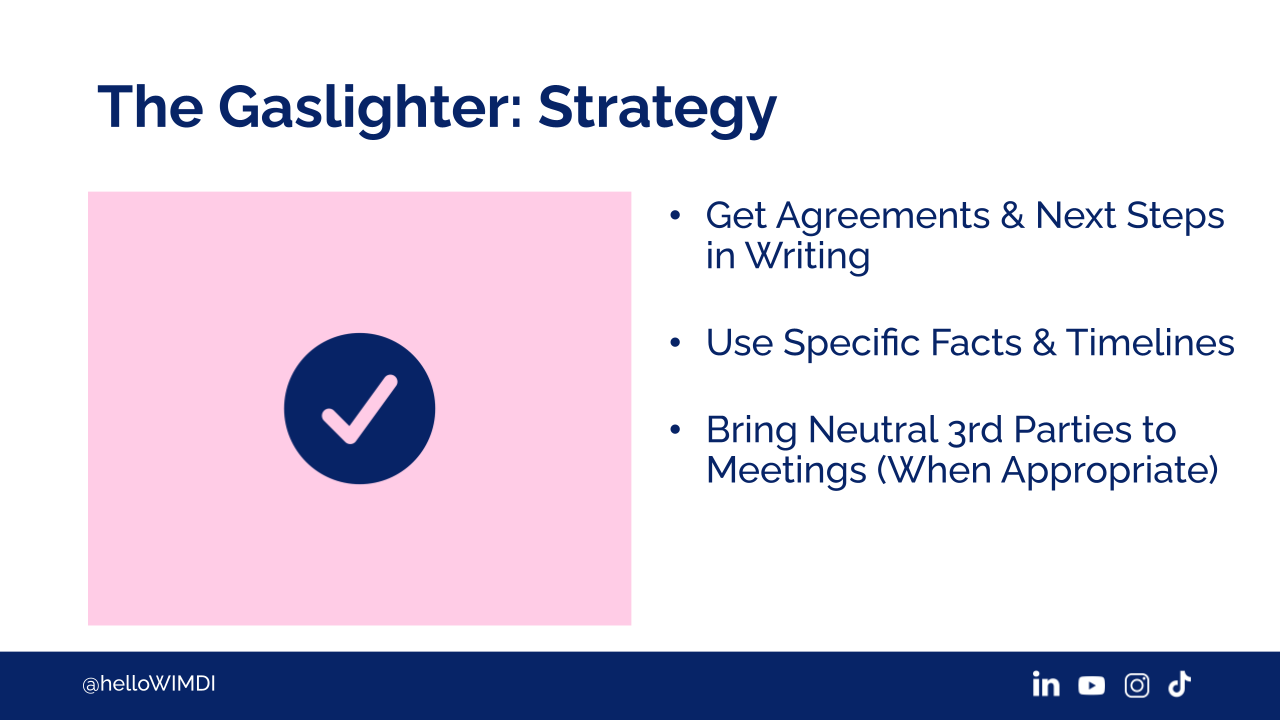
What that means is get agreements in writing. You leave a meeting, you document the time of the meeting, who is in the meeting.
You keep notes so that you can go back later and say, "This is what John and I heard in the meeting. Are you aligned?"
You want to deal in specific facts and get alignment with a gaslighter so that later, they can't suggest that you're the one who's misremembering.
In the unusual, best-case scenario, you would bring a third party to a meeting, or have them on a Zoom if you're remote. It's not always ideal, because that person really has to be part of the project.
But in an instance where it might be possible to have a third party there to hear what you're hearing, it's helpful.
That's another strategy, but the top strategy would be to get everything in writing and then to circle back with them and align with them so that you're not left redoing work or working on something for 48 hours that, you believe was the focus.
Challenging Boss #3 – The Boundary Crosser (Their Impact & Strategies to Employ to Deal With Them)
The boundary crosser is number three. There are lots of ways that bosses cross boundaries. Sometimes it's physical. Sometimes it's emotional.
I worked with a woman at one point who was terrible about boundary crossing and constantly oversharing personal information and inquiring about people's personal information. It made a lot of us uncomfortable.
What I want to talk about is when your work-life balance becomes compromised.
You've put in a whole eight-hour or 10-hour day. You go home. It's seven o'clock in the evening and you’re sitting down to have dinner with your family. Maybe you're going to help your eight-year-old with their homework.
Your phone blows up, and its message after message after message. Or your Slack is blowing up. And it becomes really hard to ignore.
What's important in that moment is to set some boundaries with them. So, let's say you're getting eight or 10 text messages from your boss late in the evening.
You know it's not going to stop unless you address it. So, you check in with them.
You give them a phone call, and you say, "Listen, I'm sitting down to dinner."
You communicate why it's a boundary crossing without saying, you're crossing my boundaries.
"I'm sitting down to dinner with my family. Would it be okay if I came in 15 minutes in the morning? Because I recognise this is urgent and concerning for you."
Boundary crossers when it comes to scope creep or crossing your boundaries about time, they want your attention right away because they're the ones having anxiety about something that's not happening on the timeframe that they want.
So, what you want to do is address it, but you want to let them know that it's not something that can be addressed right now.
If the boundary crossing has to do with scope creep, and on a Monday, your boss says, "Yep, this week we're going to focus on Project A," and by Thursday, it's, "No, we're going to focus on Project B and C also," and you're wondering, how am I going to deliver all this by Friday?
The language then is, "John, I understand that Project A and B and C are all really, really important. However, I need you to align with me on which one is the priority. Because all three of them cannot get done in the course of the next 24 hours."
Again, they may not respect that you are, you know, pointing out that they're crossing a boundary. But often they don't even realise they're doing it, and they're like, "Oh, right, okay, just focus on Project B."
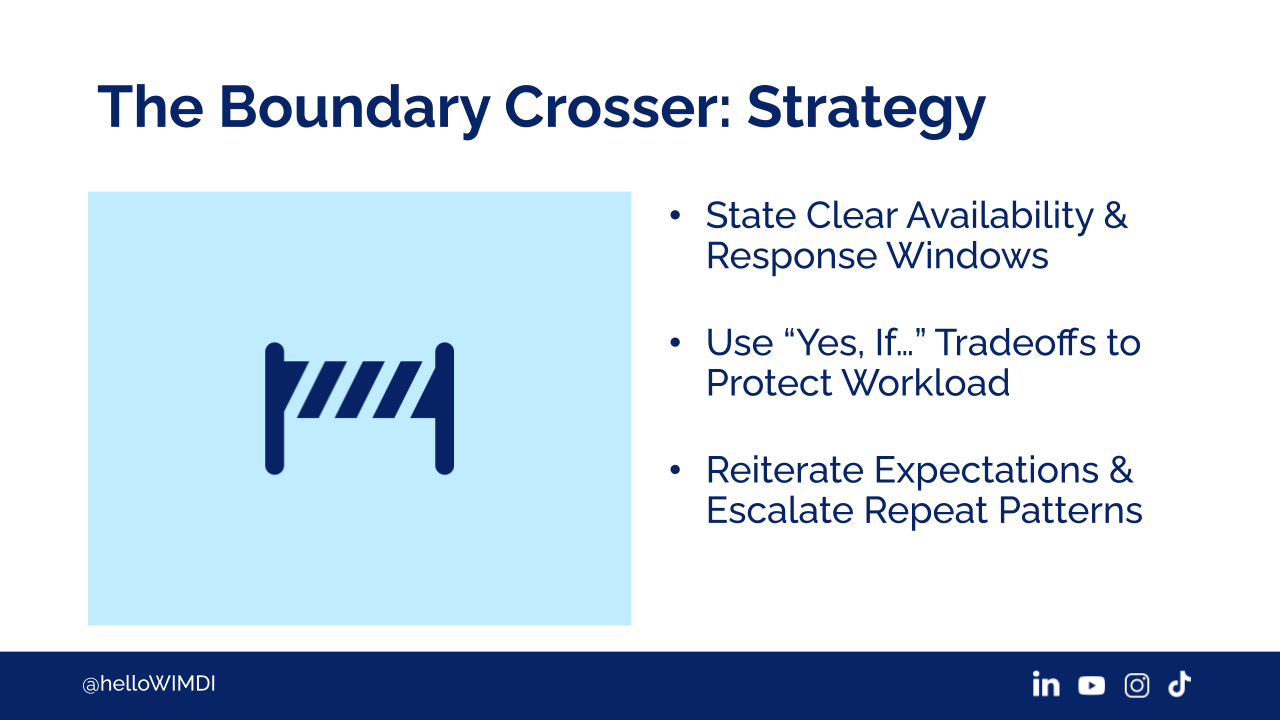
What you want to do is constantly reiterate that you do have boundaries. If you don't do this, your respect is going to feel compromised, right? So, state clear availability and response windows, okay? This is your strategy.
Say, "Yes, I can handle Project B or Project C, but what can come off my plate?" You're communicating that you have a boundary on this.
Worst-case scenario, if this becomes continual, and they do not adjust their behaviour, you may need to escalate it either to somebody who is a peer to them, potentially their boss.
I would say the first stop is probably human resources, that you're really struggling with your boss's boundary crossing. And I think it's great that you're going to have an investigator on the next speaking, Holly, because often HR is not that useful. And I think that that's a really, really keen thing to be able to share with everybody at WIMDI.
Challenging Boss #4 – The Bully (Their Impact & Strategies to Employ to Deal With Them)
Number four, we're focusing on the bully. I really hope that nobody has to deal with a bully in their career. I definitely had to deal with one or two in my time.
The impact of the bully, it's pretty obvious, I think everybody knows what a bully is, but psychological safety disappears.
And it's really easy to just want to avoid being in a room or being on a Zoom or being anywhere near a bully, somebody who wants to intimidate for their own sense of power and control.
The impact of the bully is that even if you're the one that they're directing the aggression or their frustration at, it really does impact the entire team. Anybody who has to witness a bully, especially when they do it in public, it'll bring down the morale of the entire team.
It's very hard to manage through being in the presence of a bully or working for a bully long term. It will erode your performance. No matter how hard you try, you spend too much emotional energy trying to manage around a bully. It's generally not tenable to manage for too long.
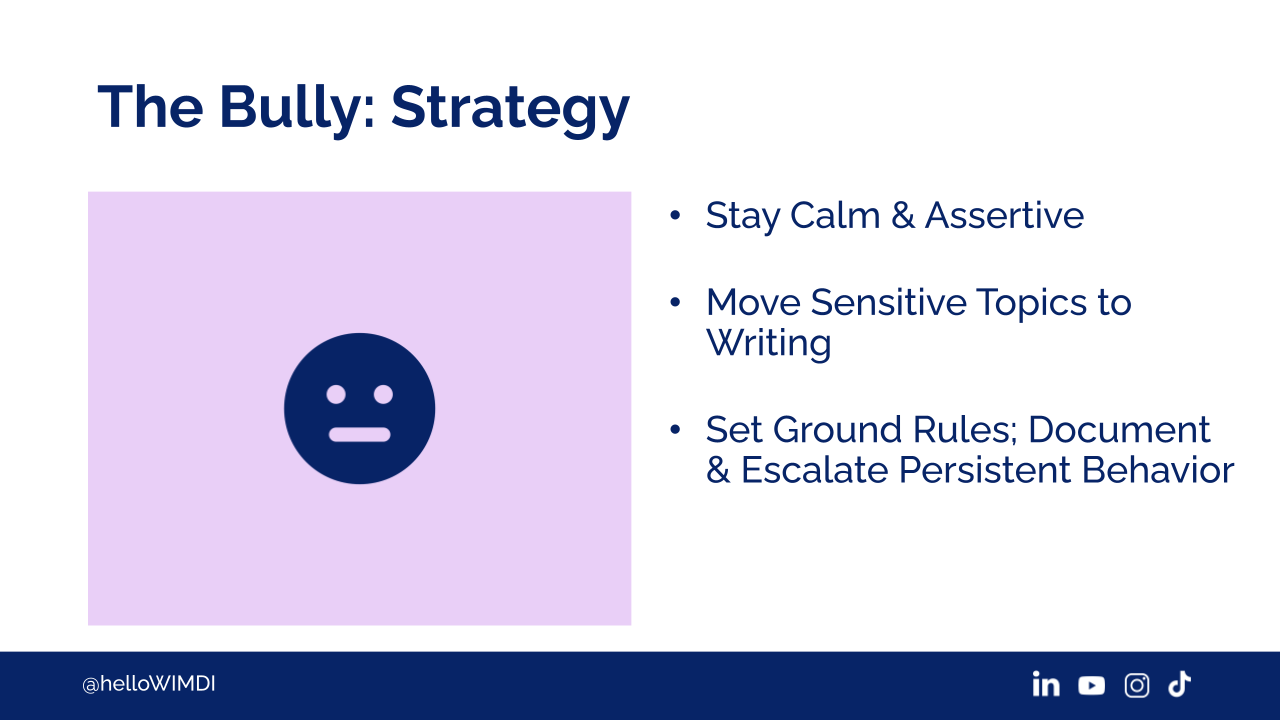
What you can do in the interim, before you potentially resign, if you're really working for a bully or before it gets escalated, is to always stay calm and assertive.
If you engage with a bully at the same level, and we're going to talk more about this and how you manage this, with the same level of energy that they have, you know, you react, and you tell them, "How dare you talk to me like that," or something along those lines, it's only going to pour more gas on the fire.
The most important thing is to take a deep breath. If possible, remove yourself from the situation. Remain calm. Observe what's happening. But we're going to talk more about those tactics shortly.
Move sensitive topics to writing. Take in the information. Respond in writing. Because if they respond aggressively back to you in writing, then you have something that's documented
Where possible, you have to set the ground rules and let them know, “I appreciate that you're really upset, but I'm going to leave the room now because I have things that I need to attend to, and maybe we can revisit this later”.
But you're setting ground rules in trying to remain calm and assertive. You do not have to tolerate a bully when they are popping off. You don't, okay? You escalate this if that behaviour persists.
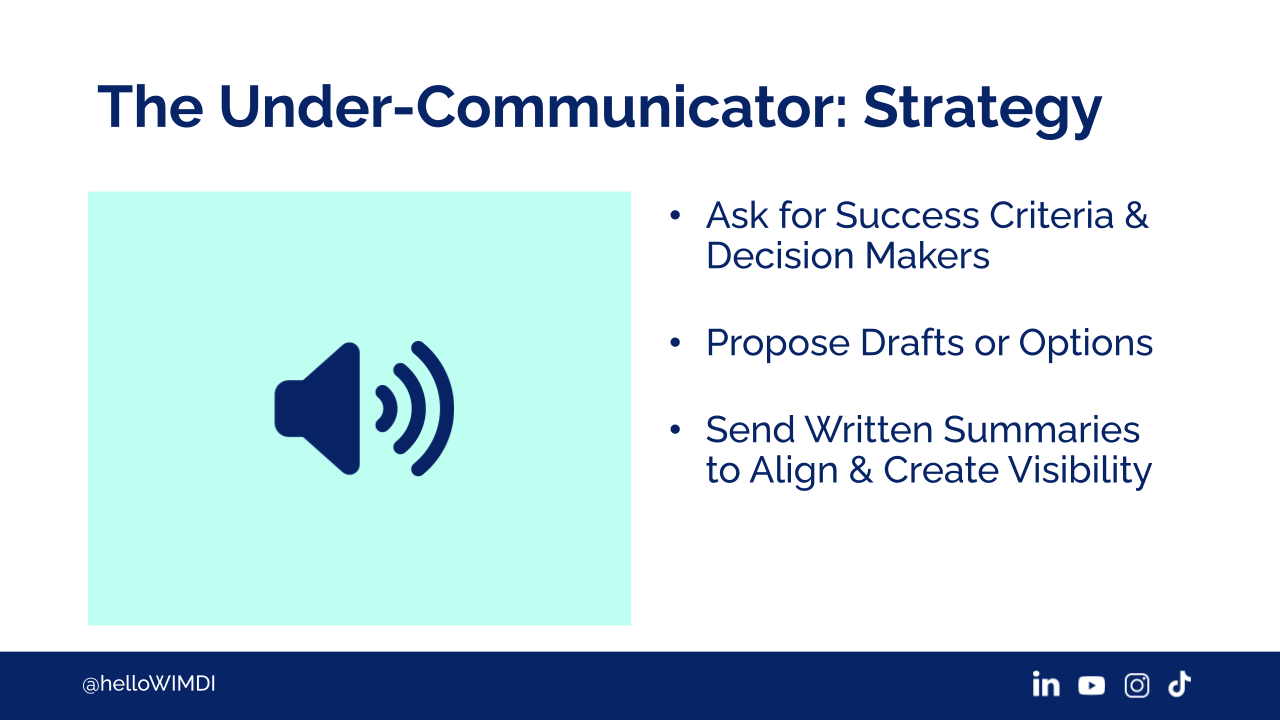
Challenging Boss #5 – The Under-Communicator (Their Impact & Strategies to Employ to Deal With Them)
The last one we're going to talk about is the under-communicator, which is a really tricky one.
I was with a client just this morning who was talking with one of her colleagues. She’s been working for the same gentleman for eight years and is probably not going to go for a promotion, because she finds it so hard to work with her boss, who is an under-communicator.
With the under-communicator, the impact is that the ambiguity of an under-communicator, it creates a lot more work.
You think that you have the full picture, and then you're halfway through the project, and you realise, wait, I'm missing this, this, and this. I need to double back with them, and it slows things down.
That misalignment will delay progress. And you end up feeling responsible.
The other issue with under-communicators, they're often not very good at communicating to their team when they've done something well or acknowledging them and letting them know that they think that the work was really good. People end up feeling as if, what's the payoff for me?
I had a colleague who was very frustrated. She was the salesperson of the year in our company. And it was a 5,000-person company, not a really small company.
We were talking about her boss. She said, "Well, she's really not that useful for me." I said, what do you mean? She says, "She just stays in her office all day with the door shut."
It was really interesting to me because her boss had a good reputation. She was excellent with clients. She was excellent with P&L. She was really good with numbers.
But she was better at communicating up than communicating down, which left my friend and colleague feeling as if she wasn't being acknowledged.
So, the under-communicator impact can really erode your confidence if you begin to feel a little invisible with them, or if it stalls work that you're responsible for.
It's important to ask for success metrics with an under-communicator. And if you still don't get clarity from them, who else is responsible for the work? Maybe it's a colleague. Maybe it's their number two. Maybe it's the chief of staff. Maybe it's a foreman.
Who else is a key decision-maker that you can go to, to extract the information you need to do your job well?
The other thing is, is that you propose drafts, and you send them back to them, whether it's in Slack or in person, or it's in an email, or however they like to be communicated with, and say, are you aligned?
You have to be proactive with an under-communicator. Because you will end up being really frustrated if not.
So if you can send a written summary and align with them, you will become less reliant on getting the information from them. Once you get the information, you can begin to actually do your work.
But working for an under-communicator, while they can be perfectly nice people, and they're not a bully, or maybe they're not a micromanager, not having full information can be really, really difficult to work for them.
So, again, you have to be really proactive when it comes to working for an under-communicator.
Case Study: Robyn & Her Challenging Boss
Back to Robyn's story, as I mentioned earlier, when she interviewed with her boss, she thought he was a really nice guy.
But what she learned pretty quickly is that he was very hands-off. She was constantly trying to figure him out. He didn't have great follow-up with her.
She started to begin to judge him. His reputation was, he cared more about managing up than managing down. And it probably was an unfair assessment, to be perfectly honest.
He may not have been a great communicator. He may not have been somebody who was skilled at managing down. But the jury was still out, and she still had things that she needed to try.
What I'm interested in now is if any of you would like to share in the chat to guess what kind of boss that Robyn was working with. What do you think her boss's behaviour exhibited?
And which of these bosses are you dealing with now or have you dealt with in your career? I'm sure a few of you have dealt with some of these archetypes. I've dealt with pretty much all of them at some point.
Yeah, the under-communicator is really, really tough.
The great poet laureate Maya Angelou, made this statement. And it did remind me, when I first heard it, what Eleanor Roosevelt said a hundred years ago, this,
"You may not control all the events that happened to you, but you can decide not to be reduced by them,"
It's very difficult to get emotional distance if you're dealing with somebody who you don't feel appreciates your hard work or your skills or your expertise.
But it's something that once you realise that that's about them and not necessarily about you, it enables you not to feel an erosion of confidence and not to be reduced by them.
How to Self-Manage – The 3 Phase Approach
Now we're going to talk about self-management in three different easy phases. These are some really basic tactics that you can employ with dealing with any of these challenging bosses that I've already talked about.
#1 – Pause (From Reaction to Response)
The first thing is to pause, and to go from reaction to responding professionally. So emotional regulation is really key when you're dealing with somebody who may not be emotionally regulated.
Whether it's personal or professional, we all know that if you're getting into a disagreement with somebody, or you're having a very big difference of opinion, combating them in the moment usually just pours gasoline on the fire.
What's important professionally is that you pause before you respond. Just do your best to get some emotional distance so that your perspective doesn't narrow.
The way to do that is to retain your personal power by witnessing what's happening. And that's where the pause really helps you. Just take a beat, and don't get pulled into that energy because you risk your credibility if you react to your boss.
At the end of the day, it's their seat. They're in charge. And you have to take a moment to just pull back and see what's happening. Your personal power is more important in this moment than being right.
They could be completely wrong. But what's really important is that you retain your personal power by taking a pause.
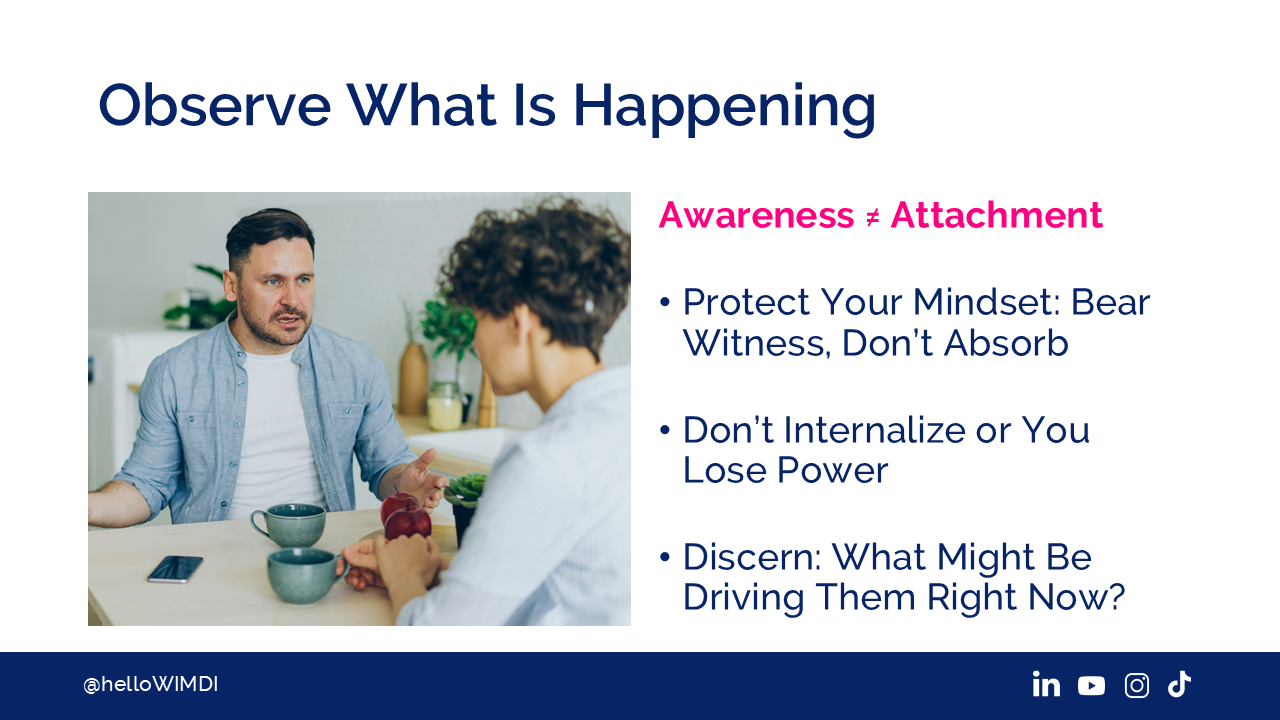
Your awareness is going to enable you to detach, not attach. You don't want to attach to what's happening. Observe what's happening.
In order to protect your mindset, don't absorb their energy. If they're being really aggressive, if they're being very intimidating, if they're being really loud, maybe they're being very anxious, maybe they're being really silent, and you're wondering what's going on with them, 'because they're an under-communicator, what's really important is to not internalise that, because you will lose power.
Try and be discerning, “What could possibly be going on for them right now?”
When I'm driving down a parkway, if somebody cuts me off, my response used to be, "Oh my god, that jerk, I can't believe they just did that. That was really dangerous."
You know, the whole mental thing that happens when somebody does something dangerous when you're driving a vehicle. Then I learned more about emotional regulation both professionally and personally.
What I learned was, when somebody cuts me off on the parkway now, I say to myself, maybe they're rushing home to get to their sick parent. Maybe they're rushing to the vet, and their dog is in the car, and their dog is really sick?
I try to put it in context, where I take a beat, and I neutralise my emotions in the moment. And I will tell you, it works every single time. I never get annoyed beyond a split second if somebody cuts me off on the parkway anymore. I try to have that distance.
I'll give you another good example. Years ago, when I was consulting for an agency, I would go in a few days a week.
I was coaching several people there, and I did watch one of their leaders pop off in the middle of a room of 80 people toward her team.
It was really unpleasant. I watched a number of the people on the team just kind of shrink into the background because of her anger.
It was interesting because they delivered information that she didn't want to hear, and then she was going to have to deliver that information to a client.
In that moment, I remember thinking, "She's really anxious. This is not good news, and she doesn't want to deliver bad news to that client".
Even though everybody was responding to this burst of anger, I didn't see it only as anger. I remember, I was a few tables away from witnessing this, and I thought, "This is anxiety in action".
My point in bringing that up is, sometimes what you're on the receiving end of, no matter how bad it feels, it is really about them and their dysregulation and not being able to manage their energy.
And when you can take that pause, it will help you neutralise and keep your personal power.
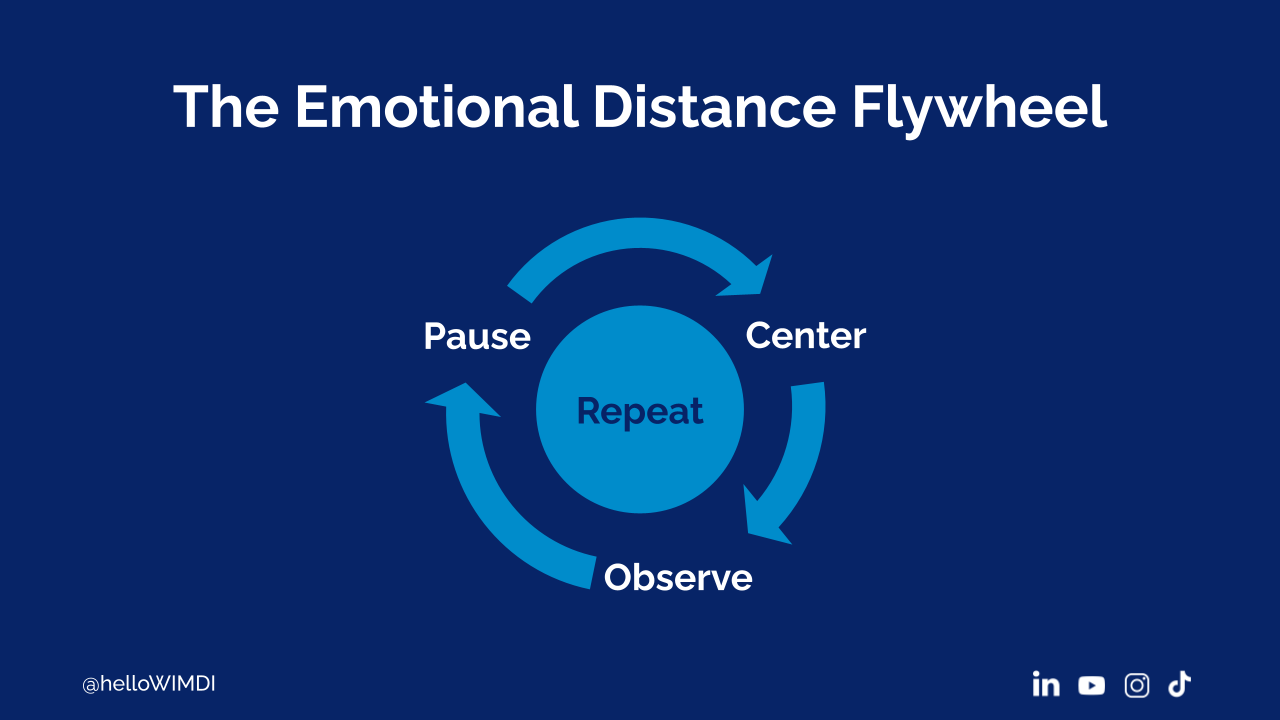
The Emotional Distance Flywheel
This emotional distance flywheel is about pausing to centre yourself and then observe what happens, and stay in that space.
Years ago, one of my counsellors advised me, when I was working for somebody who had a tendency to emote and lose emotional regulation, she told me to go back into my office, shut the door, and walk in a figure eight.
Because when you walk in a figure eight, it slows your heartbeat down. And every time I had to witness this outburst of anger from this person I was working for, I took a moment, I'd go back in my office, and I would just walk in a figure eight. And I'd give myself a couple of minutes to just calm my nervous system.
#2 – Communicate (From Conflict to Clarity)
The second phase is to communicate and to go from conflict to clarity. Lead with facts when you're dealing with somebody that is tricky or challenging.
Anchor the conversation in facts. Because facts will focus, you know, things in a professional way versus an emotional way.
What you want to do is focus on the outcome, "John, A plus B equals C. I would like to align with you on this. Do you agree?" is not the same as saying, "I just don't agree, John. I think you're being really emotional." Big difference, right?
Focus on the facts. Deliver the facts and get alignment. Emotional reasoning will not help you, but professional reasoning will help you in showing your perspective when you have things to back it up with.
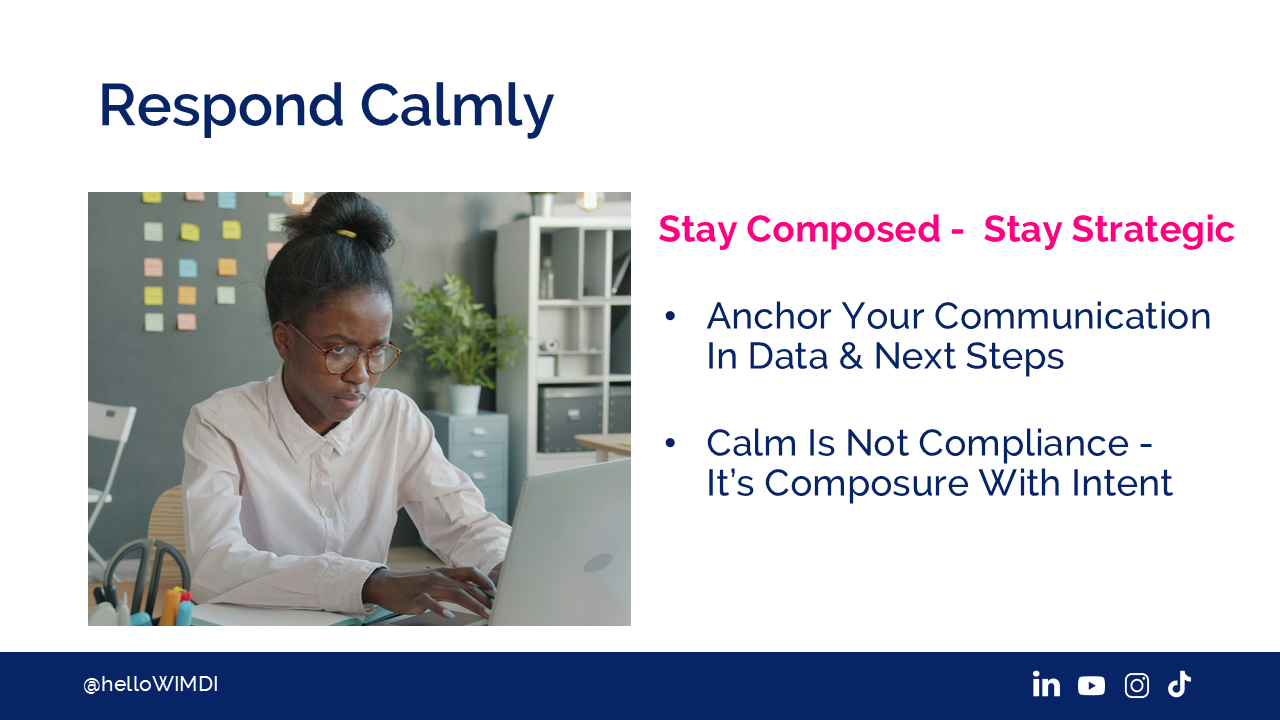
It also will enable you to neutralise and remain calm. So, stay composed. Anchor your communications in data and next steps.
I have a client that I've been working with for the past year. He works for a very intimidating, bully-like boss. And he's been trying to get a new job.
For a long time, he believed that if he didn't argue back, that on some way, he was being compliant. And all it ever did was serve to make it worse.
Calm is not compliance. Calm is not agreeing with their perspective. Calm is composure with intent.
So just because you're not telling them off, if they're popping off at you, it doesn't mean that you agree with what they're saying. What you want to do is respond calmly and regain your composure.
It will not serve you ever to go back at them. That is not the environment in which you will win.
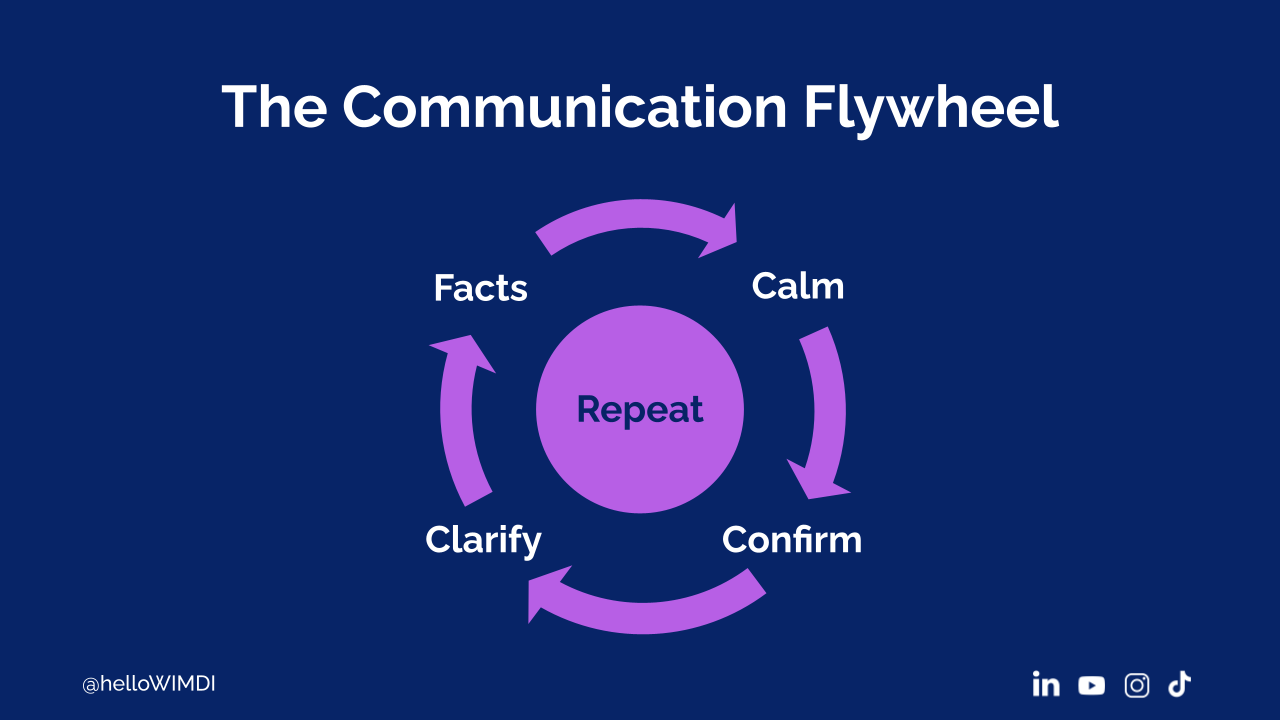
The Communication Flywheel
The communication flywheel is to deal in facts. Facts will help you keep calm. Get confirmation from your boss that they are aligning with you, once calm happens. Clarify that everything is aligned, and repeat.
It is not further engagement into whatever the emotion is. It'll help you remain calm. You confirm that they are aligned, and then you clarify, "This is the way we will move forward; do you agree?"
#3 Manage (From Tension to Trust)
The third thing is managing up. And this is going from tension to trust.
This is also something that people get confused about. I've had people say to me, "Well, is it managing up manipulation?" No, it's not.
Managing up is alignment with your leader's goals and their communication style, and adapting how you work so that you both succeed.
I am amazed at how many people start a new job and have a brand new boss, or there's change management at their company, and there are new people put in place, and they don't work to find out some key things about their boss.
What's your favourite platform to be communicated to? I know entire teams that work in Slack, and their boss never goes into Slack. The boss wants you to send them a text message. But everybody else is aligning on Slack.
If your boss wants a text message, you're going to have to circle back to make sure your boss knows what's happening. And you're probably going to have to send text messages.
If your boss is short on words, and when they communicate, they're a one- or two-sentence communicator, do not send them three paragraphs. They're not going to read it.
You have to pay attention to the communication style of your boss in order to get them to see that you are adapting to have more impactful communication to align with them.
Understand Your Boss
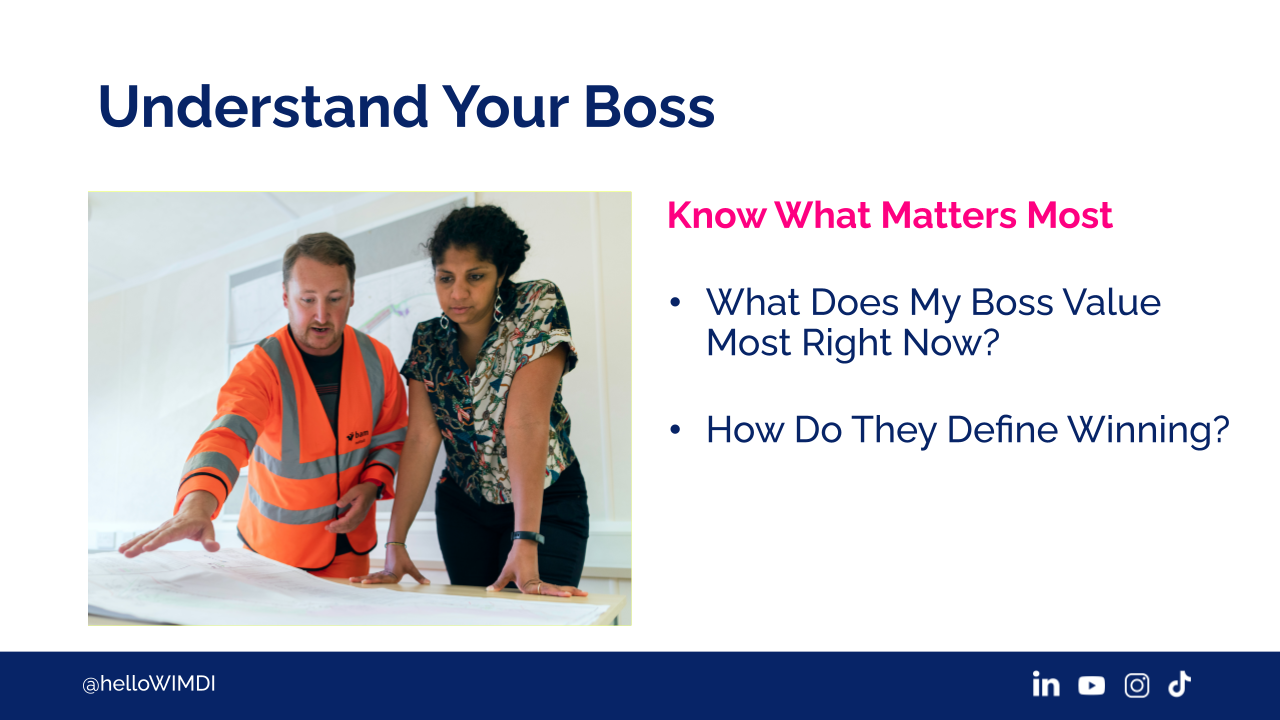
Understanding your boss is a skill. What are my boss's priorities now?
I drove revenue for over 20 years in my previous career. I may have wanted to manage my team's revenue by looking at it quarterly. Maybe I met with them regularly, but I always focused on the quarterly number.
If my boss wanted to look at it monthly, I needed to make sure I was expert at reporting numbers every month. Even if I thought it didn't matter because we were looking at it quarterly, it didn't make a difference.
Aligning with what is important to your boss and what their priorities are. How do they define success? You may think success is if we just get to this milestone, or we get to the end of this project, and we're able to go to the next level, that's success.
They may have a longer view picture of what success is or a shorter view picture of what success is. You have to know how your boss defines success. So that's part of understanding your boss.
Build Trust & Advocacy
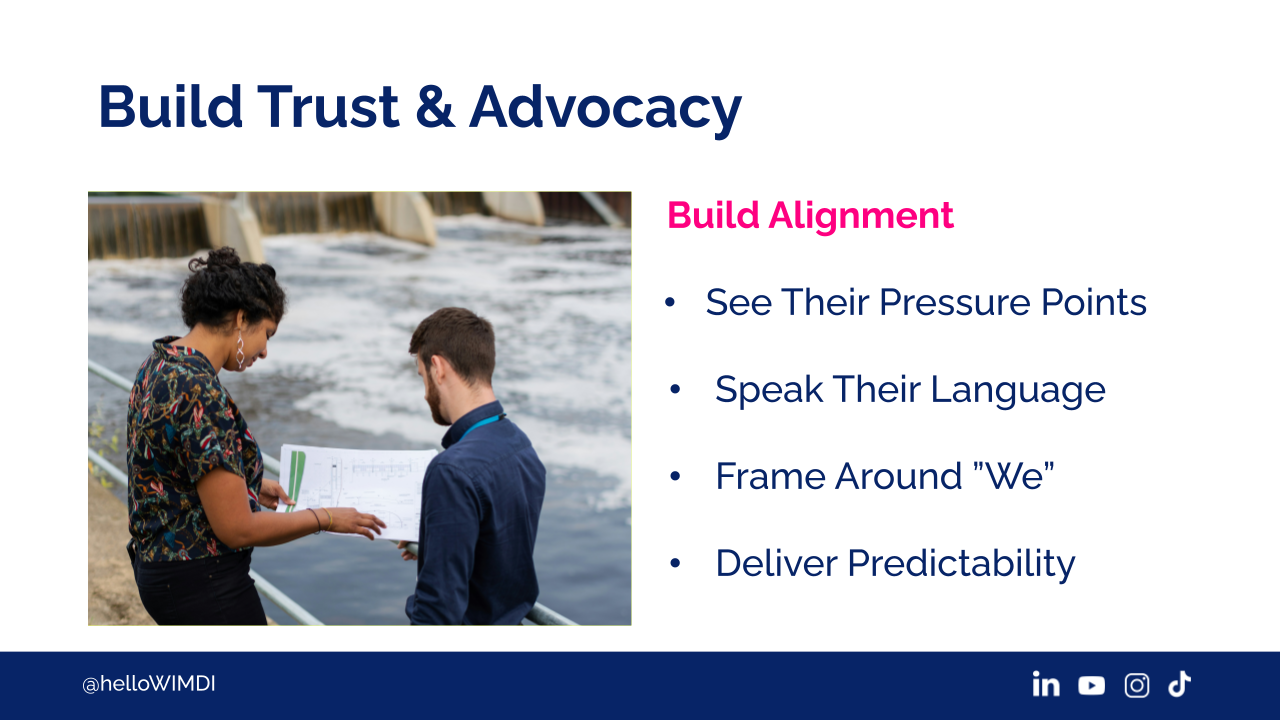
When you do this, it will enable you to build trust and advocacy. Understand their pressure points. Understand their triggers. Speak their language.
Something I spoke to a client about this morning, frame language around "we." Get rid of the subjective.
It's not "I think." Unless they say, "Holly, what do you think?" "Well, John, I think we should go in direction C".
But generally, what's really important is to frame collaboration around "we".
"Would we consider?"
"We are thinking that it might be best for the overall team", "I've taken a poll, if we did X, Y, and Z. Are you aligned?"
Show the collaboration and your interest in the overall success of what they're responsible for.
And then one of the most important things is to deliver predictably so they are not wondering what's happening, whether that is aligning in writing, whether that is checking in with them regularly.
I used to, with one of my bosses go down the hall to his assistant, and I would say, "Susan, I need two minutes with him." And she would say, "Mary, he doesn't have two minutes."
I’d say, "I need two minutes." And then she would get up from her desk, stick her head in his office, 'because his door was shut. And she would say, "Jim, Mary needs two minutes."
He would say, "Okay." And I would say, "Number one, A, B, and C. Number two, X, Y and Z." And then I’d confirm, "Are you aligned?" And he would say, "Yes, go." That's it.
Over time, the trust was built, that he didn't wonder what my decision-making capacity was or if I was making decisions that didn't involve him.
I just kept him up to speed because I realised that he would rather know than find out later. It was as simple as that.
The Advocacy Flywheel
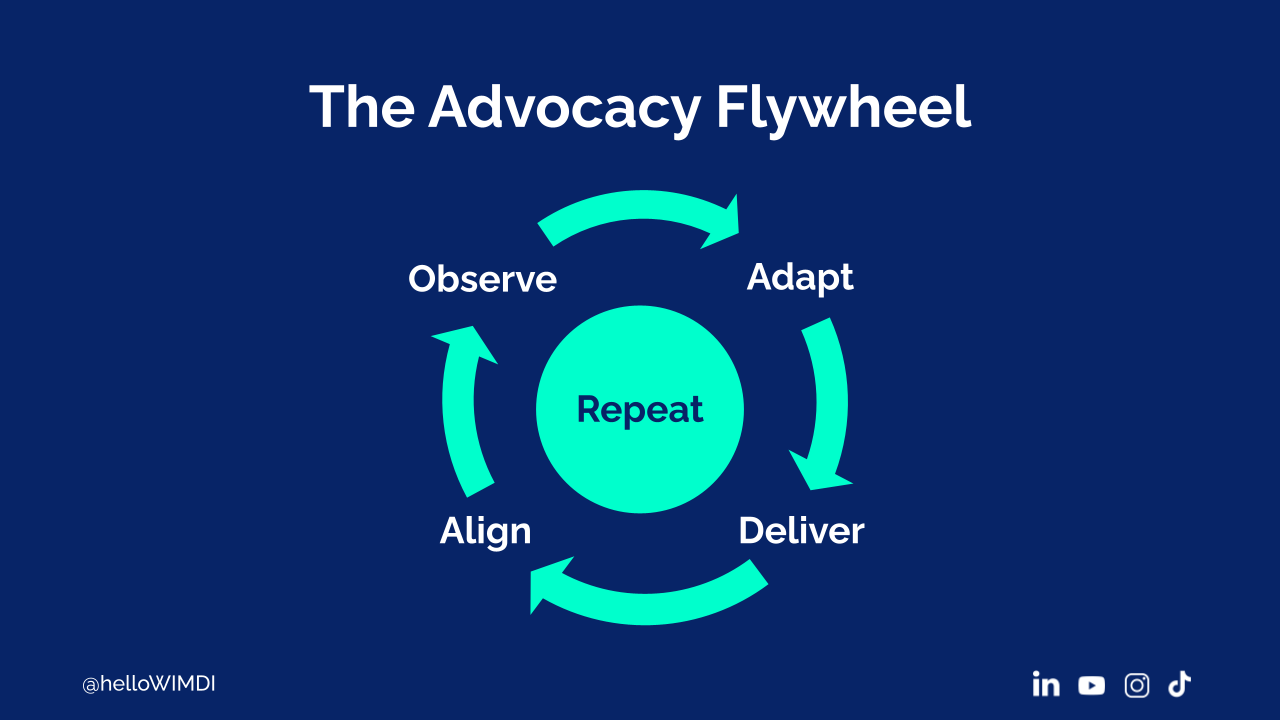
The advocacy flywheel, observe your boss's behaviour, how they communicate, what is important to them, what they care about, and adapt your management style to it.
Deliver predictably and align with them frequently. That will get you so much further in your career to have an advocate on your side. Because what you're doing foundationally, and I can't stress this enough, is creating trust. You are creating trust with your boss.
Case Study: Developing a Strategy for Robyn
Back to Robyn. I said to her, we have to dig in here a little bit before you resign with just two weeks into a new job. So, we focused on the facts.
She explained to me what was happening, how she would go to a meeting with him. It would be abbreviated within 15 or 20 minutes. She would leave without the full picture.
I asked, "So, what have you tried?" And she responded, "Well, it makes me feel really bad. So I talk to my colleagues about it, and I try and get direction through them."
I asked, "Have you attempted to go to his executive assistant and say, Our meeting got abbreviated. I need another 15 minutes with John."
She said, "No."
So I said, "All right, let's talk about strategies where you can extract more information from him. And then once you figure out how he likes to communicate, you need to lean in and be more proactive about communicating with him versus withdrawing and feeling like you are on the receiving end of his destruction.
Get direction in writing. However it is he prefers to be communicated with, I want you to communicate really frequently.
Which of these bosses do you think Robyn was dealing with? And which of these tactics do you think you can use in managing up with some of your bosses?
What is Non-Violent Communication
There is a gentleman, who passed away a few years ago, who was a psychiatrist, and he was an expert mediator. His name was Marshall Rosenberg.
He wrote a book called "Nonviolent Communication: A Language of Life." And this model is used in mediation in governments. It's used in divorces. It's used in corporations.
I have successfully used this model in mediating between clients who are having difficulty with partnerships, as an example.
Marshall Rosenberg felt that every criticism, judgement, and diagnoses and expression of anger is the tragic expression of an unmet need. This is core to understanding nonviolent communication.
In other words, suspend your judgement of what's happening with the person who is tricky for you. It's not dissimilar to the story I told you about when I was in that office as a consultant and witnessed that boss pop off.
I remember thinking, "What is going on for them right now? Are they that angry?" And then, you know, over time, as I got to know them, I knew that this was really anxiety. I learned this from reading this book and practicing this model.
I want to emphasise something that's a little bit of a sidebar about neuroscience. Neuroscience is a relatively new science. It's only about 30 to 40 years old.
Neuroscience came about because doctors were studying stroke victims. That's how they understood that the brain actually has the ability to replace damaged areas by creating new neurons that will grow over a damaged area of your brain.
That led to all sorts of testing of different components of the brain. And quite simply, one of the studies indicated that the part of your brain that lights up when somebody says, "I love you," is the same part of the brain that lights up when somebody says, "I hear you." That's important.
When you are dealing with a tricky boss, and maybe they're micromanaging you, or maybe they're being a bully, or maybe they're really narcissistic, and they are saying something you absolutely disagree with, or they have a perception that you think is completely inaccurate of facts and what happened, if you say to them, "I hear you," it will immediately neutralise the energy of the conversation.
This works. I have employed it with bosses when I've seen them get really angry. I've used it personally and professionally.
I am telling you that when you just say, "I hear you," when my boss would send me a long email complaining about somebody on my team, and I could tell they were really upset about something, I would send back an email that said, "Understood," nothing else.
More times than not, he would come down the hall to my office and say, "I know I just got really angry." It neutralised because I was acknowledging the anger. Understood, I get it. You're really unhappy.
I may not agree, but I don't need to say that in that moment. I don't need to put fuel on the fire.
I'm going to walk you through quickly Marshall Rosenberg's four main components of nonviolent communication and show you how you can use them at work.
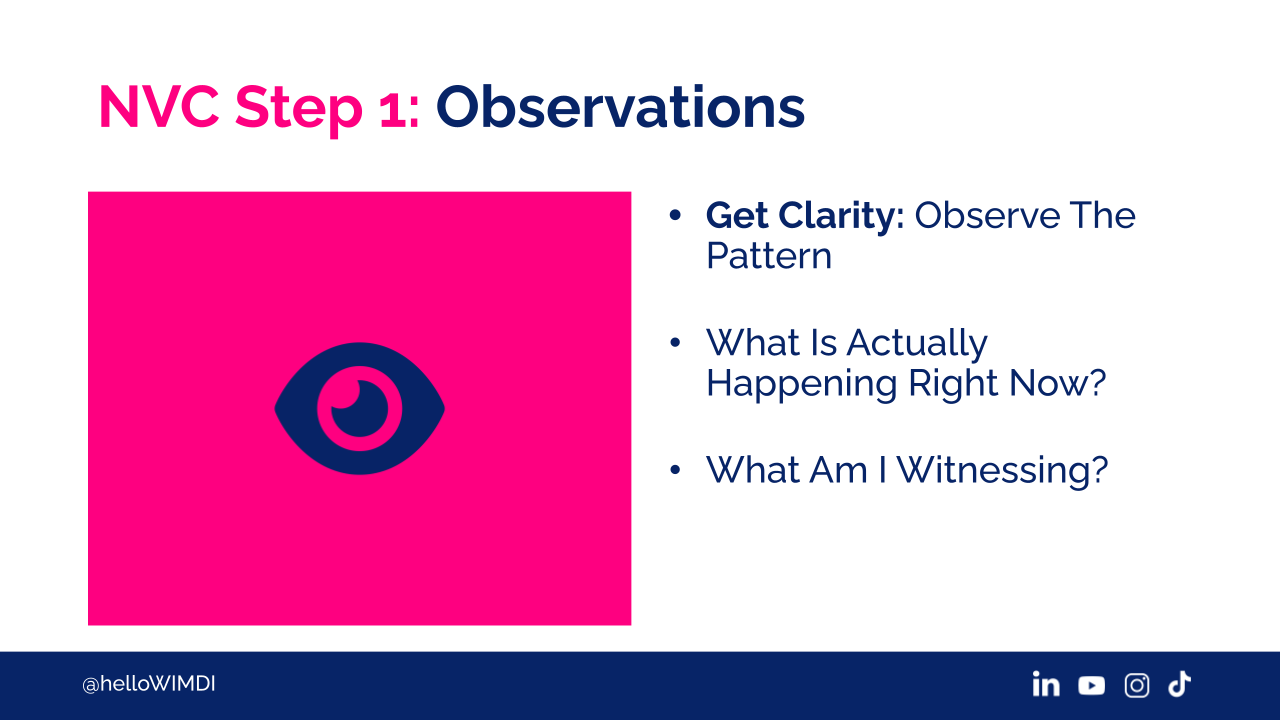
The first one is observations. You have to get clarity about what's happening. And you have to observe the pattern. What is actually happening for this person right now? What am I witnessing?
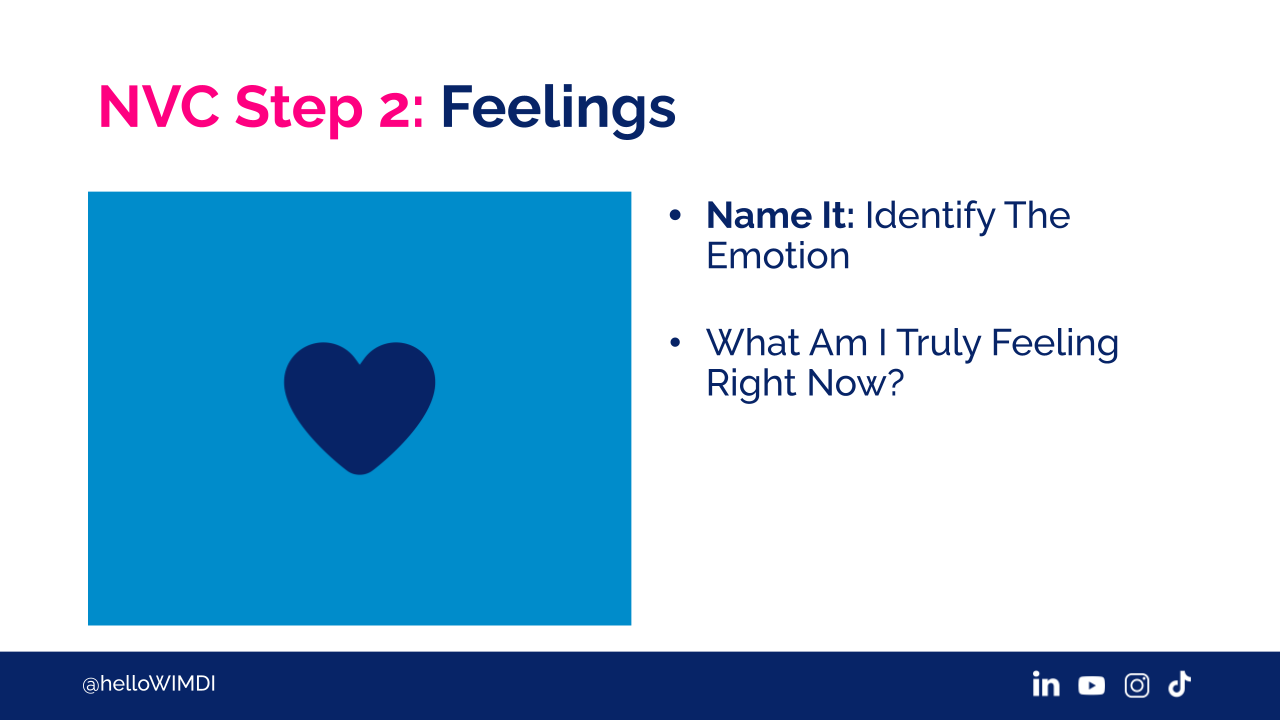
The next component is feelings. You have to get in touch with what you're feeling. Not with what they're feeling, with what you're feeling. Identify the emotion. What am I truly feeling right now?
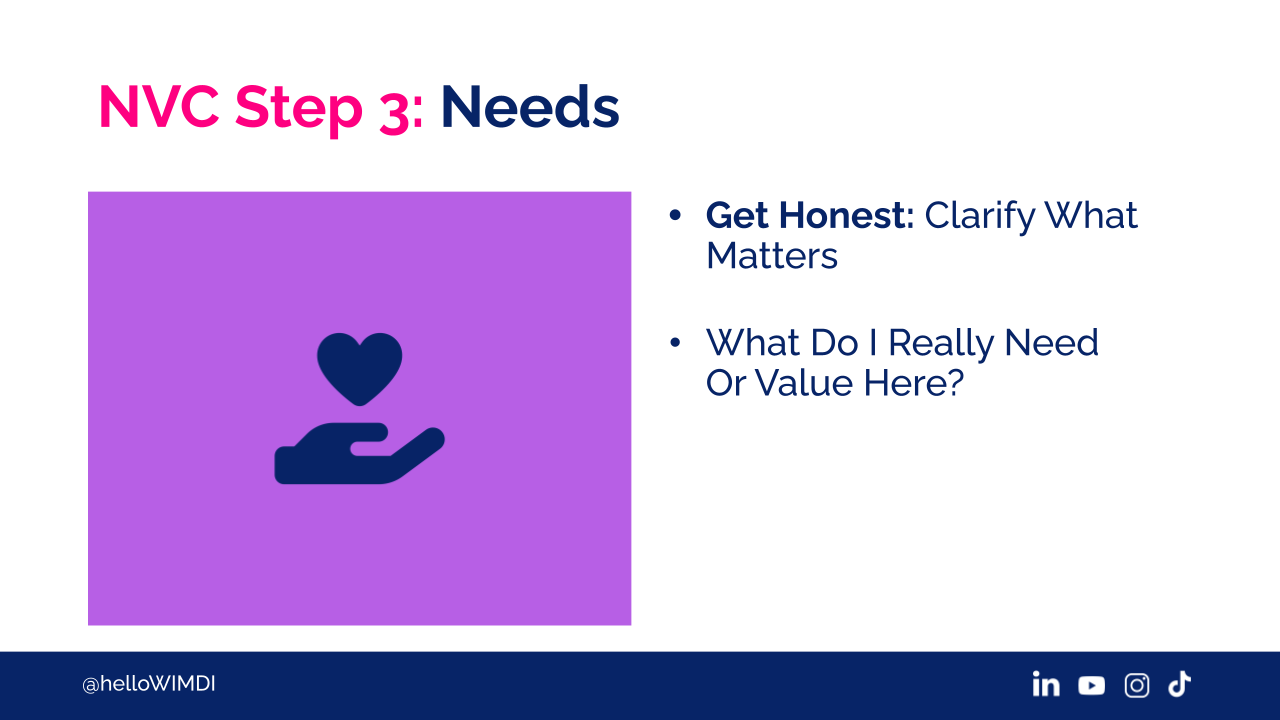
What do you need right now as a result of this experience of dealing with this dysregulated emotional boss? What do I really need or value in this moment?
Non-Violent Communication with The Gaslighter (with Examples!)
I'm going to show you this in action with a gaslighter, and I think it's going to make a lot more sense.
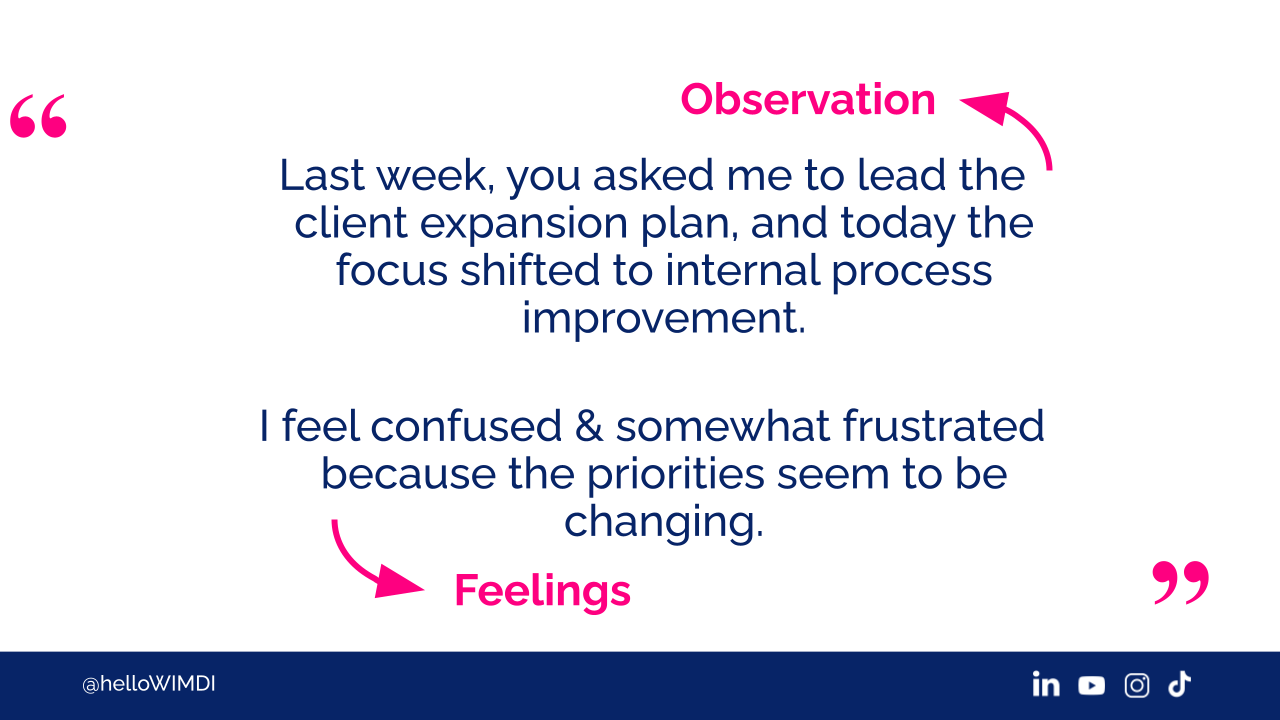
"Last week, you asked me to lead the client expansion plan, and today the focus shifted to internal process improvement."
That's the observation. Strictly unemotional, professional.
"I feel confused and somewhat frustrated because the priorities seem to be changing."
It's your feelings. You're just being really direct, assertive. I feel confused, and I'm somewhat frustrated because the priorities seem to be changing.
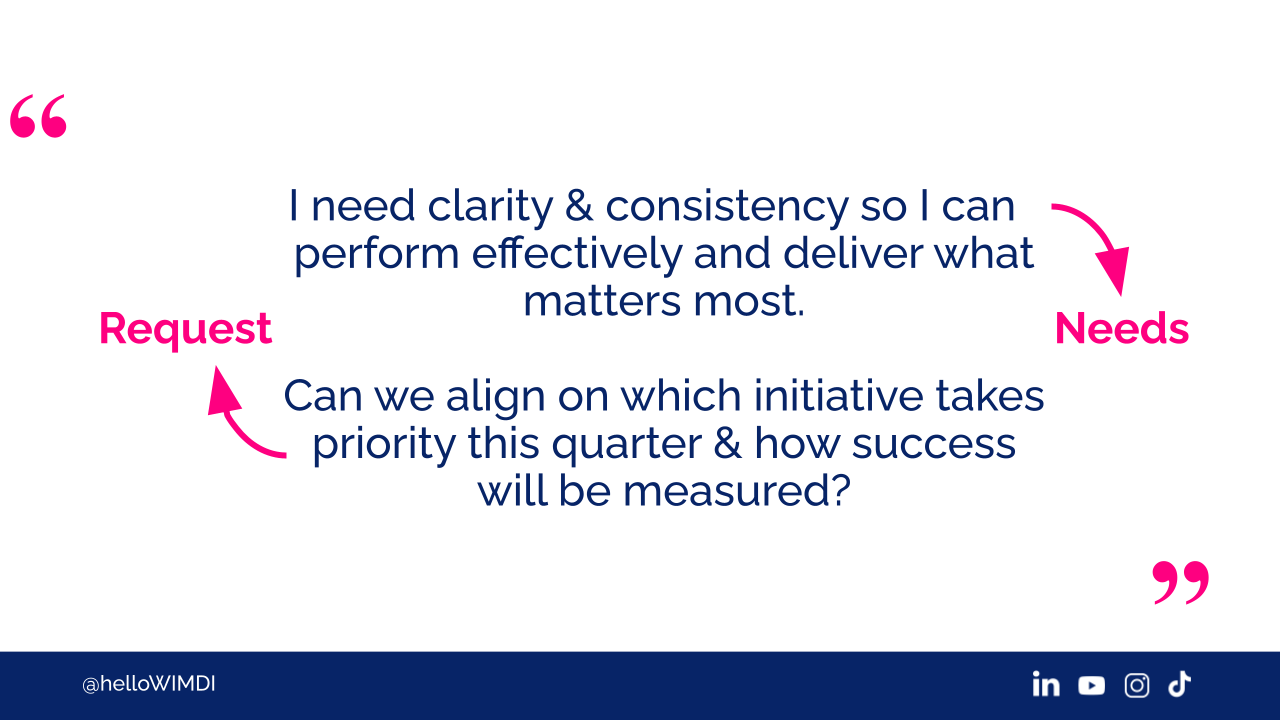
"I need clarity and consistency so I can perform effectively and deliver what matters most."
You're showing that you care about the product output. And you're telling them what you need in order to succeed.
"Can we align," here's your request component, "Can we align on which initiative takes priority this quarter and how success will be measured?"
See the difference between, "You told me something different before, and now I'm in the dark, and your tone of voice is pissing me off, and I don't know how to move forward?" Very different.
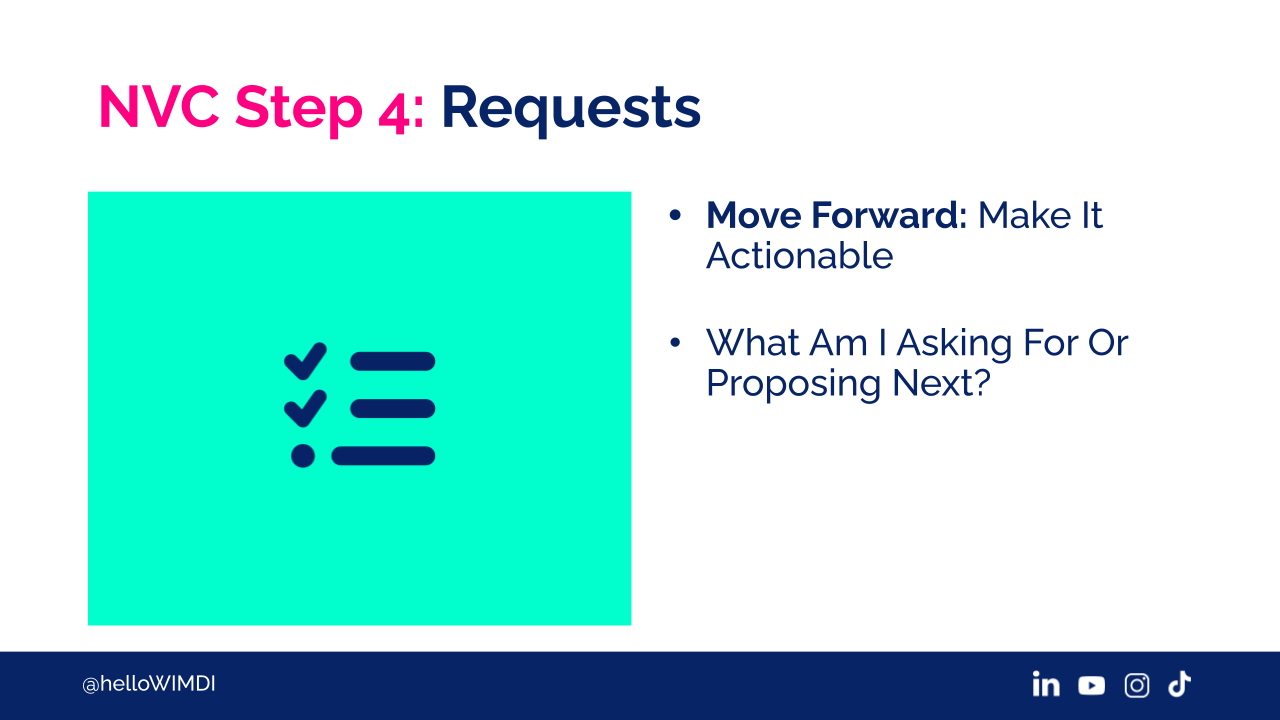
This is the genius of nonviolent communication. Observations, feelings, needs, requests. It has been a game-changer for so many of my clients who were having trouble communicating effectively with some of their bosses.
Case Study: How Robyn Used These Tools to Manage Up
Back to Robyn, this is a great example of how we used it with Robyn.
"Our recent check-ins have been lacking clear next steps. I'm feeling unsure, and I need clarity on how to progress. Can you confirm the next two priorities for Friday?" Observations, feeling, needs, requests.
When you first begin to do it, it feels a little awkward. But I'm telling you, after one or two times, it is such an excellent way to communicate. You can do this personally.
There's a wonderful book by an author named Charles Duhigg that you may be familiar with. It came out in April of 2025, I think. It's called "Supercommunicators." And it's wonderful because he talks about the three different types of conversations one can have.
And one of the biggest mistakes that people have, you know, husband and wife, brother and sister, boss-employee, is one is having an emotional conversation, and the other's having a logical conversation. And it's a miss.
You have to know what kind of conversation you're having. And you have to engage with them, in understanding.
If your boss is having an emotional conversation, you don't give them advice. They don't want your advice if they're really angry. Nobody wants advice when they're really angry.
Do you ever do that with your partner? "Well, I think you should..." I am not asking your opinion.
"Supercommunicators," highly recommend the book. It's also, anecdotally, super interesting because he has a main character in it who was the number one operative in the CIA who turned people to being informants.
Obviously, that is a really complicated thing. But it was really interesting to understand the dynamic of how trust is forged in human beings.
That really was the premise of the chapter. It wasn't about manipulation. It was about understanding, how do we enable trust?
What's really important in your career is enabling trust with your boss. So, we'd love to know what nonviolent communication steps you might use to help communicate with your boss. And if you want to share in the chat, we would be really excited by that.
Summary & Key Takeaways
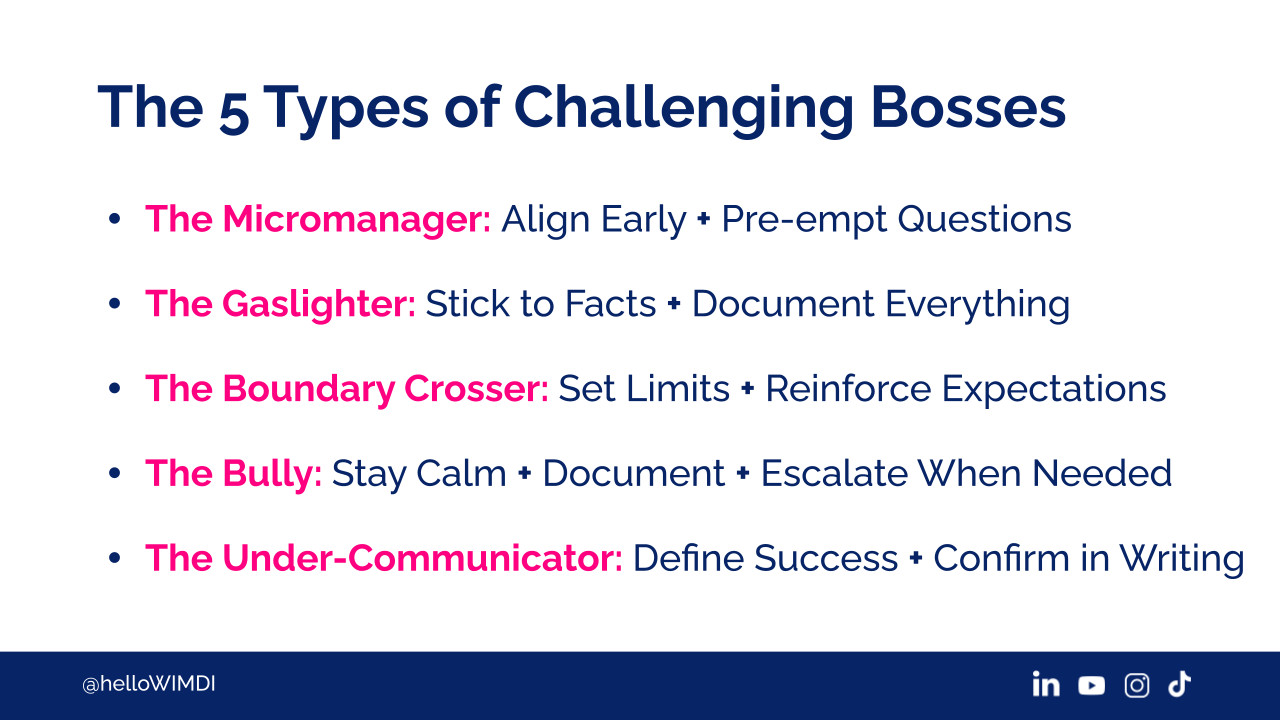
We're going to go into summary. The five types of challenging bosses we talked about tonight was the micromanager. So, you want to align early, and you want to pre-empt with questions. You want to find out what it is that they care about.
The gaslighter, stick to the facts and document everything.
The boundary crosser, you want to set limits and reinforce your expectations at all times so that they can understand that they're kind of breaking through here, and they need to begin to self-manage.
The bully is absolutely about staying calm. Document what's happening, and if you have to, escalate it to HR, because they're probably the most difficult of all five of these to work with.
Then the under-communicator, you want to define success. You want to build confidence as a result of predictability. You want to extract the information and get their success metrics and deliver predictably.
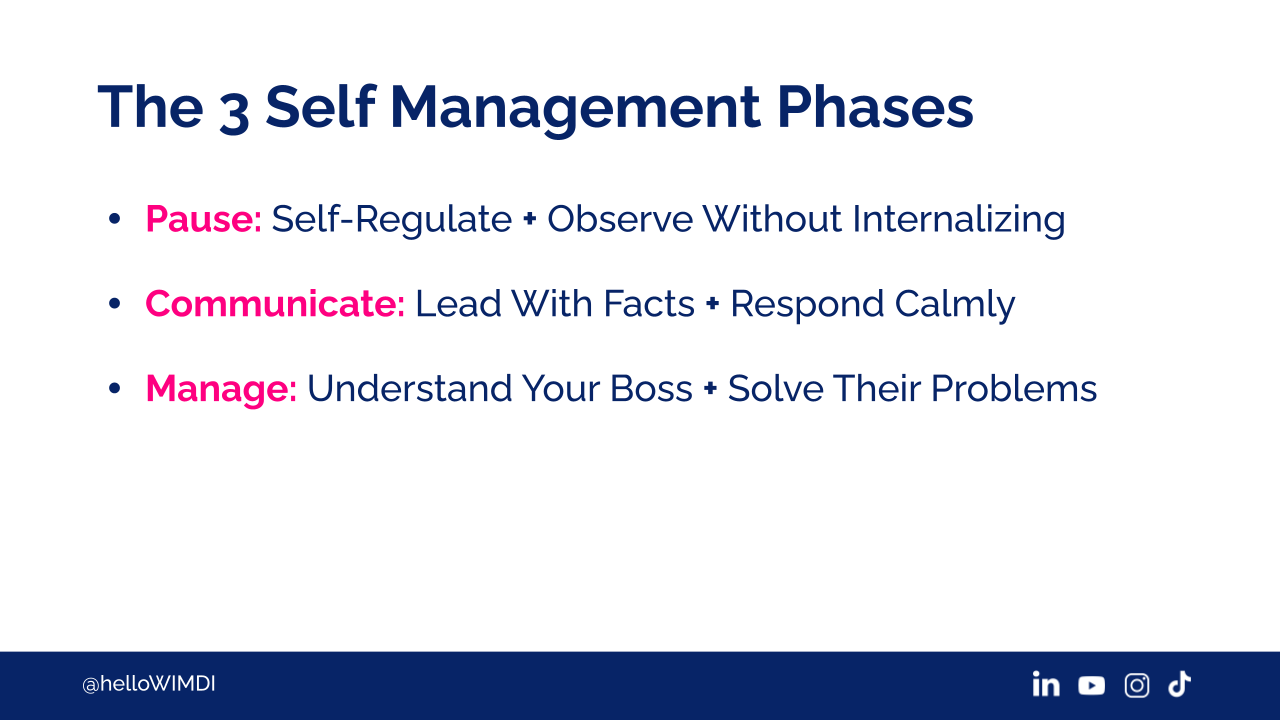
Three self-management phases. Pause, self-regulate, observe without internalising their energy. It has nothing to do with you. It's their emotional dysregulation.
You communicate, you lead with facts, and you respond calmly. You know, the more you can respond with facts and data, neutralise.
Then to manage, you have to understand your boss's preferred way of communicating. You want to understand their priorities. You want to understand what matters most. And you want to solve problems predictably to enforce trust.
4 Steps of Non-Violent Communication
Four steps of nonviolent communication.
Observations, share what you're seeing. This is what I want to really emphasise. You stay in the subjective when it comes to nonviolent. It's "I".
These are my observations. This is what I heard. This is the way it feels. I feel frustrated. I feel confused. I feel in the dark. I need to have better understanding of what your objectives are, what your priorities are.
Share what you need to be successful. And requests, share what behaviour or action you need to move forward.
Case Study: How Robyn Succeeded
Here's the exciting thing about Robyn.
She improved her proactive communication with her boss. She leaned in and didn't take it personally when the meetings were abbreviated, or she felt like she didn't have the full picture.
She figured out his favourite way of communicating, and she aligned with him later if the meeting closed early.
He ultimately advocated for her, because her work product was so good, that within six months, she was leading the highest visibility project in her department that put her directly in front of the C-suite.
She was working directly with the CEO within six months of working there. She felt empowered. Her contributions were being recognised. She couldn't believe that he became such a big advocate for her. She was seen by senior leadership.
It completely changed the direction and the course of her career and she was promoted to vice president in a year.
This was a woman who was going to resign two weeks into the job. And instead of personalising what was happening, she leaned in, and she employed a couple of tactics, asserted herself, figured out how to communicate effectively with him, and she turned a challenging boss into a trusted partner.
So, if you find yourself in an adversarial place, the goal is to create an ally so you get advocacy, and that ultimately you can get promoted.
The alternative, we all have choices, you know? People feel trapped in their careers all the time. The choice is you can always resign.
I resigned from two jobs without another one lined up. I don't recommend that. But I was working for a bully. And, you know, I gave it a year. I gave a couple of months notice and I knew I had leverage, that they needed me. It enabled me to pursue another opportunity within the two months. Bullies are particularly hard.
But outside of that, any of these other archetypes, you generally can manage around pretty well. As the late Canadian politician Rosemary Brown said, who broke down many doors,
"We must open the doors, and we must see to it that they remain open so that others can pass through."
As women, especially women in a male-dominated industry, it is so important, I can't stress it enough, that you keep striving for leadership.
Because things will not change unless women migrate up into leadership. You cannot count that things will change necessarily, whether it's in pay equity, whether it's in representation, whether it is in diversity, whether it is in values-based work environments.
Reflection Tool: The Stay, Go, Grow Questionnaire
I am going to leave you, after this evening, with a reflection tool. And it is a model that I've used with a number of clients. It's called Stay, Go, or Grow. It’s a little quiz, 10 questions.
And the paradigm is, to stay where you are, if you are in a really tricky place or working for somebody that you don't feel is an advocate or can be an ally.
Am I still learning, influencing, and feeling valued for what I do? Have I outgrown it? Do I need to move on, this environment? Have I reached the ceiling of where I am? Maybe nothing's really wrong, but you're not sure you're growing in your career. And do you have to leave to grow?
What new challenge or direction can I take, whether it's here or whether I have to pursue it outside?
This brief little quiz has been really helpful for a lot of people to get perspective on where they are at a certain point in their career.
So, I'm going to also leave you with a little bit of homework to find out what shift you will take this week to maybe improve a situation or a dynamic with a boss that you find tricky.
And I just want to thank you all for having me. And I hope you'll stay in touch, you know. This is my email, mc@mccoachingnyc.com And it's been an absolute pleasure. And I am really honoured to be part of this group tonight.
More Fun Stuff!
If you loved reading this transcript, you might like to watch the video or learn more about our amazing speaker! Check it out: