Winning at Office Politics – Transcript
transcript
Transcript
Winning at Office Politics
Here to read instead of watch? Click through the headings to a section of the full transcript, or scroll away!
- What's the First Word You Associate with Office Politics?
- The Definition of Politics
- What Are the Risks & Rewards of Office Politics
- Why Mastering Politics is the Ultimate Career Cheat Code
- Why Politics is Considered "Dirty"
- How Society Reinforces the Negative Narrative About Women & Politics
- Women's Political Moves Have Historically Been Diminished or Erased
- Case Study: Hollywood's Sisterhood
- Case Study: Taylor Swift
- Case Study: MacKenzie Scott
- Women Master Politics in Everyday Life
- Levelling Up Your Politics by Playing "Jumanji"
- Why Playing Big Matters
- What Playing Office Politics Looks Like
- Power Move #1: Lead with Visibility
- Power Move #2: Confidently Claim Credit
- Power Move #3: Get to Know The Players
- The Decision Maker: How to Spot & Leverage Them
- The Gatekeeper: How to Spot & Leverage Them
- The Influencer: How to Spot & Leverage Them
- Homework to Get to Know The Political Players
- Power Move #4: Trusted Partner Influence
- The 4-Step Process of Influence Stacking
- Step #1 - Frame the Pain
- Step #2 - Align On The Cost
- Step #3 - Float The Possibility
- Step #4 - Make It An Easy Yes
- Power Move #5: Borrow Power for Influence
- The 5 Power Moves Summary
- Key Takeaways
(Edited for length and clarity)
I'm so excited to be here. Holly shared, this is a long time in the making. I didn't get involved until a few months ago, Holly, but I'm so glad to make your 10-year WIMDI dream come true.
We are here to talk about winning at politics today, and I am sure you notice the word winning because this is going to be a game that we're going to be talking about.
Before we get started, just a bit about me. My name is Adora, I'm an Executive Coach.
Some fun facts about me are that I rose in leadership at one firm for 25 years. I did not start off as a Senior title and stayed there for 25 years.
I started off as an associate at a startup during university and stayed with that company when I graduated and got acquired by a larger public firm and found my way into a Managing Director title.
My secret hack of wellness and staying centred is that I get to do sunrise yoga with my husband three times a week, and it's not just me and him, we go to a class, but it's led by a neighbour.
We're a very small community here. I'm so excited to have been doing that for, it'll almost be a year coming up soon.
I'm based in the San Francisco Bay Area. This is the land of the Ohlone people.
What's the First Word You Associate with Office Politics?
I'm going to start off by handing you the mic, and I want to ask you guys to share in the chat, what is the first word or phrase or the first few words that come to mind when you hear office politics?
[Adora reads responses from the chat]
We've got some, tense. Tension.
Exhaustion. We got a “ugh”, talk about emojis, like, there's an emoji for that for sure.
Snakes. Worry.
Another, ugh. We got run.
Drama, stress. Playground, interesting.
Stress, anxiety, performance, not belonging, lack of trust, psychological unsafety. You guys are bringing it tonight, I love it.
Waste of time. What makes me curious is the playground comment.
Participant - I always think of, when you're at school, junior school or whatever, kindergarten, all through school, if you think about what goes on in the playground, it's no different from what goes on in corporate life.
It's just the same. You have the same characters. The same players. Very little difference, which is why playground comes to mind when I think of office politics.
Adora - Yes, thank you for explaining that. That makes a lot of sense.
When I think about the schoolyard and playground, I think of bullying, I think of cliques. I think of, "No, she’s my friend. She's not your friend. You can't talk to her."
Thank you very much for your participation.
Non-consensual chess.
Participant - It comes from having worked in some political environments and sometimes you just want to do your job, but you have to play chess to do your job, and you spend maybe 70% of your energy getting to the point where you can do the thing that you get measured on.
So, I say non-consensual chess because it is like playing a game that I don't always want to play and can't get in the mindset to be, like, what an interesting strategy, experience.
Adora - Sometimes you get to sit back and observe what's going on, and sometimes you get pulled into the game without your consent, as you said.
Participant - That's the piece, it's that inducement, like, sometimes as you say, you can find the opportunity to step back and sometimes there is no way to step back and still accomplish your role, depending on the environment.
Adora - I know that I myself have had the thought, you know, gosh, our work is so complex to begin with, so complicated, and where I used to work, it was also, like, we're also over-complicating things ourselves, but on top of that, you layer on the politics, and it's just like, you know, can we just focus on the work?
The Definition of Politics
Let's talk about what politics is and I am offering you today the definition that being good at politics is about mastering influence over people, relationships, and information to get the outcomes that you want.
I'll say it again. Mastering influence over people and information to get the outcomes that you want.
This is how I define politics, and we can dive more into whether you want to call it something, add on to it, or maybe take something away from it, but we'll explore together today.
What Are the Risks & Rewards of Office Politics
Now, we talked about politics as a game and we talked about chess, as well. Let's stop pretending that the game doesn't have consequences.
When you don't learn how to play it, it doesn't mean the game's not going on. It just means you are not playing it strategically.
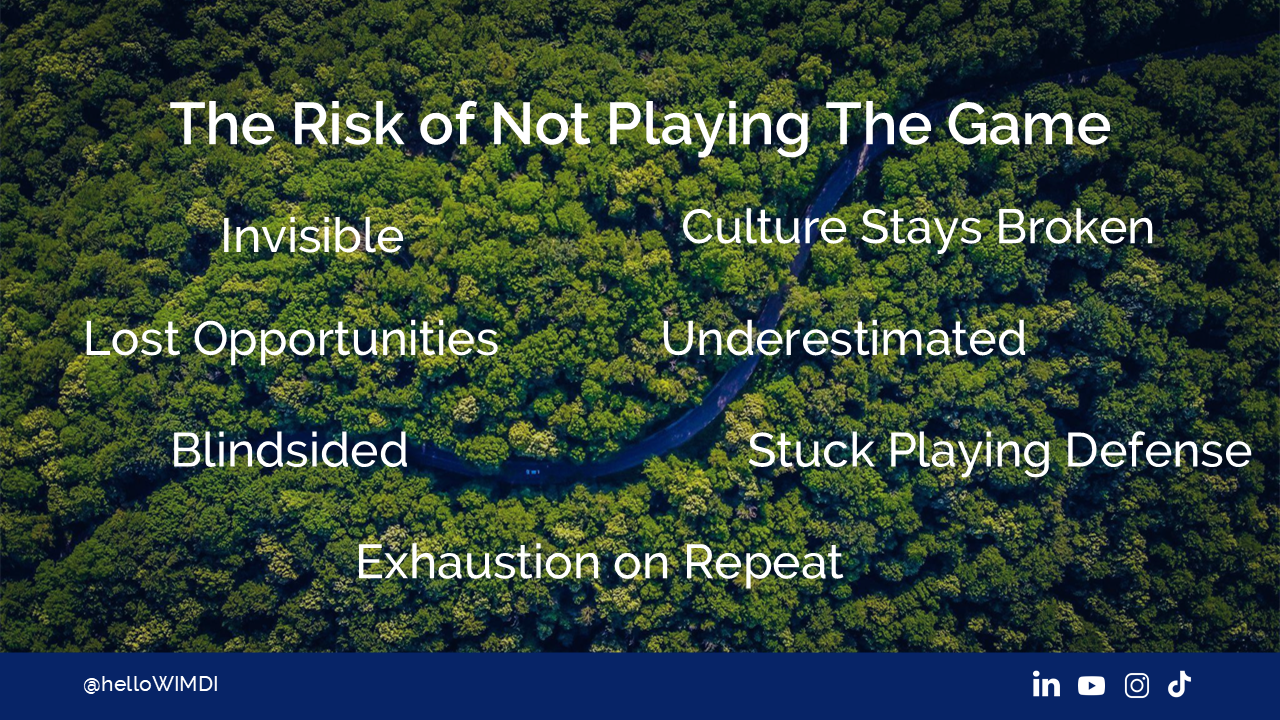
And when you don't play the game strategically, here's what you risk. You risk staying invisible.
You miss opportunities. Projects, promotions, visibility, they go to other people who are visible and who are playing the game.
You might get blindsided. You didn't see something coming, you couldn't read the signals. Maybe you weren't in the room when the signals were being sent. The culture stays broken.
When we don't play, the old guard continues to keep the power and the door stays closed to any changes for the next generation. You stay underestimated.
Who here, I bet, I'm sure some of us here, most of us here are considered the reliable one, the team player. "Oh, if no one else wants to do that, so-and-so will do it no problem."
We remain being the one who gets the grunt work and without the influence if we don't play the game. We also get stuck playing defense.
So, instead of leading, we are reacting. We're cleaning up the messes instead of the one initiating the moves.
And let's be real, it is exhausting. It is painful to keep showing up, doing good work, and still feeling like you're two steps behind.
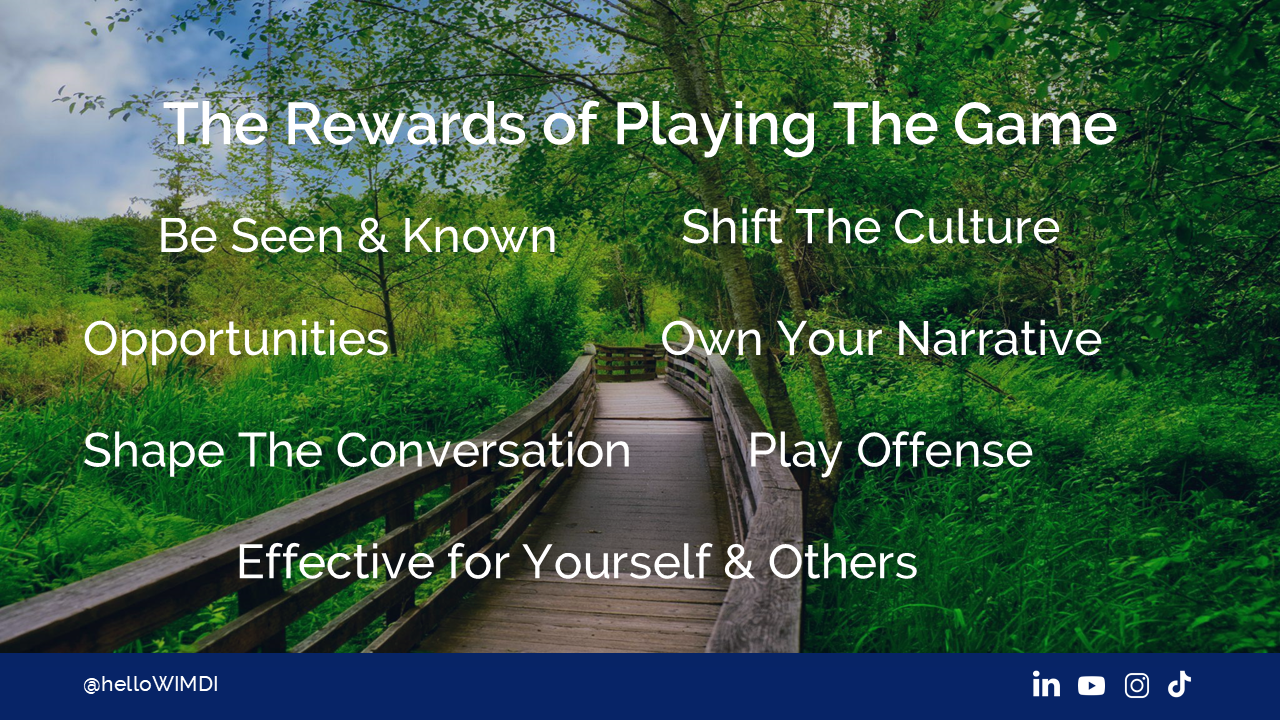
Now, in contrast, let's talk about what happens when we learn to play the game smartly. We get seen and we become known.
When our voice lands early and your work gets recognized, your presence shapes the room. You start to earn that reputation, a good reputation.
You get opportunities, you get the best projects because people know you, they've seen your work. You get the stretch roles because you've been able to say in a room what it is that you're looking to do next.
Promotions start to come your way. Decision-makers know your name, and they know your value.
You get to shape the conversation. You're not just in the room, you're guiding what gets discussed, what gets prioritized, what gets decided, what moves forward.
You get to shift the culture. Every time you lead with clarity and power, you make space for others to do the same, and the system, the game, starts to look more like you.
You own your own narrative. No more being nice, but forgettable.
You're the one that people credit, they quote, they refer to you, they ask for your input, for your opinion when it counts. You play offense.
You have first movers advantage and you move with allies and partners and you no longer react to politics, but you're the one driving it and designing the game board.
You get to pull others up. When you play to win, it's not just your career that changes. You bring others with you.
Playing politics does not make you manipulative, it makes you effective. And let's talk about the result of playing this game well.
This is not about being shady. Like any game, it can be played for good or for evil.
It's about knowing who holds the power, building trust before you need it, and getting the right message to the right person at the right time. This concept of win-win, right? Everyone knows this.
This is about you benefit and I benefit. I say that playing politics well is a win-win-win benefit.
It takes the classic win-win one step further, and it means win for you because you get your ideas across, win for them because the other person you're working with or the stakeholder sees the value, benefits, gets to get done what they want to get done as well, and it's a win for the system, the team or the organization or their larger mission, also gains.
So, it's not just a personal win, it's a strategic one that makes things better overall.
It is the antidote to zero-sum thinking. And when we play politics with this mindset, we gain alignment, impact, as well as advancement.
Why Mastering Politics is the Ultimate Career Cheat Code
I say mastering politics is the ultimate career cheat code, and what we'll talk about today is how to lock into that cheat code and level up.
Why Politics is Considered "Dirty"
Before we get into the nitty-gritty of how to play this game and what the shortcuts are, let's talk about the context, the backdrop of why we think politics are dirty. A few minutes ago, with the chat, we got all those responses.
It was exhausting, it was ugh, we got a few of the ugh, let's explore why we think politics are dirty, and hint, hint, I will change your mind about that.
We will talk about why politics is not dirty, it's not only essential, it's not just something you have to do, but if you can play it well, you can use it to your advantage and to your win-win-win benefit.
How Society Reinforces the Negative Narrative About Women & Politics
From an early age, this "good girl" narrative. We are socially conditioned and taught to play fair, to be liked, and avoid conflict.
This socialises girls and women to be agreeable, cooperative, and to prioritize the needs of others, and it can significantly impact our experiences as adults, including advancement in the workplace. We're taught that good girls don't scheme, strategize, or play the game.
Instead, girls are supposed to be empathetic, be agreeable, nurturing, cooperative, polite, and accommodating. I could go on.
I'll say that me, the way that I look and the way that I was raised, I call myself a triple threat or maybe a triple whammy. I'm a woman, I'm a minority, and I'm the first-born daughter of an immigrant, and all those profiles have taught me the "good girl" narrative.
We even have cultural examples of this. With Cinderella waiting for her turn.
We have first ladies, Eleanor Roosevelt, Michelle Obama, I am in the US, so, those came to mind, women who wielded power discreetly, never too much in front.
And this is why so many women today still feel uncomfortable with owning their power.
It's been ingrained in us that power-seeking is bad. We've been taught that to be powerful, we must be soft or invisible.
There's a theory called role congruity theory. This theory suggests that leadership qualities often stereotypically are associated with masculinity, and this leads to prejudice against women who display these assertive traits or challenge the status quo.
When women collaborate, network, and influence, which we do all the time, it's called soft skills, not strategy. When men do the same thing, they get credit for being power players.
When we build relationships, we're seen as being nice, but when men do it, they're seen as being strategically connected. Well-networked.
I've experienced this double standard myself, I'm sure we have stories here in this room.
My story is about a certain meeting where I was growing impatient and I started to use a different, slightly sharper tone, maybe stronger words.
My body language stood up and there was someone else in the room as well who was also agitated, happened to be a man, who was dropping F-bombs everywhere.
And after that meeting, I was pulled aside, and it was recommended to me that I calm down and that I don't need to use that tone of voice.
I was just beside myself because I felt like I just modulated my voice maybe half a step, while the person next to me was pounding the table, pulling out his hair literally, and dropping expletives, and he didn't get that talk.
That was because of what's something that I call baselines. His baseline, he was always like that, every meeting, every day. His reputation, and he was accepted for it, so when he did it, he was allowed to continue doing it.
I set my baseline very calmly, I'm proud of that actually, level-headed, but because I raised the module just half a step, I got called out on it and I felt like that was very unfair.
In my mind, after that moment, I decided that I would set my baseline higher, that I would not be the good girl so early upfront and so often, so that I could have more room and more freedom to express myself, and you know, use my voice and my tone, and my words the way that I would need to.
Again, I'm sure that everyone here has their own version of this. Unfortunately, the double standard today still exists.
Women's Political Moves Have Historically Been Diminished or Erased
Now, I'd like to say that women have always navigated power structures, but we don't often see this in history because their political moves were not recorded the way men's were.
It's not just that we didn't know how to play the game or that women didn't play the game well, it's that nuance of how it was recorded in history.
Instead of being strategic leaders, women were labeled as supportive wives when they were the ones really running the show. They were mediators when they were really the ones negotiating deals.
They were called the admins when they were coordinating and controlling access to key decision-makers. Again, it's that management of people and information.
Playing politics. They were the ones doing it, but they were called admins.
Case Study: Hollywood's Sisterhood
Let me share some examples in history about this. I present to you a case study.
We're calling this Hollywood's Sisterhood, because we're not talking about necessarily capital P politics in government. This is something a little bit closer to home if Hollywood is closer to home for you.
Here's a story that rarely makes the history books, but it's pure political brilliance. Back in the 1940s, some top Hollywood actresses like Bette Davis, Katherine Hepburn, and Olivia de Havilland were stuck in exploitative studio contracts.
They couldn't choose the roles they wanted. They couldn't negotiate pay. They couldn't escape a bad studio without being blacklisted. So, what did they do?
They didn't march in the streets, they didn't scream and yell, they played the long game together. They quietly banded together behind closed doors, they coordinated refusals of bad contracts.
They staged illnesses to delay filming, and they used their public personas to sway executives, male executives, without direct confrontation.
Olivia de Havilland specifically sued Warner Brothers and won, and the result of this case is that the entire system changed, benefiting both men and women actors.
They won more control over their contracts, but what does history remember? It remembers the lawsuits, not the years of behind-the-scenes coordination that made this change possible.
There was no org chart, no formal authority, just relationships, timing, and well-placed influence.
Case Study: Taylor Swift
I present another example to you. Let's talk about Taylor Swift, not just the artist, but as the businesswoman and the strategist.
In 2019, her former label was sold and what this meant was that the rights to her master recordings of her first six albums were also sold to the new label, and this was done without her involvement and against her wishes.
Instead of going nuclear, marching in the streets, she played it smart. She announced that she would re-record all six of her albums creating quote, 'Taylor's version' that she would own.
This was a bold, strategic move, not one that was seen often in the music industry. She leveraged fan loyalty, public sentiment, and precise timing to turn a business loss into a massive win.
Each re-recording has topped charts, broken records, and earned her back both control and money.
She reshaped how the music industry talks about artist rights without ever losing her image as the one in control.
She took back her power and the world applauded and watched.
Case Study: MacKenzie Scott
I've got one more example for you. MacKenzie Scott.
If you don't know her, she's the former wife of Amazon founder Jeff Bezos. She has become one of the most influential philanthropists in the world.
She's done it without fanfare or the traditional power trappings. After her 2019 divorce, she received $38 billion in Amazon stock, and she began giving it away at unprecedented speed.
She's taken an unconventional way of executing her philanthropic vision. Most pledge large sums but trickle them out over decades and have conditions attached.
They use giving to boost their reputation, think of buildings named after donors, and they also usually insist on personal oversight, which slows down disbursement of the funds and second-guess the frontline leaders.
Instead of setting up a foundation with her name on it, she relies on experts or consultants who work behind the scenes and use data to identify grantees, trusting those closest to the work.
She's chosen to gift organizations led by women, people of colour, and underrepresented communities, no strings attached. She boosts groups that don't usually have access to elite donors like her.
She's donated over $19 billion to more than 2,500 organizations since 2019, and she does so quietly without press conferences, without naming rights, without buildings with her name on them, or without personal branding.
What's really interesting is how she has influenced through her money, because her style has reshaped philanthropy and she's effectively putting glaring pressure on billionaires into rethinking how they give.
Her style challenges their pace, their conditions, and their need for recognition, all without ever saying a word about them directly.
Women Master Politics in Everyday Life
Guess what? It's not just women in history and celebrities and people divorcing the founder of Amazon that play politics and achieve a win-win-win.
Those of us here today, even you, have played politics and likely played it well. However, you may not have realized it or you may not have even been willing to admit it maybe until now.
Let me try to convince you for those who think that they haven't played politics still. Let's move to some examples that are closer to home for each of us.
Politics outside the office, here are some everyday examples that maybe you can see yourself in.
When it comes to family dynamics, maybe you've got your in-laws or your parents to change family holiday plans, the when and the where to fit your schedule or fit your preference.
Maybe you've gotten to know that teacher or that school administrator or that coach to get your kid into the right class or the right team.
Maybe with your friendships you've, you know, smoothed over conflicts by talking to each one individually before coming back together as a group to acknowledge, you know, the smooth-over.
And it's not just examples outside the office, for sure, examples inside the office as well that I can offer to you. Perhaps you knew a group conversation was going to be tough.
So, what did you do? You prepped each participant one-on-one before the call.
Perhaps you were the one to decide who got information ahead of time, the what of the information and the when of the information, and that helped set the tone of a room.
Perhaps you've done a pre-meeting, quietly coordinating a group of colleagues to back a policy change or maybe a decision or maybe a recommendation before the team meeting.
Here's another one. Maybe you've gotten to know the admin, you've become his or her friend, you've helped them out so they can help you out, maybe give you some early insight into when that all-important senior leader comes to visit.
You know when they come in the office, you know which day they're arriving, you know when they have a free moment for you to pop in and say hello. This is political strategy.
You shaped an outcome by managing people, relationships, and information.
I invite you again to share in the chat, what is something you've done at work that was actually politics, but maybe you wouldn't have called it that before today?
[Adora reads responses from the chat]
Getting hired into your role. And individual info sharing.
Brenda was able to create a brand-new role for herself that didn't exist. Nice job. There's a lot of pressure with that, too.
She went behind her colleague's back, stole a promotion from him, but he tried to steal it from her first.
So, was it the same promotion that you stole back or was it a better one?
Participant - The same one and then I made it better in the stealing.
Exactly, exactly. Promoting a great person for an important position.
Yeah, you created an ally. They deserve that promotion. Great, but because you helped them get that promotion, there's a little bit of loyalty created perhaps.
I think we can all agree we already play the game. The game is navigating politics. We already play it.
Levelling Up Your Politics by Playing "Jumanji"
Let's learn how to play the game more strategically and with intention, and I offer to you, let's level up this game and let's call it Jumanji.
I'm going to call myself Adora the Explorer, bringing you through the Jumanji game board, and I'm going to put on this hat to denote that we're going to go on a safari.
All those benefits that we talked about of playing this game of Jumanji and playing it well, we're not only going to help ourselves, we're going to help others coming up after us and we're going to help the organization. So, let's play this game.
Most of us have been taught to play it small. We talked about how we're already playing these politics games and already playing the game well, decently enough, but we're taught to play small originally.
We are taught to be nice, stay humble, wait our turn. It's like petting zoo politics.
Small plays equal small outcomes. And worse, you're surrounded by people who play the game bigger.
So, you know when you offer help, when you avoid conflict, when you don't rock the boat, maybe you get a gold star, maybe you don't.
You've already been using these tactics, like smoothing over conflict, reading the room, seeding ideas. You are more skilled than you think actually.
But the real game is actually Jumanji. It's fast-moving, it's high stakes, it's filled with power players who know how to survive and how to win.
But this isn't a reason to panic. It is instead your invitation to gear up and play this game boldly because you've got the instincts, you've got the tools, you've got the intelligence, and now let's use those same skills, but let's use it with intentionality, with reach, and with reward.
Why Playing Big Matters
Why does playing big matter? Why should we?
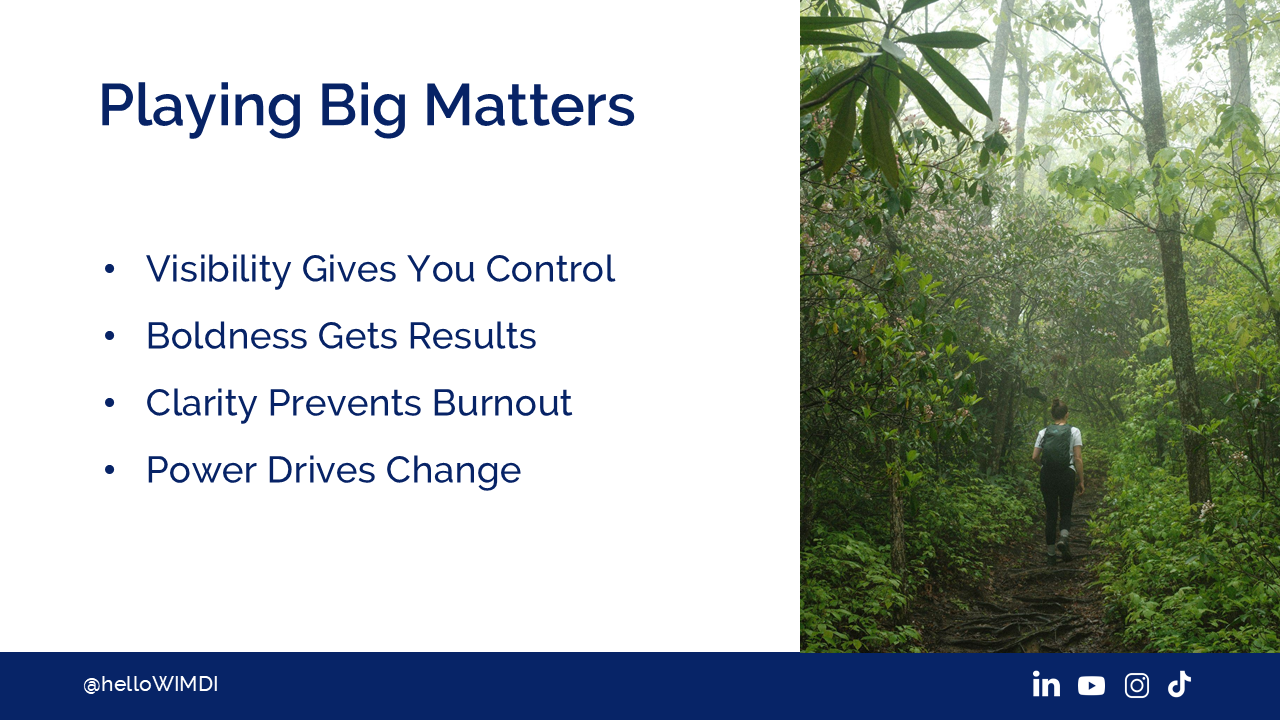
Remember, visibility gives you control. You're seen for what matters and not just what's on your task list.
Boldness gets results. Soft asks lead to soft outcomes. So, let's speak like it counts because it does.
Clarity prevents burnout. Stop over-functioning, start playing a smarter game. Power drives change. You can't rewrite the rules if you're not holding the pen.
So, this isn't about being slick or being manipulative. It's not being shady, not being dirty.
It's about owning your leadership in a space that's honestly messy by design. Influence is not optional.
If you want things to get better for you, your team, and the next generation for your organization, for your culture, then you've got to play bigger.
Let's not aim for perfection because we know that that can actually be a barrier. Let's aim for impact.
What Playing Office Politics Looks Like
What does playing Jumanji look like?
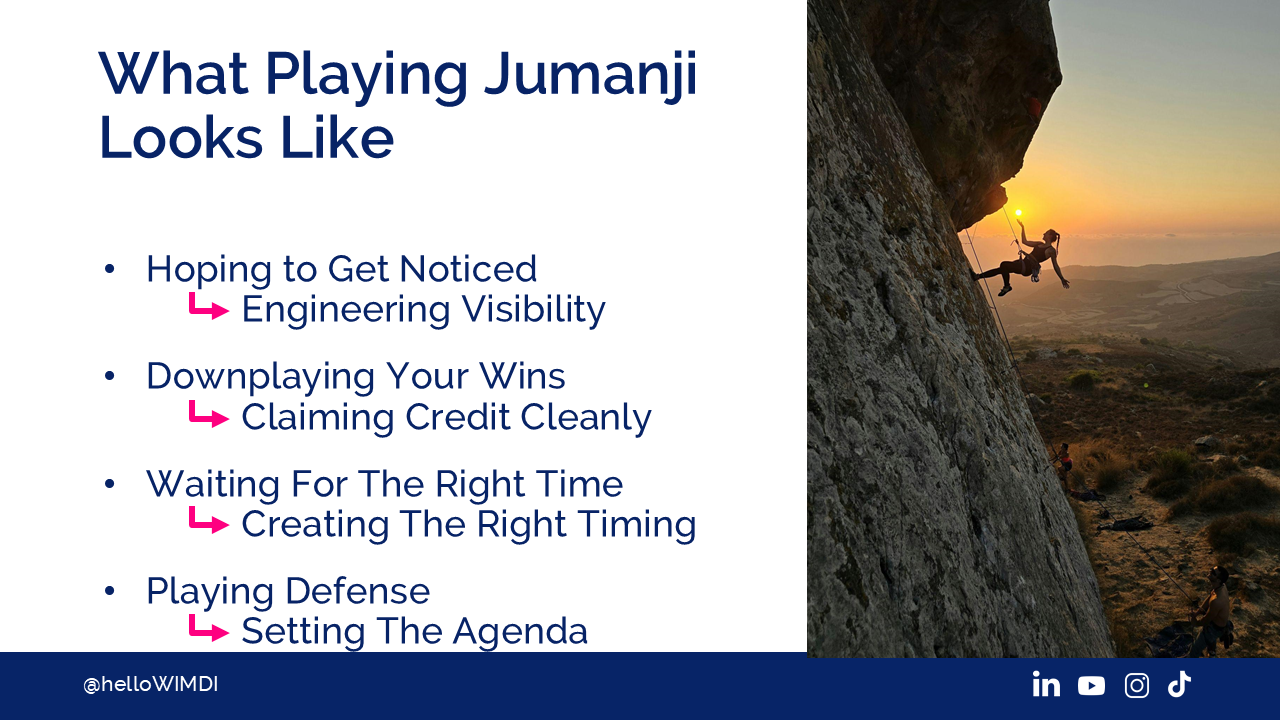
From playing small to playing smart and bold. This looks like going from hoping to get noticed to actually being strategic about when you're seen and when you speak up.
This is about, instead of downplaying your wins, playing the humble game, acknowledging your team without acknowledging yourself as the leader, instead of that, you claim credit cleanly, and instead of waiting around for the right time, which we know never comes, you play the game to create the right timing.
This is where we change our tactics. We're not doing dirty politics, we're rewriting the game as one where we can lead with vision, clarity, and power.
We go from playing defence as well to setting the agenda. This is about redesigning the game board.
We're not just players, we're going to shape this game board. Let's stop disowning politics and start mastering it with discernment, strategy, boldness, generosity and guts.
I'm going to show you five power moves to consider when playing this game. We're going to learn how to play the game of Jumanji without selling your soul.
Power Move #1: Lead with Visibility
Power move number one, lead with visibility. This is the move that's about being seen.
This is the move that gets you on the radar. You proactively shape how your work is seen by making it visible at the right time to the right people in the right way.
It's about owning the narrative of your value before someone else claims it, before someone else defines it, or before they miss it entirely.
With each power move, I'm going to offer a power phrase, an actual quote that you can use the next time you want to use this power move.
So, the phrase with this power move number one is this. "Here's what I'm building and here's why it matters now."
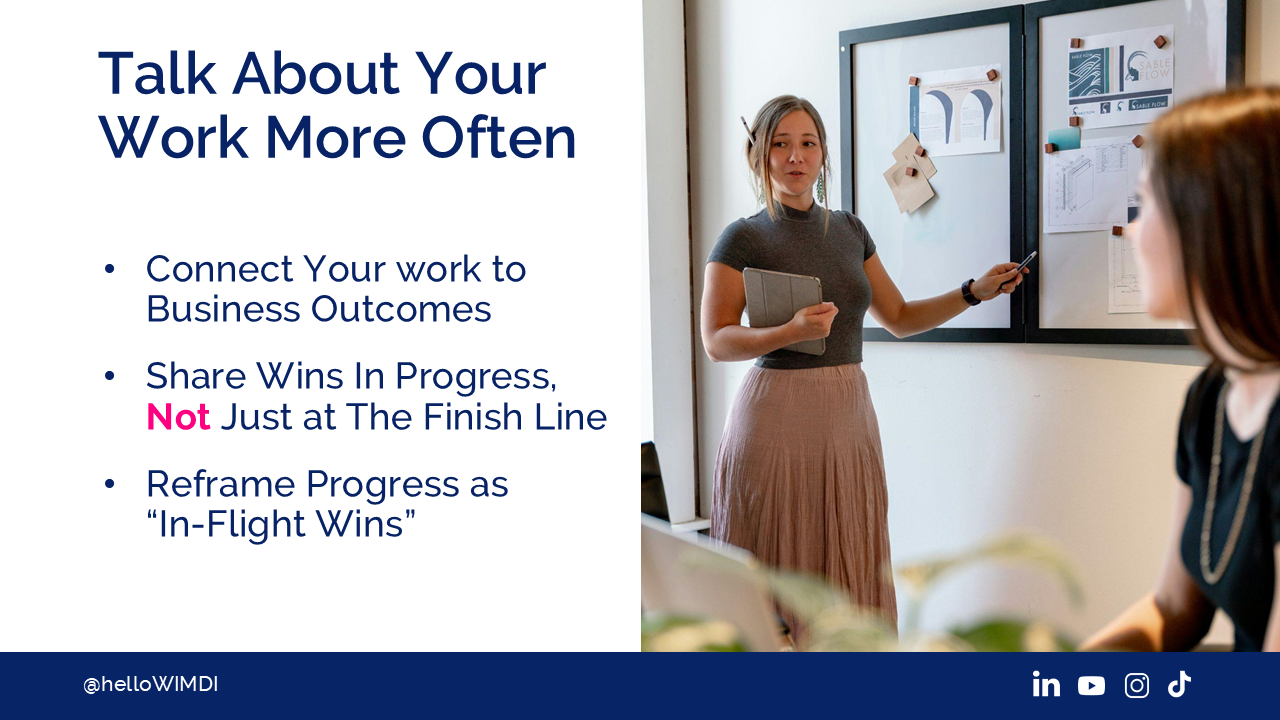
And we'll go into some more specifics about how to do this move. This is really about talking about your work more often.
Connect it to business outcomes. This is not just about the things that you did, this is about the impact that it brought to your team and to your company. Share wins in progress.
How often do we wait until we're done, until the nice, neat bow is tied on that box, before we're willing to talk about it? That's actually a disservice to ourselves.
Sharing wins in progress is going to be the thing to get you more visibility.
One of my clients waited six months to present a major project, she waited for that nice, neat bow to be tied up. By then, the company's priorities had shifted, and the impact was not there.
We reframed her updates for her next project as in-flight wins. So, the next time they met, she dropped a mid-progress update right in a team meeting and her boss said, "This is terrific, I'm excited to hear it more. This is the kind of initiative that I want to see more of."
And that moment changed how she was seen.
Again, the quote is, "Here's what I'm building and here's why it matters now."
Do not think that things have to be perfect and complete before you talk about it. Speak early about your projects. Lead with visibility.
Power Move #2: Confidently Claim Credit
Power move number two, this is about being acknowledged. It's the move that makes sure you own your territory.
Again, we're playing Jumanji. You own that part of your game board.
If you own your contributions early and unapologetically, you build credibility and career capital. The power phrase here is, "I led the project and the team crushed it. I'm really proud of what we pulled off."
In this way, you get to own your wins with clarity, and you don't put yourself back behind the team.
Women often downplay their role in the wins. I believe we need to stop doing that.
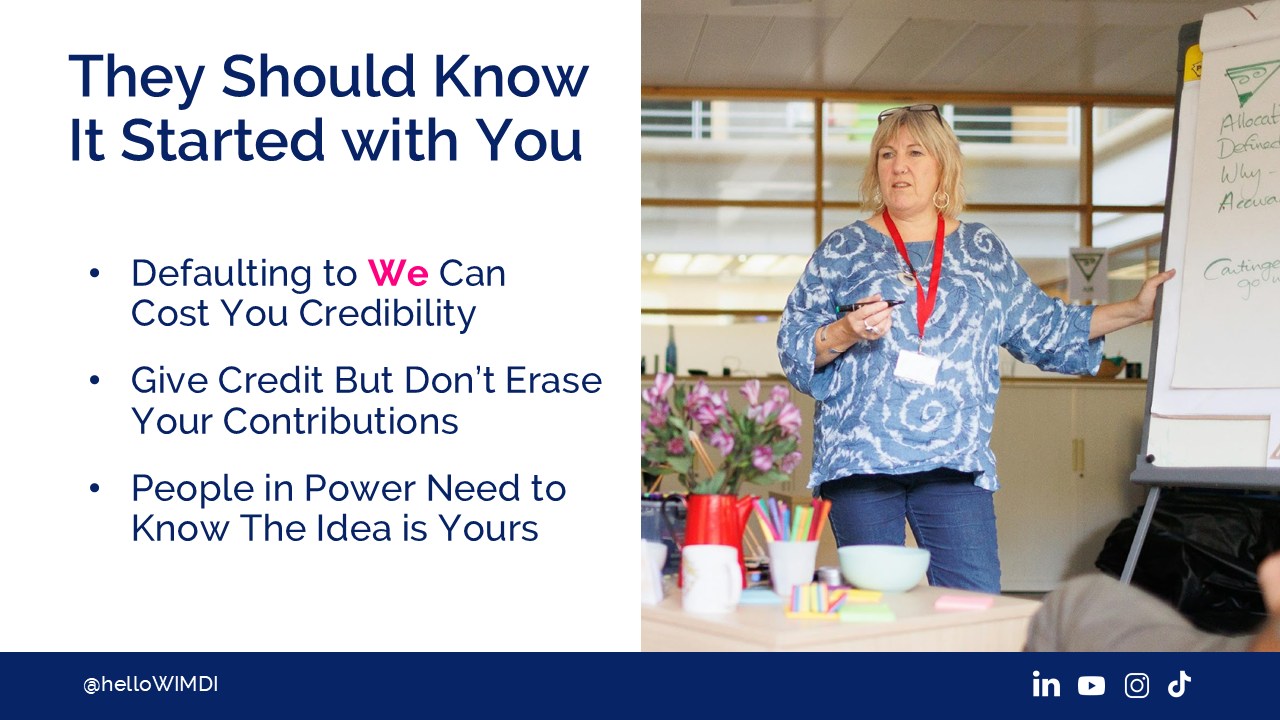
Use the word 'we' when appropriate, but don't erase your leadership because they should know that it started with you.
Generosity is great, but if you keep spreading the credit, kind of like frosting a sheet cake, no one's going to know who made the cake. You made the cake.
Some people, especially the ones with power, they need to know it was you. They need to know it was you who did it.
Defaulting to 'we' can cost you credibility. You hide yourself behind the team.
You can give credit without erasing your contributions. The example I have here is I had a client whose idea was taken and reshaped, and it was announced by her boss without acknowledgment.
When she came to me with this during a coaching session, I asked her how she wanted to handle it.
At first, she said, "Oh, it's fine. As long as the idea happens, that's all I really care about."
How familiar does that sound? I know that I've said it to myself.
But instead, we wrote together a Slack message that said something like, "Glad to see this team is building on the strategy that I seeded last quarter. Love where it's going. Can't wait to see what happens with it next."
She got replies like, "Oh, that's right, this was your idea."
And this subtle shift changed how her peers saw her. I wonder if those of us here in this room have stories like that that they could share.
Power Move #3: Get to Know The Players
Power move number three is get to know the players. We're on this Jumanji game board, we need to know who the players are.
The power phrase here is, "Who else should I loop in to make this land?"
I'm going to give you a little bit of a tour on who these power players are.
But before I do that, I want to point out that power is not the same as the job title.
The org chart is not equal to the real power structure. There are titles that is like the formal power, but there's also relationships, which is more like the real power.
These are the shortcuts. Both pieces are crucial.
A title is like the visible path and relationships are like the hidden trails that get you there faster, especially when the formal path is blocked.
So, I just wanted to make that point. Both pieces are crucial. Title and relationships, you need to consider when figuring out your next move.
The Decision Maker: How to Spot & Leverage Them
The decision-maker is power player number one, i.e. the lion. These are the people who call the shots or maybe they have veto power.
These aren't necessarily the highest-ranking person. This is sometimes the person the highest-ranking person listens to.
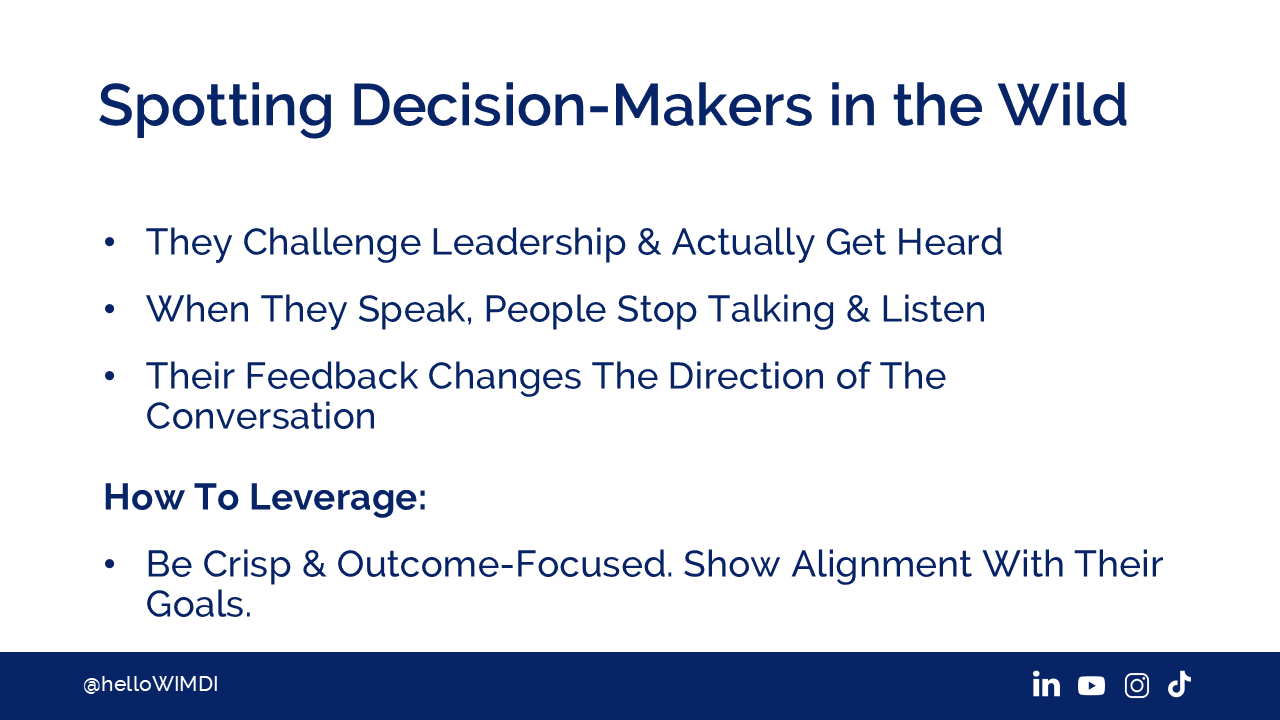
These are how you spot decision-makers in the wild, in the game of office politics. They challenge leadership and they actually get heard.
Maybe it's that someone when they speak up, people stop their side conversations, they stop and they listen. Maybe their feedback changes the direction of the conversation, changes the direction of where the leader was going to go with this discussion.
And how best to leverage the decision-maker, you be crisp with them because they are outcome-focused. You show that your ideas are in alignment with their goals as well.
The Gatekeeper: How to Spot & Leverage Them
Power player number two is the gatekeeper, or the shepherd dog. These are the people who control access to the decision-makers.
It could be an executive assistant, a project coordinator, or a chief of staff. They may not make the final call, but they decide who gets in the room when the final call is made.
The shepherd dog is alert and protective, but they guide people who want to get access to the decision-maker.
So, how do we spot gatekeepers in the wild?
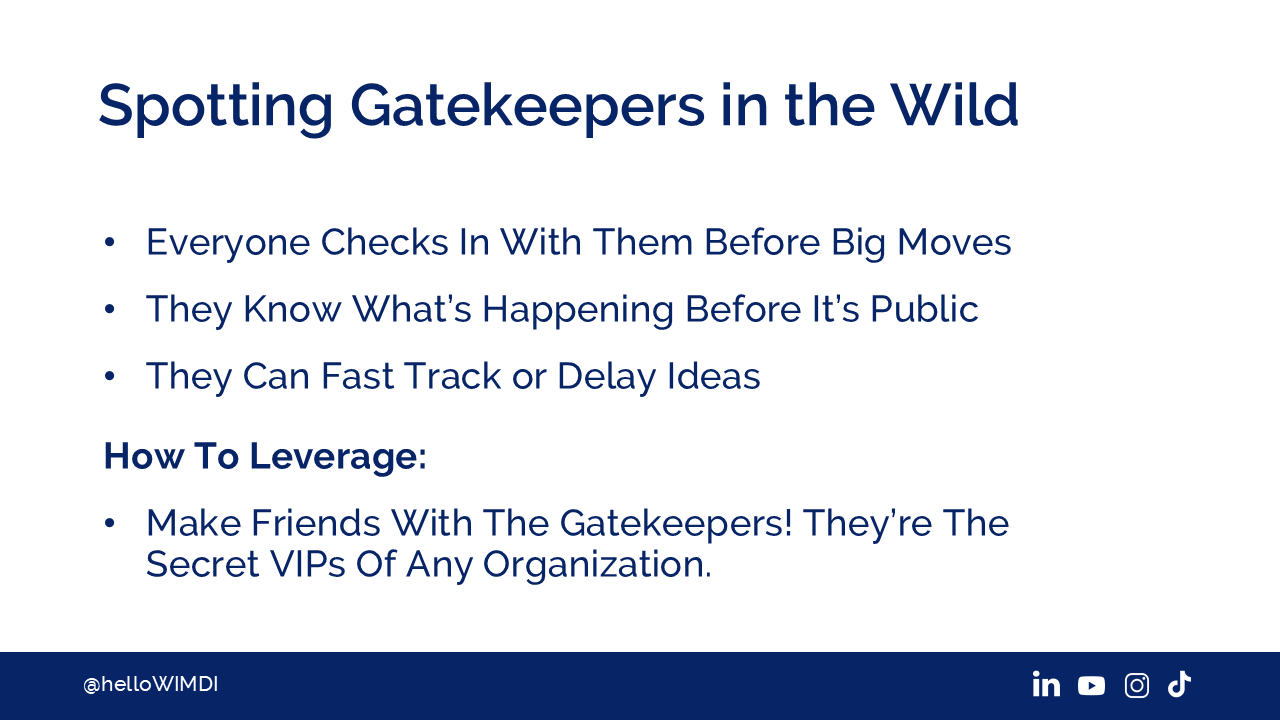
These are the people that everyone checks in with before the big move. The gatekeepers are the ones who know what's happening before it's made public, and they have the ability to fast-track or delay ideas.
I highly suggest you make friends with these gatekeepers. They are the secret VIPs of any organization.
Particularly, with power move number two, to confidently claim credit, make sure the gatekeeper knows your name is on that idea. That's where they can help you.
The Influencer: How to Spot & Leverage Them
The third and last power player is the influencer owl. These are the people who don't always have authority, but people listen to them.
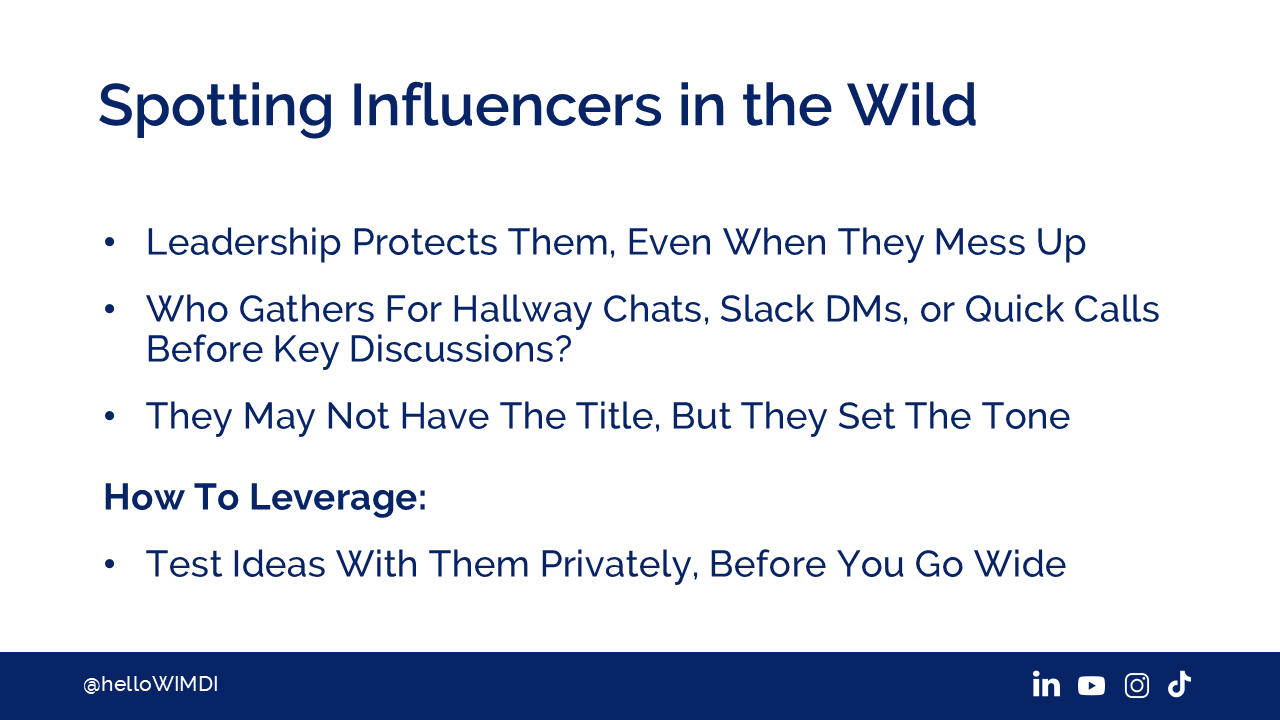
Leadership protects them even when they mess up. They're the ones who gather certain people in the hallway for pre-meeting chats.
Maybe the Slack DMs, again, as you're heading into the meeting, or maybe they do quick calls before key discussions. Maybe they even do the after-meeting meeting for a debrief.
They may not have the title, but they set the tone.
How do you leverage influencers in the wild?
You can test your ideas with them privately before you go wide. And that's in an upcoming move that we'll talk about as move number four.
So, again, we have the decision-maker lion, the gatekeeper shepherd dog, and the influencer owl as the power players.
Homework to Get to Know The Political Players
So, I have a question for you, given a recent project or initiative, who played the role of decision-maker, gatekeeper, or influencer?
Where did you fit into that structure and who do you need to build a stronger bridge to?
Power Move #4: Trusted Partner Influence
Power move number three was know the players. We're going to go to power move number four, trusted partner influence.
This is where you build buy-in through partnership, you build alignment through strategic conversations and the small yeses. This is where you build allies without burning bridges.
The power phrase here is, "Do you agree that's something we should get ahead of?" And this will position you as a high-trust, high-value partner.
The 4-Step Process of Influence Stacking
I'll show you the steps of how to do this. What we're going for here is getting layered buy-in.
We're going to use something called influence stacking. This is about getting small yeses before a big ask and making that big ask easy to say yes to.
This is a four-step process.
Step #1 - Frame the Pain
Step number one, frame the pain. Establish a shared reality. Align on the problem.
An example of something you could say to frame the pain is, "Have you noticed how low energy and disconnected the team's been since the reorg?"
I don't know anyone who would say no. They'll likely say yes and agree with you, which makes the next step a little bit easier.
Step #2 - Align On The Cost
Step number two, align on the cost. What is the cost of doing nothing and what is the urgency here?
There's something that I want to introduce here, which is called the persuasion psychology, which says that we are more likely to act on conclusions that we speak aloud ourselves.
So, instead of convincing them, you ask a smart question that helps them say the urgency out loud.
And that's how you can create commitment without pressure. So, you can ask something like, "Do you think it's starting to impact collaboration and delivery?"
When you ask like a trusted partner, you're not just pitching an idea, you're actually helping them lead better, and that is influence right there.
Step #3 - Float the Possibility
Then, we float the possibility. We get agreement on the change we want to see happen, and then you ask for the resources you need.
So, continuing this example is, "What's your take on dedicating maybe some focused time to reset the team? Perhaps an offsite?"
Step #4 - Make It An Easy Yes
Step number four is make it an easy yes. You've already built this layered cake.
Now, it's time to make it easier for them to say yes than it is to say no, but it's important to give them an out. But still, you make it so silly for them to say no that they don't need to take the out.
So, you can say something like, "I've looked into a few options, and I found a facilitator who's done this kind of reset for teams. Would you be open to reviewing the proposal?"
Note that you're not asking for approval of this, you're asking for, would you be open to reviewing the proposal? That is your easy to say yes to question.
In my world, we call this the irresistible offer. So, you're offering this irresistible offer to your manager, your boss, whoever it may be, helping them to say yes easier.
Power Move #5: Borrow Power for Influence
Lastly, power move number five, borrowing power for influence.
This one is about gaining traction through co-signs or through social proof. This is about amplifying your message to leverage someone else's credibility or position.
This is the move that gets you a louder mic when the stakes are high. And the power phrase here is, "Will you back this if I raise it?"
You are taking the lead, but you know who to align with to gain access and gain speed.
This is about amplifying power strategically, borrowing credibility to be heard. And there's a concept here that I'm going to go deeper into, which is borrowing power versus deferring power.
This is quite nuanced, and I think you guys will enjoy this. Let's look at some examples.
Borrowing power means you're leading with backup. There's someone behind you, you're using someone's name to back you up.
You're not hiding behind someone else's voice. You're not deferring, you're taking the mic, and asking someone else to raise the volume.
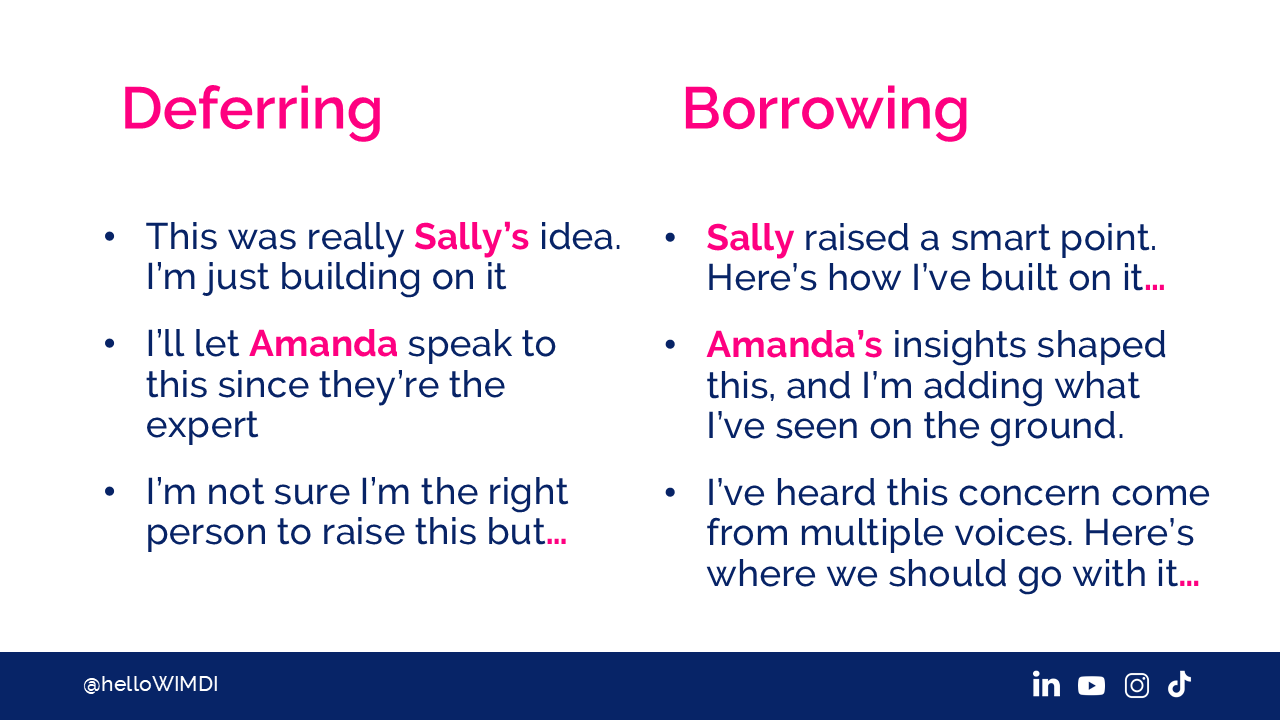
So, when someone is deferring, it might look like this, "This was really Sally's idea, I'm just building on it."
What might this look like if we were borrowing power instead?
It might look like, "Sally's raised a smart point and here's how I'm going to build on it."
You're acknowledging that Sally made that point, but you're also giving yourself credit that you're taking it one step further.
What's another example of deferring power? Maybe saying, "I'll let Amanda speak to this since they're the expert."
Instead, you could say, "Amanda's insights shaped this, and I'm adding to what I've seen on the ground."
How about this example of deferring? "I'm not sure I'm the right person to raise this, but..."
Instead, you say, "I've heard this concern come up from multiple voices. Here's where we should go with it."
So again, you're still leading the idea and you're strategically amplifying it by aligning with someone who's already had the influence.
So, playing politics is not about manipulation. It's not dirty, not shady. It's about using these power moves, that get you noticed, respected, and promoted.
This is how you level up and play and win at office politics.
The 5 Power Moves Summary
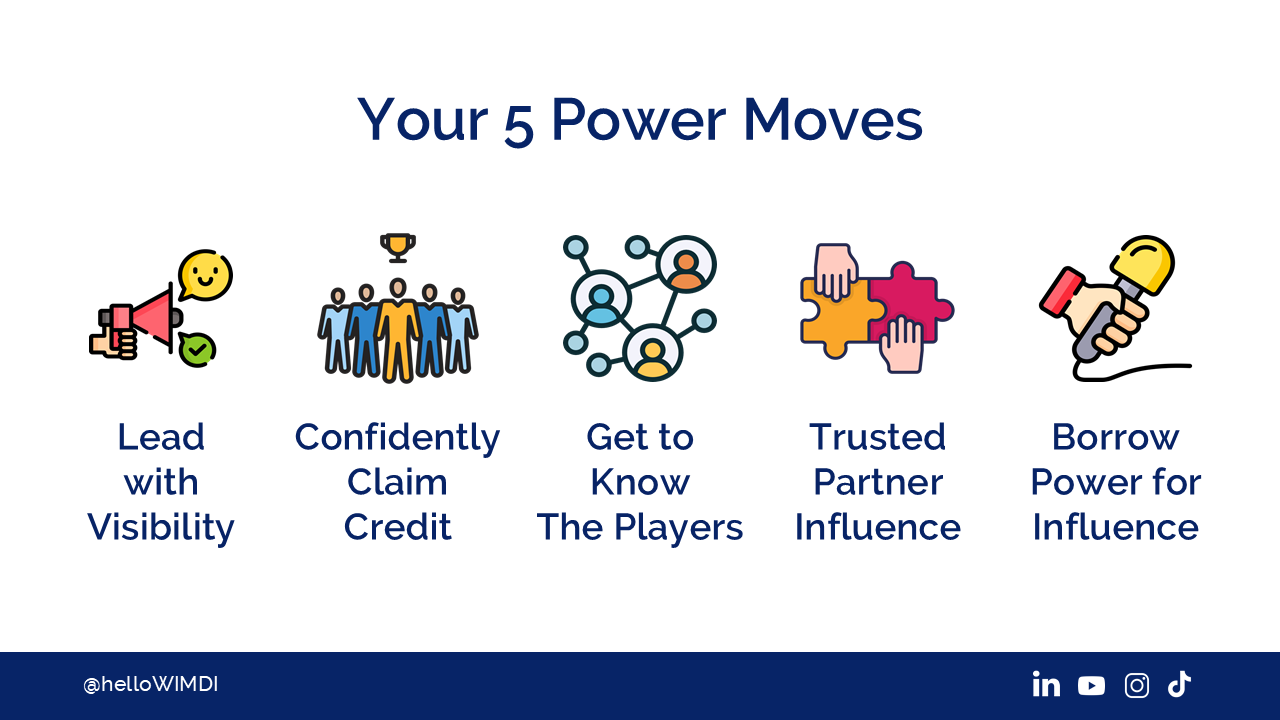
So, here are your five power moves in summary.
This is about leading with visibility, getting on the radar.
This is about confidently claiming credit, so you own your territory.
You get to know the players, so you know who you can build bridges to.
You can get trusted partner influence; you can win allies through that.
And borrowing power for influence, about getting a louder mic, borrowing not deferring.
So, I ask you all to pick a power move to apply to a current or upcoming major project in your workplace.
What would be your most valuable move in your work today? Is it about visibility? Is it about credit? Knowing the players? Trusted partner? Borrowing influence?
It's important to say that these moves aren't necessarily in sequence. I mean, there is a natural building up of it, but depending on the project, depending on where you are, depending on what your analysis of who you need to build bridges to will determine which power move will be best for you.
Key Takeaways
The key takeaway here again is managing relationships well is your shortcut across the board. That's how you're going to win the office politics game.
Mastering politics is the ultimate cheat code. And I hope that you enjoyed the tour of the game board and a nice overview of some of the power moves today. I hope that you found this useful.
Figure out who's the decision-maker, the influencer, and the gatekeeper, who you need to build bridges to, and which power move you need to use that will help you get seen and get heard and get that triple win.
I'd love to stay in touch. You can visit my website for what I'm doing these days. I've really enjoyed my time with you.
More Fun Stuff!
If you loved reading this transcript, you might like to watch the video or learn more about our amazing speaker! Check it out: