How to Sound Like an Ultra-Hireable Genius in Job…
transcript
Transcript
How to Sound Like an Ultra-Hireable Genius in Job Interviews
Here to read instead of watch? Click through the headings to a section of the full transcript, or scroll away!
- The 2 Things You Need to Succeed in Job Interviews
- Part 1: “If you got a problem” - Determine What They’re Looking For
- Example Job #1: How to Decode What This Company is Looking For
- Part 2: “yo, I’ll solve it” - Using the STAR Method
- Pros & Cons of the STAR Method
- Upgrade the STAR Method to the START Method
(Edited for length and clarity)
Welcome everybody to "How to Sound Like An Ultra-Hireable Genius in Job Interviews."
I'm really excited to do this because, what a promise, ultra-hireable genius. You know, we like to over-promise and then over-deliver. So, I'm excited to show you what I know about how to do job interviews in a way that will have people feeling really impressed with you.
I know the job market these days is incredibly tough, and I'm hoping that some of the tools that I teach you today will be really helpful.
For those of you who don't already know who I am, I'm Holly Burton. I'm an executive coach for Women in Male-Dominated Industries and that means that I work one-on-one with ambitious women just like you who want to help get ahead in their careers and build into these leadership positions that we all wish had more women.
Now, some of my work involves that sort of more leadership angle of things, but a bunch of my work involves everything job search related. Resumes, cover letters, interviews, negotiation, the whole gamut.
Today I’m talking to you about what I think is maybe my favourite part of the job search, which is actually interviewing.
I'm one of those weird people that gets excited to go on job interviews, and you are probably sitting there right now going, "I don't know if I can trust this woman. I think I need to leave. Who likes to go on a job interview", right?
But I will tell you what I tell all my clients, that when you learn the skills to do it, and when you get enough practise, it can actually be really fun, because it's basically the art of walking into a room and shooting fish in a barrel when you do it right.
The 2 Things You Need to Succeed in Job Interviews
For you to succeed in an interview, you need to be able to basically do two important things. Number one is to figure out what they need and then you need to be able to show them how you can give them that thing that they need.
Basic level, this is what you're up to in any interview, it's also what you're up to on your resume for what it's worth, but in an interview you have to figure out what they need, AKA what are trying to buy, they're out here shopping for a person to work for them.
What are they trying to buy? And then do you have that thing and how can you show it off? The way I like to think about it in simpler terms is with a quote from my favourite mediocre white rapper from the '90s, Vanilla Ice, which is "If you got a problem, yo, I'll solve it."
Two parts. If you got a problem and yo, I'll solve it.
I want to be crystal clear, you know, Vanilla Ice didn't have a number one hit that we're somehow still talking about to this day with the hook of like "Let me tell you about all the problems I've previously solved regardless of whether you actually have them."
For starters, it's very wordy, and I don't think it would have fit in the song, but also, it's not that compelling, right? I don't really want to know about problems you've solved that aren't my problems. That's not that helpful to me.
But this is actually how most of us approach job interviewing. We tell people all about our exploits without really figuring out whether those exploits will be interesting or valuable to the people that we talk to.
I want us to stop doing this approach and instead go to the "if you got a problem, yo, I'll solve it" kind of approach.
Let's talk about how to do it. Let's kick it.
Part 1: “If you got a problem” - Determine What They’re Looking For
We'll start with part one, "if you got a problem."
I don't know about you all, but these days my crystal ball is broken. It's not working for some reason, I'm not clairvoyant anymore, I can't read the minds of the people that I'm interviewing, and it's really disappointing.
I feel kind of stuck in that this answer doesn't come automatically, but the good news is, I'm a detective and I can go and figure out what they want, even if I can't figure it out from my crystal ball.
There's a lot of clues left along the way, and if I can be the detective, you all can be the detective.
Example Job #1: How to Decode What This Company is Looking For
The first place we're going to start is with the job description. So, I'm going to do an example here with you all. I'm going to do lots of examples today. And all these examples are going to be for marketing jobs.
We kind of all know what marketing is. Roughly, we get marketed to all the time. So, I'm going to use marketing as sort of the example type of job that we're applying for.
In this example, we're applying to a really big company, 10,000 people, it's publicly traded, and it's a SaaS company, software as a service, meaning it's in the tech industry.
Let's read this fictitious job posting that I've made up just for this presentation that only has three bullet points and see what these people want.
First of all, they're looking for somebody who can drive lead acquisition through innovative campaigns. Okay, they want more clients.
Somebody who can build cross-functional marketing strategies. Okay, they want to be able to work with different departments.
And somebody who can work closely with sales and customer teams to drive continuous conversion. Okay, they want to have people buy stuff all the time and working in conjunction with these two teams.
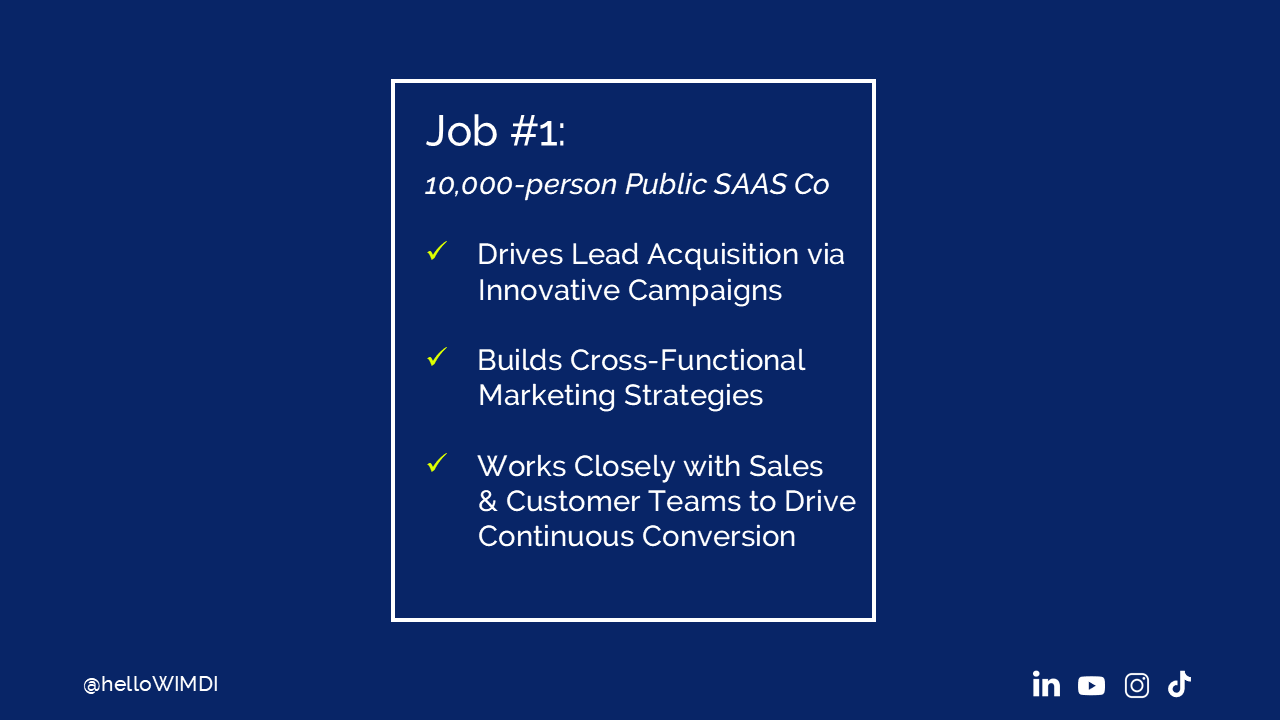
Based on that job description, what are the key skills we think this employer is looking for in this hire based on this job posting?
What do we think the most important things they want to see out of this hire are, key skills?
[Holly reads the chat]
Okay, Rhonda says, "Works as part of a cross-departmental team, growth and collaboration, leadership skills, problem-solving",
H - yep, I see all those things.
"Cross-functional collaboration",
H - another up-vote for that one.
"Project management", says Rhonda.
H - Sure, yeah.
"Communication, innovation".
H - Perfect, okay.
We're reading lots of interesting things here. Let me share with you what I thought it would be when I read this.
I would say, based on this job posting, a collaborative marketer who can un-silo marketing and integrate with sales and customer success to drive lead-gen. That's what we're looking for here.
Part 2: “yo, I’ll solve it” - Using the STAR Method
Let's go on to part two. We figured out what their problem is, what they're looking for. Now let's look at the "Yo! I'll solve it" piece. We want to be able to build these key skills that we just identified into all of the answers that we do in our interview, right?
When they ask us questions, we want to make sure that we're giving answers that show off the very things they want to buy. But how do we do that?
"Like I get it, Holly, but what does that actually look like?"
Now, most of us, when we go into a job interview, we use something called the STAR method. The STAR method is a really common way of answering interview questions, and it stands for Situation, Task, Action, Result.
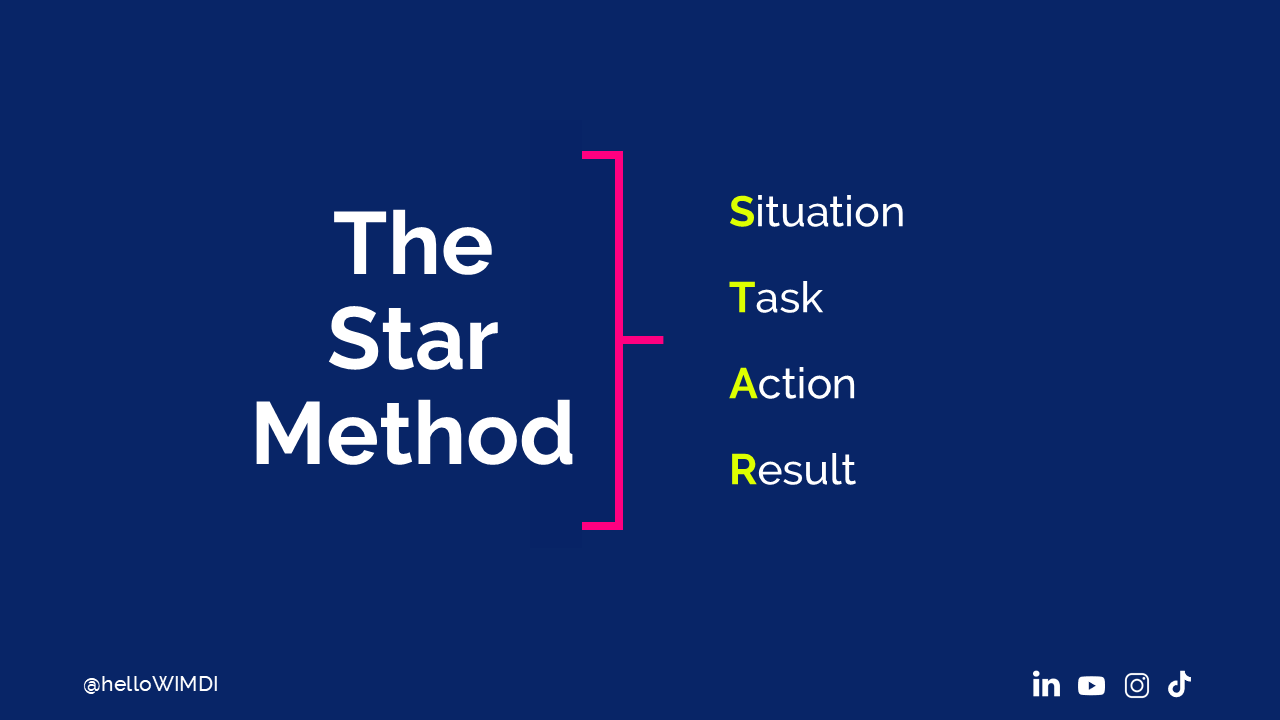
This is a normal way that human beings tell stories that make sense, and it tells you the order that you should put these things in. And if you don't know about it, don't worry, we're going to do a detailed example next so you can see exactly what this looks like.
Let's take a look at the example for the STAR method that most of us use to answer interview questions. Imagine we're in an interview, and they ask us this question.
Tell me about a successful marketing initiative you started in the last year.
Step one, we're going to freak out, right? Just fully panic, full body sweat, wish we were dying, never want to come to an interview again, regret all of our life choices.
Then we're going to get a handle on ourselves, take a deep breath and get into our STAR answer.
"Earlier this year, we were attending our largest conference", that's the situation.
"And it was up to me to figure out how to increase our leads coming out of the show." That's our task, the thing we had to do.
"So, I created an internal campaign where I took the attendee list, ran it through Salesforce and assigned every sales rep to call their clients who were attending." So that's the action that we did.
"With our goal being to set up meetings ahead of time so our reps calendars were full before they even hit the trade show floor." A little more action, a little more detail about what we did.
And then the results. "It was a huge success. We doubled the opportunities coming out of the event and increased our pipeline from $200,000 to 1.2 million bucks."
Pretty good. Made a million bucks. I like it!
So, we survived. We did it. We can wipe our pants on our very professional-looking skirt so that people don't realise that we've sweat everywhere in trying to come up with this very professional-sounding answer.
I'm curious to hear what you all would say. If you were the interviewer, what did you learn about me from that answer? What did you learn?
[Holly reads responses from chat]
Okay, Rhonda says, "I'm strategic in my approach."
Darryl says "Nothing." Thanks, Darryl.
H- Thanks for the support.
Supreet says, "I've got this."
"Plan of attack and metrics to back you up," says Susan.
Now let me ask you, did you see me talk about any of these key skills? Could you see these key skills in what I said? "Yes", a couple of people saying yes.
I would say the answer for me is actually, meh, only a little. Olga says "Not clearly", and I agree. I think that these key skills were implied but not said.
I don't want to have to rely on the interpretation of the interviewer. I don't want to have to let them make that leap. I don't want them to have to be smart to figure it out. I want it to hit them over the head and be super obvious that I am the person who will solve their problems.
We think about back in the day, what was the promise for the iPod? "A thousand songs in your pocket", right? Not, "Music, I guess".
It was very specific about what you would get. And I want us to be equally as specific as the marketing geniuses at Apple in the early 2000s.
The reason why we're not effectively showing off those key skills, even though we've got like an objectively impressive story to tell, is actually because of the way the STAR method worked.
Pros & Cons of the STAR Method
There are some pros and cons here. The pro is that it's a really easy, intuitive format to follow. Like I said, most people tell stories this way naturally.
If you leave out any one of those pieces, like if you talk about the task, but you don't talk about your actions, and you go straight to results, people won't understand, right?
This is the normal way to tell stories. And most human beings can get it with a little bit of practise. But it does make you seem a little bit junior. Part of the reason it can make you seem junior is because it's really task focused. It's right there at the beginning, task.
It shows how somebody can hand you a task and then you can execute on it, which is an amazing skill to have, but it's a skill that's way more prevalent and important in junior roles and way less heavily weighted in more senior roles.
This doesn't allow you to show off your approach, your thought process, the strategy behind your actions. It's just this straight from point A to point B type situation, where you're describing exactly the task and what you did about it.
It doesn't really give very much business context. We don't totally see why you did it or why it was so smart and amazing and that you'll be able to do it for them in the future. The thing I hate most about it of course is that your amazing expertise is just implied, but not actually made explicit.
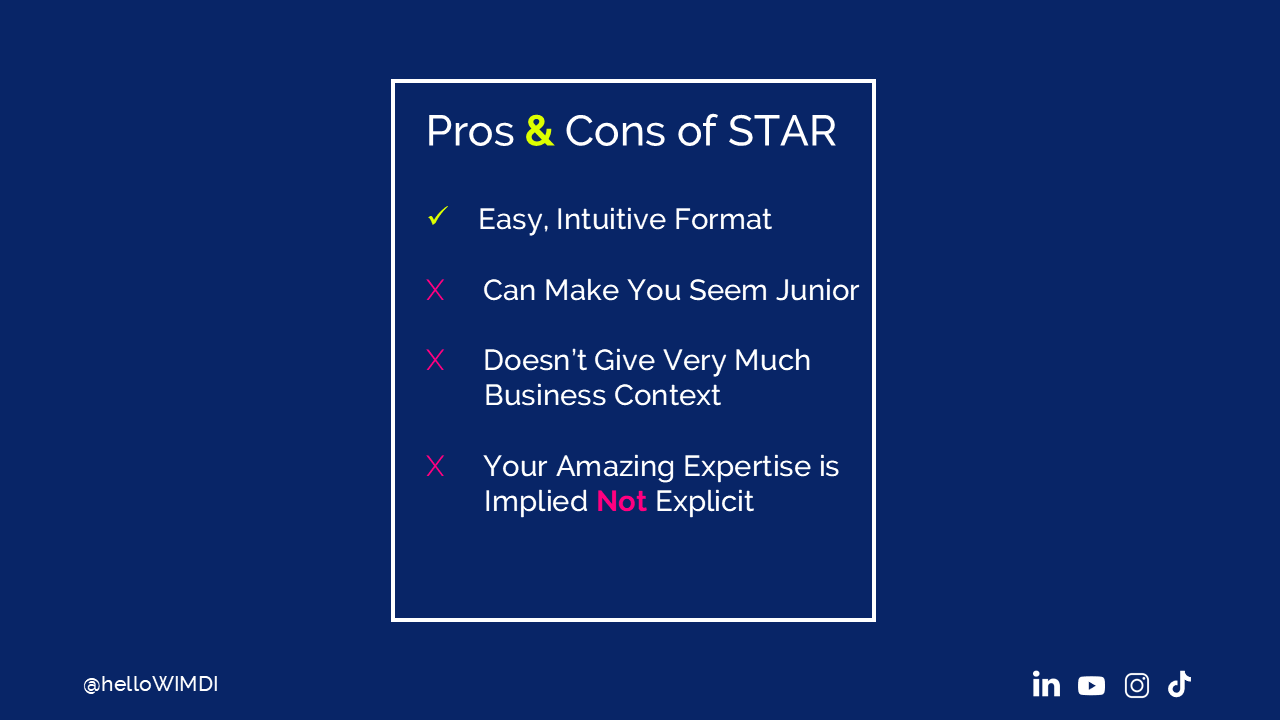
I don't love that, and I think that we can do better than this. I think there's a format we can use that will better show off your skills and make it clear exactly what you bring to the table.
Upgrade the STAR Method to the START Method
So, we're going to make a little bit of a change here. We're going to switch from the STAR method into the START method. We're going to add this extra T on the end that stands for "Takeaway" and that my friends is going to transform everything for us.
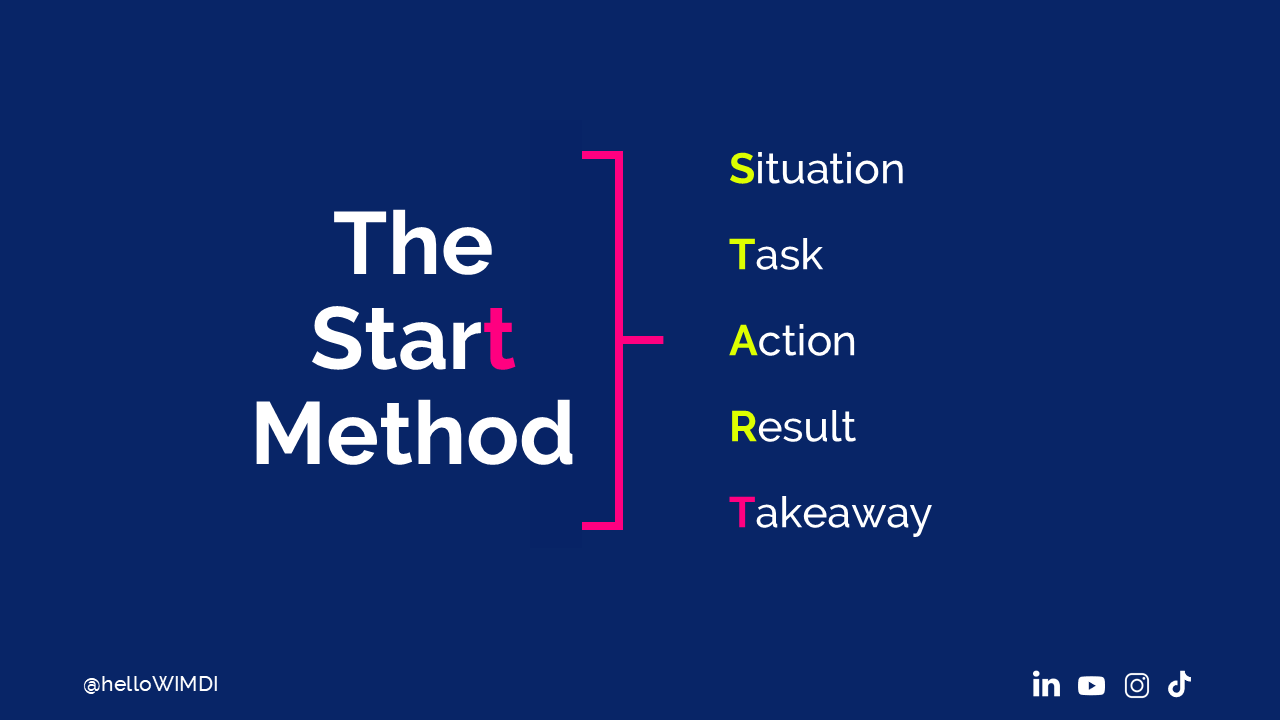
This magic takeaway that I am now introducing into your life is going to do a whole bunch of amazing things for you.
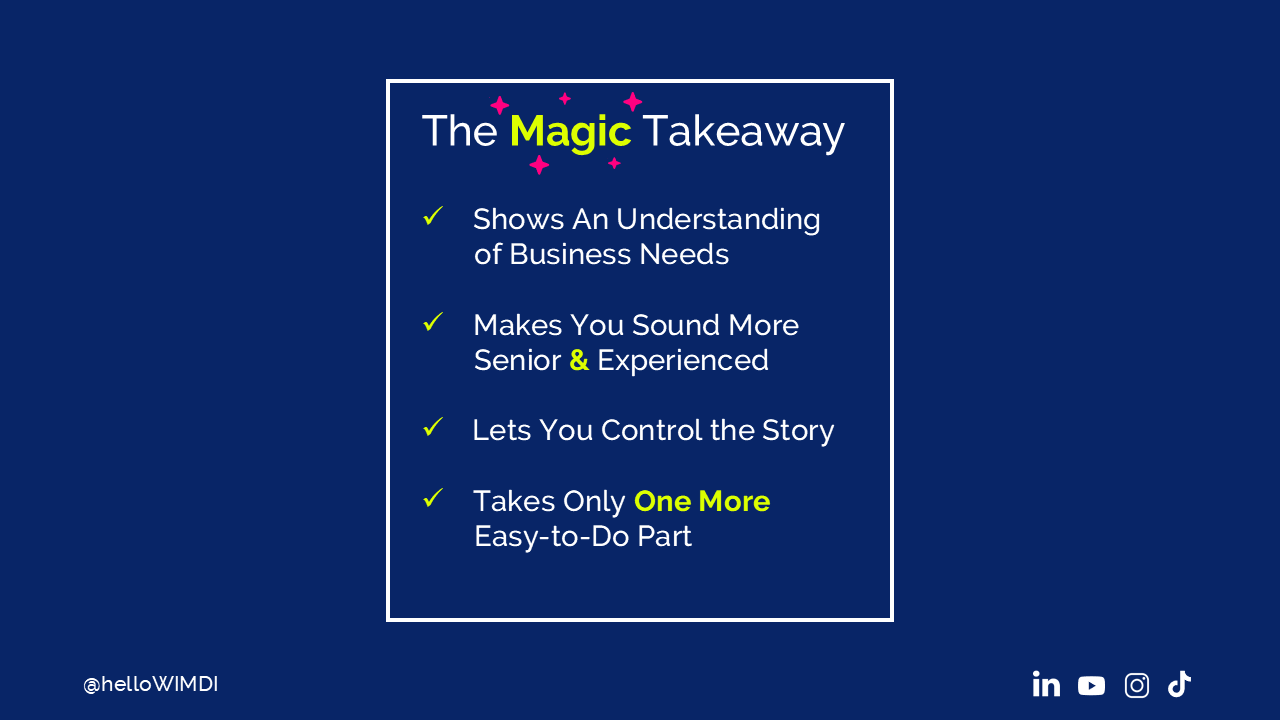
Number one, it's going to help you show off an understanding of the business needs. It's going to help you show why we're doing this, what it does for the company, why is this thing important that I'm talking about. I made a million bucks, so what?
It's going to make you sound more senior and more experienced because we'll get out of that super task focus. It's going to let you have a little more control over the story. You're not going to have to rely on how the person listening interprets your skillset. You're going to be able to tell them directly.
It takes only one more easy to do part, that even if you're in a full panic in the middle of your interview and you've already gone through your little star format that you're used to doing, and you're going, "Oh my God, I forgot. "I have to do one more thing."
You can just tag it on the end. Even in a full panic, you could just tag on, one or two more sentences and you'll be there.
How to Craft the Takeaway
How do we create this mysterious takeaway that I'm now telling you will transform your entire life and make everything so good?
The keys to that takeaway are the business context in which you made these decisions and the key skills that you were deploying in doing it. These are the two things that I want you to share with these people in describing, hey, this is what I want you to take away from the story. This is the important thing.
This is sort of a way of shining a spotlight and saying, here's what matters, focus on this. We want them to be able to focus on this business context and these key skills.
Let's do an example so you all can see what this looks like in real life.
Example Job #1: Using the START Method
We have the same job as we had before. Exact same key skills, collaborative marketer who can un-silo marketing and integrate with sales and customer success to drive lead gen. Those are the big goals.
We start with the exact same question as we had before, "Tell me about a successful marketing initiative you started in the last year."
But this time, we're excited because we know we've got our magic takeaway in our back pocket as our secret weapon.
We start exactly the same way. We talk about, we went to this conference, I needed to increase the leads, I got all the reps to call all their clients, they filled up their calendars, boom, we made a tonne of money, a million dollars.
Tell the story exactly as we told it before, exact same content, plus this time, we add on our magic takeaway. And we give the business context. We say,
"Okay, let me give you some context for the projects. One of my main initiatives was to increase collaboration and reduce the longstanding silos between marketing and sales.
So, it was important for me to establish some quick revenue generating wins with the sales team in the first six months in the role, so I could build our relationship as strategic partners for them."
That's the business context. That's why we're up to this, because we're smart. We've gone, ooh, I want to partner with the sales team. I want them to have some wins. And here's how I plan to do it.
They can already see we're strategic masterminds. And then we say,
"I'm a highly collaborative marketer who likes to build win-win-win campaigns with teams across the org, but especially the sales and customer-focused sides of the business."
So here, just in case they missed it, I just throw in all the keywords they want. I'm really collaborative. I like to work across the org. No more silos.
I love to work with sales and customer-focused teams. Just like you want, guys, what a coincidence. It's almost like you told me in the job description and then I just displayed them here for you.
What did you learn about me from that answer? Now that we've got that magic takeaway added onto the end. What do you know now?
[Holly reads out responses from the chat]
"I can fully circle around and understand the question, I read the job description, read the summary for their notes."
H - Yeah, they'll hardly need AI in this interview, right?
Now Daryl says "she knows I have exactly what I'm looking for so much better than the nothing she got out of my previous answer."
Rhonda says "I'm collaborative",
H - Exactly.
They're way more easily able to see that, yes, this is the person who is the answer to my prayers, I should hire them. And all of a sudden, when you add in this magic takeaway, people start asking questions, "Hey, can you start yesterday? I've got a project, you're busy, what are you doing this afternoon? Could we sign this contract and get you going?"
Why the Takeaway is Actually Magic
Amazing, it's exactly what we want out of a job interview. This magic takeaway does all this great stuff for you, and it really is magic. It does so much in just a few little sentences.
Add it on to the end, even if you forget halfway through. And the thing I really want to emphasise for you all now is this third bullet point here about how it lets you control the story because I actually think this is my favourite part of this little magic takeaway.
Because it's this little bolt on piece at the end that allows you to say whatever you want. You can make them focus on anything you want at the end. This will allow us to take this single story and turn it into anything we need.
I mean, not anything, right? You're not going to tell a story about babysitting puppies and suddenly that's how you built amazon.com
But in general, it'll let us take a single story and redeploy it for a whole bunch of different needs and situations that we might find throughout our interviewing history.
It's very unlikely that every single job we interview for is going to want the exact same set of skills, but we only have so many great accomplishments we've done so far in our career. So, we're going to have to repurpose them, and this takeaway is going to help us do that.
Let's do some examples so you can really see what I mean at work, because it can be a bit hard to wrap your head around without seeing it in action.
Example Job #2: Using the START Method + Magic 🧙🏻♂️
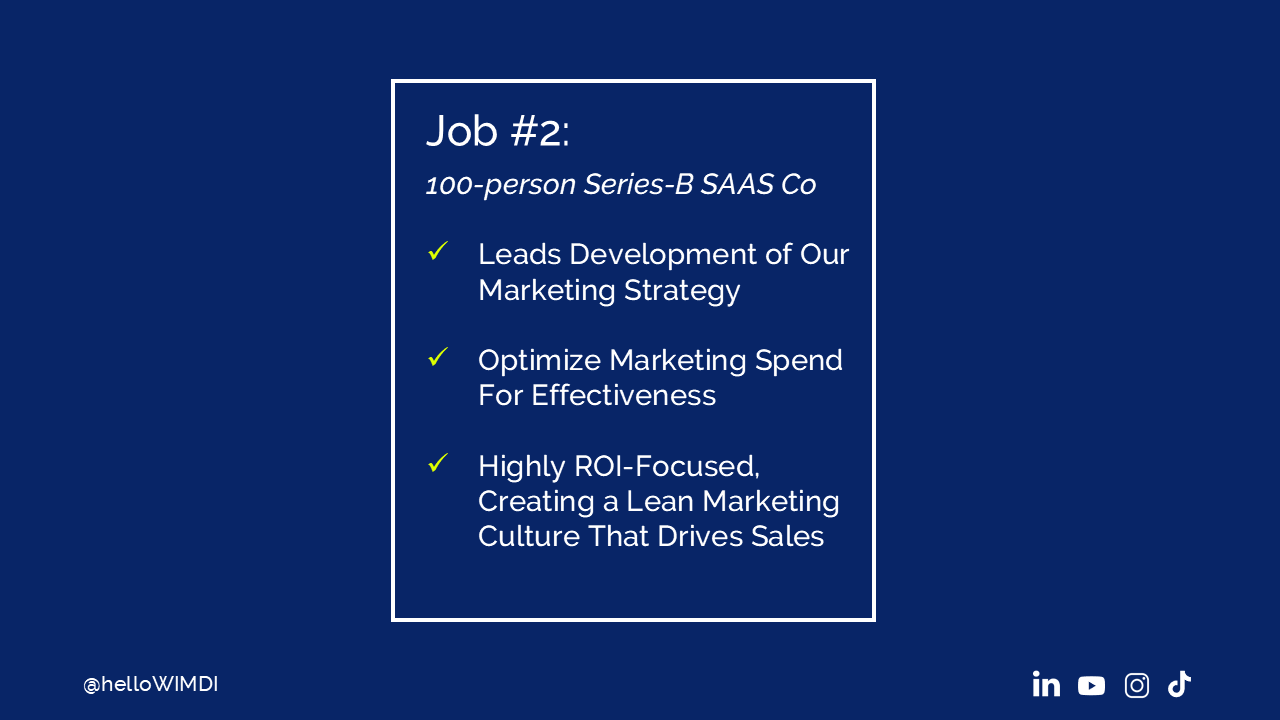
Here's a second job. This one is very different, still in marketing, but it's for a much smaller company. Only 100 people work here. They're series B, so they're a startup. This is also a software as a service company, so we're working in the tech sector still.
Let's see what these folks want in a marketer. Here they want somebody who can lead development of the marketing strategy. Okay, that makes sense, they're a small company. They probably don't really have one yet. They probably just been flying by the seat of their pants.
Then they want somebody who can optimise marketing spend for effectiveness. Okay, so they really want to make sure the money they're spending is getting them results.
And they want somebody who's highly ROI-focused, for folks who don't know that's return on investment, highly ROI-focused, creating a lean marketing culture that drives sales.
Same question as before, what are the key skills that they're looking for based on this job description?
[Holly reads responses from the chat]
Kelly says, "Leadership, critical thinking, "strategic initiatives."
Rhonda says, "Very budget aware."
H - I agree. Two-thirds of this is about money.
"Focused on serving sales with leads in the funnel",
H - yep.
"Focused on money and efficiency, business focus, strategic mindset, cost effective while trying to reach a new market",
H - potentially, yeah, yeah. You are all on the right page.
The way that I'd phrase this is I'd say they want a highly strategic marketer who uses every limited dollar of budget effectively. Basically, the same thing you all are saying.
How would we craft our magic takeaway here to show off those key skills and talk about the business context for the exact same story.
The one where we went to the conference, got all the sales people to get in contact with all their clients, they got all these meetings, and we made a million bucks. How do I turn this into a story that will show off how I'm strategic and cost-effective in acquiring leads?
Here's what that magic takeaway could look like. I would finish telling them about a million bucks, and then I would say,
"Hey, now one of the most important things I focus on during scale-up growth is maximising our revenue per marketing dollar spent. Our biggest low-hanging fruit in the budget was this trade show. It was one of our most expensive line items, so it was important for me to optimise our lead output from the show."
Okay, so we can see the strategy and why I'm doing this. Then I would say,
"I'm always building my strategy to squeeze a little bit extra out of the dollars in my budget so I can grow revenue without endlessly expanding our costs on new initiatives."
And wouldn't you know it, when we start to have an answer like that, suddenly they're offering you a billion-dollar salary and you're going, "Guys I thought you were all concerned about cost this is really flattering you must really think I'm going to add some value to the business here. Okay, I'll sign on the dotted line, I'm in."
Example Job #3: Using the START Method + Magic 🧙🏻
Let's do one more just to drive this home because I really want you all to see how this magic takeaway can be the sort of bolt-on that completely changes the context of the answer that you're giving in these interviews.
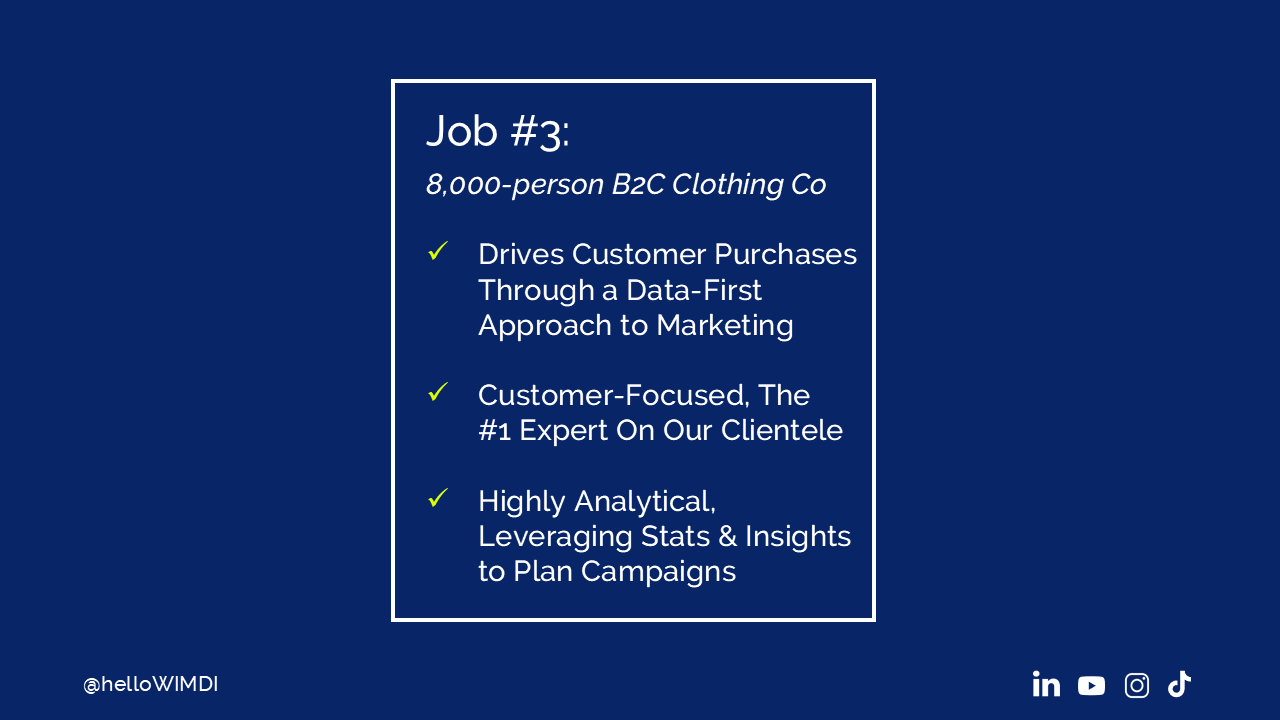
This is yet another marketing job, but this time for an 8,000-person clothing company that sells directly to consumers. They're not selling to businesses like these tech companies we've been talking about. They sell their clothing to consumers. It’s a little bit different.
What are they looking for? So, they're looking for somebody who can drive customer purchases through a data-first approach to marketing.
That makes sense. They're a big company with 8,000 people. They probably get a lot of data if they're selling this online about what their customers are doing.
Then they want somebody who's customer-focused, who's the number one expert on their clientele. And they want someone who's highly analytical, leveraging stats and insights to plan campaigns.
Same question as before, friends, what do we think these key skills look like for this particular job posting?
[Holly reads responses from the chat]
Mia says, "Data literate,"
H - for sure. For sure, for sure.
"Customer-centric, analytical skills, data-driven,"
H - says Kelly. Yeah, I agree.
Supreet says, "Business intelligence and a strategic mindset using a data-driven approach."
H - Yeah, I think you might've stolen my next slide. That's right on, I'd say.
Susan says, "Sounds like Shopify."
H - I don't know if it is Shopify, Susan. I made it up. (laughs) But that's interesting.
So let me show you what I think it is. Basically, I think they want a data nerd. A marketing data nerd who tracks and uses customer metrics to optimise campaign impact. That's what they're looking for. Data, data, data, data. Every single bullet point there was about use data to make us money, pretty clear.
What's our magic takeaway now? How do we finish that story about this conference and make it sound like we know all about data?
We tell them we made a million dollars, and then we say,
"Now, that revenue increase is impressive, but it wasn't a surprise. It was a result of my strategy. I prioritised this project because my data showed that face-to-face interactions increase our sales team's win rate by 10% versus email campaigns, which have a smaller impact and a longer lead time.
So, I knew I'd create more revenue by getting the sales team in front of the clients than if I spent that same time writing yet another email campaign ahead of the show. This data-first approach is key for me.
I'm always looking to leverage what we already know about our customers into new revenue."
Pretty good, sounds just like what they want. Bunch of data, we get a bunch of money. And surprise, surprise, they agree.
They say, wow, you do sound like an ultra-hireable genius. So interesting that they used exactly the language that we used in the title of this talk, but coincidences, I guess.
And they say, "You know what? I'll tell HR to write up the contract. Let's get you on board."
So, hooray, we did it. The magic takeaway works again. Yay, friends, I'm so excited. (chuckles) I get entirely too much glee out of these made-up scenarios where people just hire people because I've said so, because I put it on the slides.
But this really will happen to you, I think. I've seen it happen enough with my clients, but I feel pretty confident.
Summary: The Steps You Should Take to Nail Your Job Interview
Let's recap everything that we need to do to nail our job interview and have people think that we are ultra-hireable geniuses.
We're going to start by channelling our bestie Vanilla Ice, our two-part situation. "If we got a problem, yo, I'll solve it."
We're going to figure out what they need and what they're looking for, and then we're going to tell them how we can solve it. That's the whole thing we're up to in this interview. What do you need? How do I show you I've got it?
Then we're going to get out our little detective outfit and take a look at the job description and try to identify those key skills that we think they really need in this next hire. What are the most important things they're looking for so we can say we have them.
Then we're going to augment our boring old, tired STAR method with our magic takeaway, so that we have a little more control over the story. And we're going to do that by giving business context and key skills.
That's what that magic takeaway is made of. First, the business context, why we're doing this, why we're thinking about this, what our strategy is, and then the key skills that we showed off, so they can see, yes, she's got everything I want. These are all the amazing things about the Magic Takeaway.
I really hope that you all will have some success trying this out. I think you're going to have a lot of fun playing around with it. Once you get good at this, you can turn a story into everything. And it's a really fun skill to have.
I think there's really only one way for me to end this talk, and that is with yet another Vanilla Ice quote. "Yo, man, let's get out of here. Word to your mother." My favourite Vanilla Ice line of all time.
If you want some help from me on doing all of this you can ask me questions about it or hell, just hire me. I'll teach you exactly how to do this and we can practise live in the room so you get super good at doing this and you can impress the pants off of all your future interviewers.
Friends, have a lovely day.
More Fun Stuff!
If you loved reading this transcript, you might like to watch the video or learn more about our amazing speaker! Check it out: