How to Lead Change (Without Inspiring a Mutiny!) –…
transcript
Transcript
How to Lead Change (Without Inspiring a Mutiny!)
Here to read instead of watch? Click through the headings to a section of the full transcript, or scroll away!
- Meet Amina – A Case Study for Implementing Change
- Negative Comments You Might Hear Before Implementing Change
- The 4-Part Process for Making Change
- Part One: Awareness
- Awareness: The To-Do List
- Awareness: Potential Concerns & How to Mitigate Them (with Examples!)
- Awareness: What Should Be Communicated and To Who?
- Awareness Checkpoint: Are You Ready to Move Onto the Next Phase?
- Part Two: Design
- Design: The To-Do List
- Design: Potential Concerns & How to Mitigate Them (with Examples!)
- Design: What Should Be Communicated and To Who?
- Design Checkpoint: Are You Ready to Move Onto the Next Phase?
- Part Three: Detailed Planning
- Detailed Planning: The To-Do List
- Detailed Planning: Potential Concerns & How to Mitigate Them (with Examples!)
- Detailed Planning: What Should Be Communicated and To Who?
- Detailed Planning Checkpoint: Are You Ready to Move Onto the Next Phase?
- Part Four: Execution
- Execution: The To-Do List
- Execution: Potential Concerns & How to Mitigate Them (with Examples!)
- Execution: What Should Be Communicated and To Who?
- Execution Checkpoint: Reflection and Reporting
- Summary & Key Takeaways
(Edited for length and clarity) Welcome, everyone. So, our topic today, as Holly has said, is How to Lead Change Without Inspiring a Mutiny.
So, before we begin, let's take a moment, I'd like to also acknowledge the traditional territories of indigenous peoples and their commitment to stewardship of the land.
We acknowledge the communities in circle, the North, West, South, and Eastern directions, and the Haudenosaunee, Huron-Wendat, Anishinaabeg, Seneca, Chippewa, and the current treaty holders of the Mississaugas of the Credit peoples.
We share responsibility with the caretakers of this land to ensure the dish is never empty and to restore relationships that are based on peace, friendship, and trust. We are committed to reconciliation, partnership, and enhanced understanding.
I'm Amy Au, Founder and Executive Coach of Innovate You. I'm an ICF-certified coach and Fascinate Certified Advisor who really is inspiring transformation.
My passion is to empower women leaders in STEM to uncover their unique values to stand out, reach their potential without hesitation, gain clarity and focus to take confident actions and turn their aspirations to accomplishments through positive change and transformative coaching.
My clients gain confidence to pursue what aligns to their values and purpose. They become better at communicating their strategies, make better decisions, establish their thought leadership voice, and lead their teams with empathy and authenticity.
So, here's a fun fact I'd like to share, I became an international bestselling author a few days ago as my book was launched on Tuesday, called the "Evolution of Leadership in STEM".
Meet Amina – A Case Study for Implementing Change
Let's take a look and walk into Amina's world in the next 45 minutes. Amina is the Director of Operations at a web design agency.
Her company sells website development services to other businesses, and she is responsible for three departments; the service department, which are the engineers and designers, the sales finance, and also the sales team.
Lately, Amina has been under fire and her boss has been yelling at her. The problem is they are 20% over budget already, but it's not even the end of year yet.
In Q1 and Q2, they did not meet the revenue target and even though the sales team has been really busy selling. Amina realises that they have not been delivering fast enough and not recognising the revenue fast enough either.
She wonders what's going on. So, she digs a little bit deeper, and finds that the sales cycle is way too long, and the revenue recognition is way too slow.
When she looks to where the problem lies, she sees that the team is very slow in issuing quotes, invoicing, and fulfilling the orders. Sometimes there are delayed payments or missed payments that they didn't even know about until months later.
With the current process, Amina has described as the sales issues, the proposals are primarily provided using PowerPoint. They create the quotes in PDFs and then send it via email to the accounting team with the contract once it is signed.
But then the accounting team has to upload it into their system, whatever that system is. They manually create a PO and then email it to the customer.
Now, once that is sent out, a manual follow up is still required. It’s slow, and also sometimes they forget.
The sales team also sometimes forget to send it over to the service team so they can start doing the work. So, there are many delays and errors in the process. Do you feel that headache that Amina is having right now?
And then, sometimes the sales team quote custom packages not even on the system. It's just like if you go to the grocery store, and try to get organic bananas, there’s nothing on the checkout screen that's organic, so you just choose bananas, right?
So, what happens? They scan through and choose something close, but the price is different, and the company has lost money.
What would you do if you're Amina? Let's change it.
Negative Comments You Might Hear Before Implementing Change
But before you know it, everyone's up in arms about this. What? What's going on? Why do people want to mutiny over this?
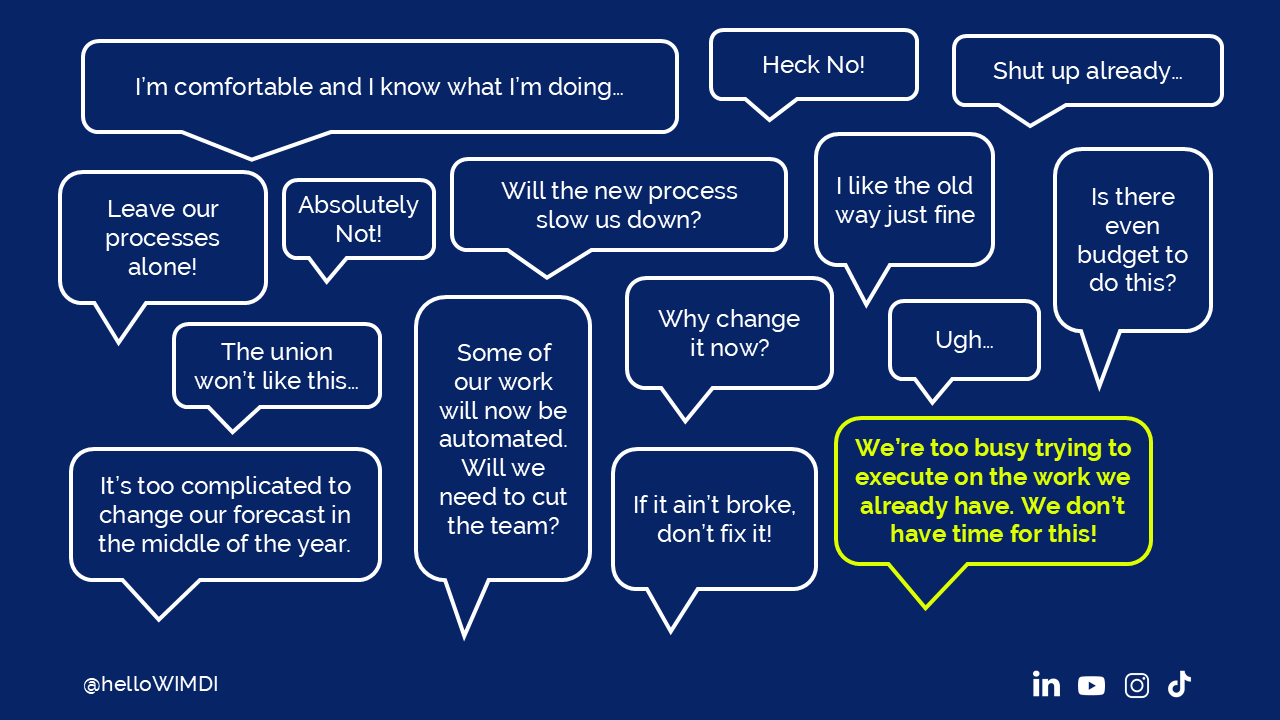
Well, Amina heard the rumbling and talk among the teams that says,
"Leave our process alone!"
"I'm totally comfortable with what I'm doing now."
"I know what I'm doing. Don't change it."
"It'll be too complicated to change our forecasting midyear. How will we explain this to our shareholders and management?"
"Will the new process slow us down?"
"Well, some of this will now be automated. Will that mean we need to cut the size of our team? Could that be me?"
"Is there even a budget to do this project?"
"We’re way too busy to try to execute work we already have and we don't have time for this project."
So, Amina is facing challenges across all her teams, but she does know the incentives for making this change are pretty high. She has done some really high-level estimates and believes that there will be a 30% improvement in revenue.
Not only that, but she will hit the budget, won't get yelled at by the boss, and keep up with the industry trends. That will keep the company competitive, the team members’ skills and resumes will be up to date and maybe, maybe they’ll get a bonus.
So, Amina asks, "How do we do this? How can I make a change?"
The 4-Part Process for Making Change
There's a four-part process that Amina can leverage for making change. That four-part process includes awareness, design, planning, and execution.
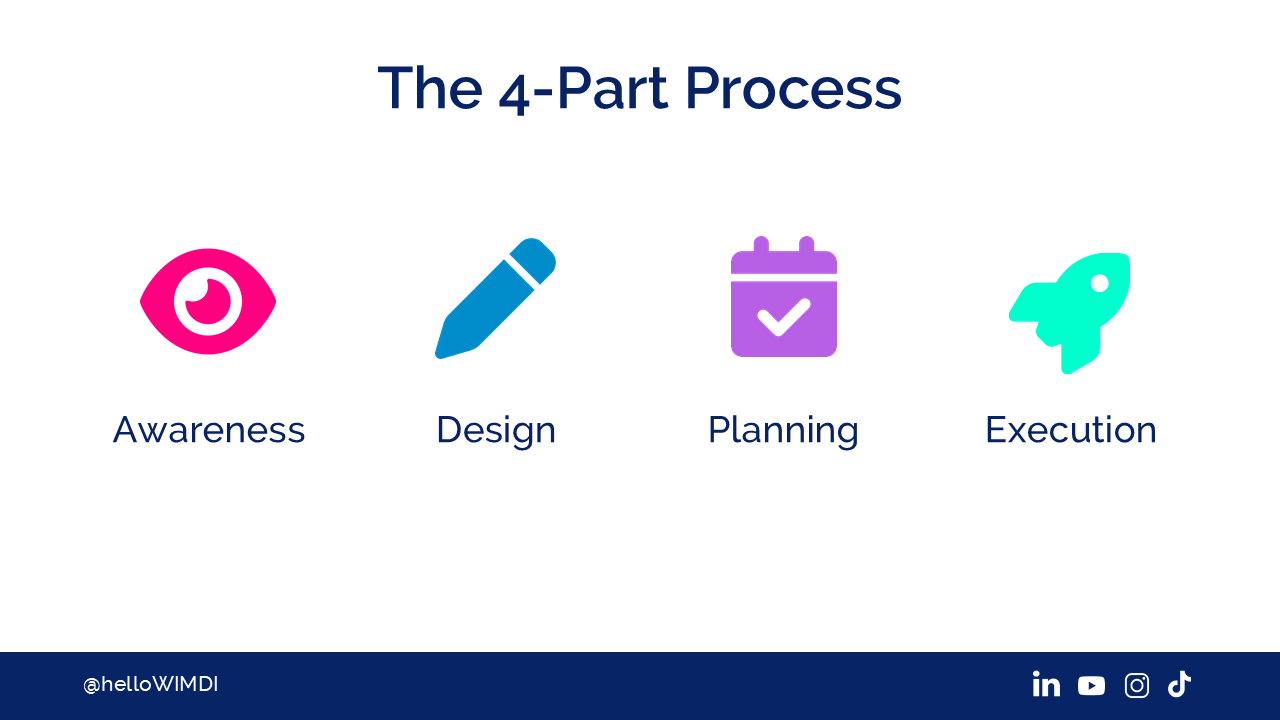
For each of these phases that we're going to talk about are the key things that Amina would need to manage in order to be successful.
That will include the to-do list, the major challenges for communications, the checkpoints, and how you would know you are ready to move on to the next phase.
Part One: Awareness
With the awareness, it's two-fold. Awareness of the problem for the change leader, and then also the awareness of the problem for all the other leaders as well.
It's about building the early stage buy-in. And why is this phase so important? You can only get buy-in to fix a problem if people know what the problem is.
The earlier they know, the more time you have to get them involved and help them understand what's at stake for them. Not just the technical details of what the change is, what the solution is, but also identifying what is really in scope and also out of scope as part of the change.
You might think that the prerequisite for getting that awareness is that you need to know what's not working, right? Figuring out what the problem is for yourself.
Amina needs to understand the current sales process, where the process is too slow, too complex, too manual, and the errors between each step.
Awareness: The To-Do List
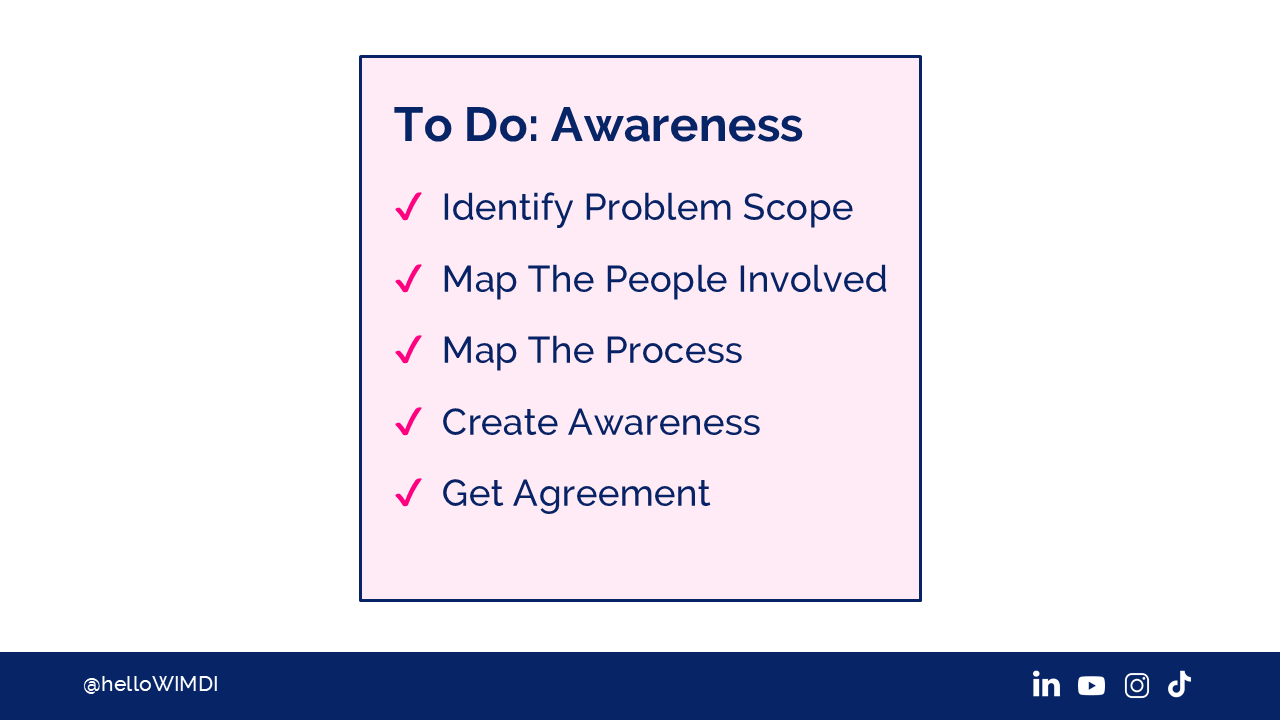
Let's look at Amina's to-do list for this first phase, the awareness phase.
First of all is to identify the scope of the problem. What is the root cause? So, as we said, she digs deeper and then realises each step of the process has its own problem.
What is the magnitude of the problem, how much does it affect the processes and the people on the team?
Second is to map out the departments and the people involved. So, who is actually involved within each process that would be contributing to or having the impact on the problem.
You also have to map the process. So, Amina has to know what part of it is efficient, which might not need to change, but what part is actually redundant or inefficient.
Also, it could create negative effects within the whole process . And, make others aware of the problem too. Identify who those stakeholders are. Whether it's HR, finance, IT, maybe tax department as well.
Then she’ll need to communicate the risk of the problem to all of the people it affects, and why this is a necessary process change. So it's not just one person or department who feels that they have to change, but also all the other teams that might get impacted by the process and by the change itself.
Finally, Amina needs to get agreement this there has to be a change.
Amina just has to take this to-do list, get the check marks done, and then that will be all good?
Not really. Amina also has to face any concerns that need to be addressed very quickly.
Awareness: Potential Concerns & How to Mitigate Them (with Examples!)
There are two of them in this phase.
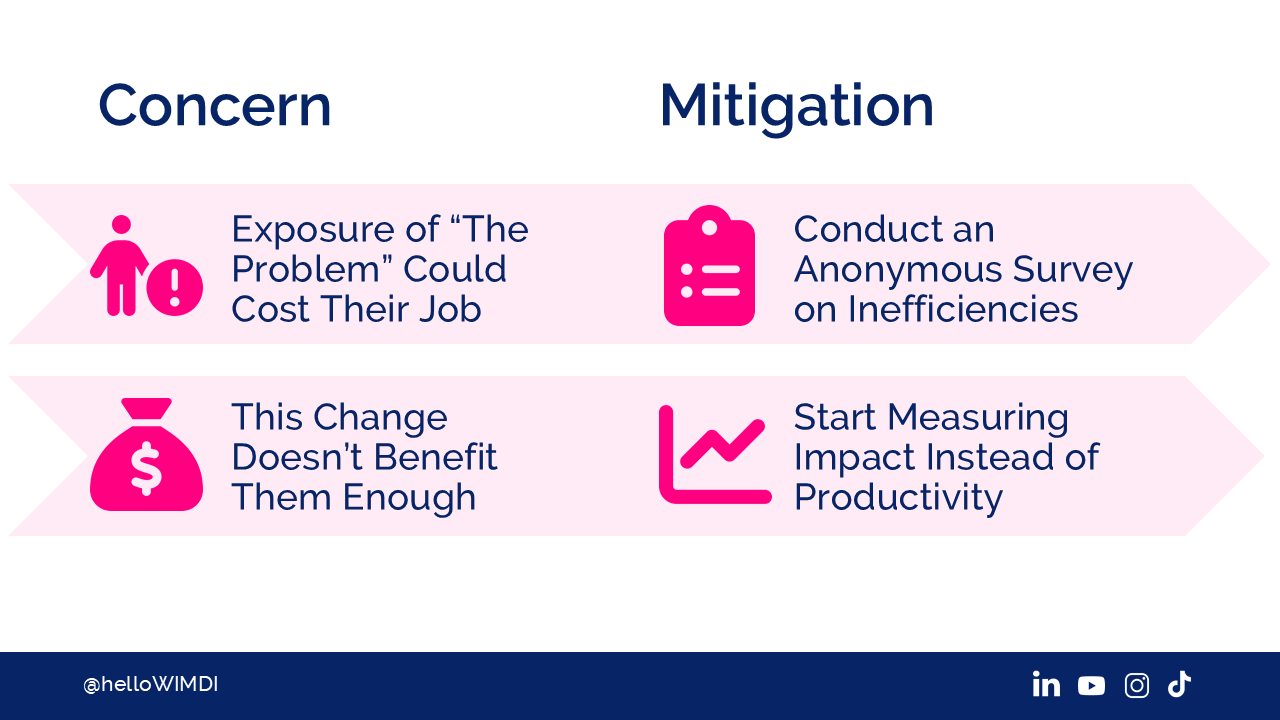
People could cause a change to fail even if they're aware of the problems. The first might be the operations managers who are part of the process. Even though they are aware of issues, some of them could be keeping it under the radar, because they are afraid that if it’s exposed, their jobs could be at risk.
And that's probably the reason why Amina hasn’t noticed until the budgets been over and they're not delivering as much over the year.
So, what does that really mean? Is it the operations managers don't want to be exposed? It's that they were saying well, it's hard to find time on the calendar to investigate exactly what that issue is.
They might not tell you the truth or share it in full detail. And if you ask them a question, they might give you a very short answer.
They might say, "Well, it's compliance issues that we have to do it this way. The process has to be done that way, blah, blah, blah."
But you know that, deep in your heart that’s not the real reason. It's nonsense. How do you mitigate that?
You could conduct anonymous surveys so people feel safe to share what's actually going on, what's not working well in the process. Or, you can have an open forum.
Give time and space for people to talk about what suggestions they have to make improvements. If you open that forum, there might be an understanding of what's not working well today and stay in that mindset of continuous improvement.
Number two, this other concern is either that the change that doesn't benefit them, or benefit them enough. How do you make sure they understand that there's actually good impact?
To mitigate that, you can use some impact measures, instead of just the productivity measures. Highlight the change impact, for example, the percentage of revenue increase.
Like in Amina's case, she estimated that 30% increase. What does that mean for the team? What is the real impact to people?
Awareness: What Should Be Communicated and To Who?
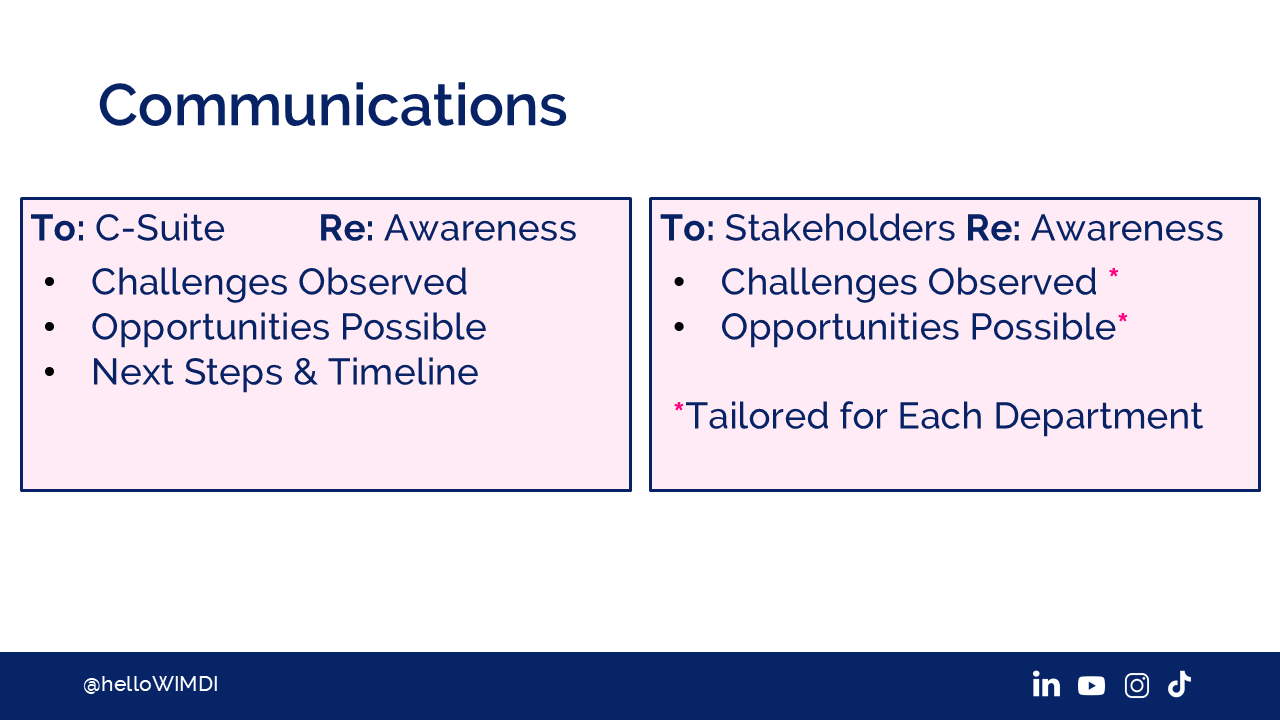
In terms of the communication piece, Amina will have to make sure that at this stage, the C-suite is informed and presented with the problem, how it's going to benefit the organisation to get the buy-in for change.
Amina will need to get them to endorse and get the go ahead. There is a high-level of understanding what the problem is. There's a change that needs to be made and the return on investment is large enough that the C-suite will be on board, so they'll commit to fix it.
Once Amina has that, will it be okay? Not quite.
Amina will have to provide some sort of informal communication to all other stakeholders. So, each department, the department heads might need to know that there is a problem being presented to the C-suite and they're working on getting the commitment to go ahead.
Then, Amina will need to go back to all the different department heads and find people from their teams who can do additional communication.
Once the project gets started, she might need additional support from the different teams. So, it's important at this stage to make sure that other departments are aware that there's potential this project might be going on.
Awareness Checkpoint: Are You Ready to Move Onto the Next Phase?
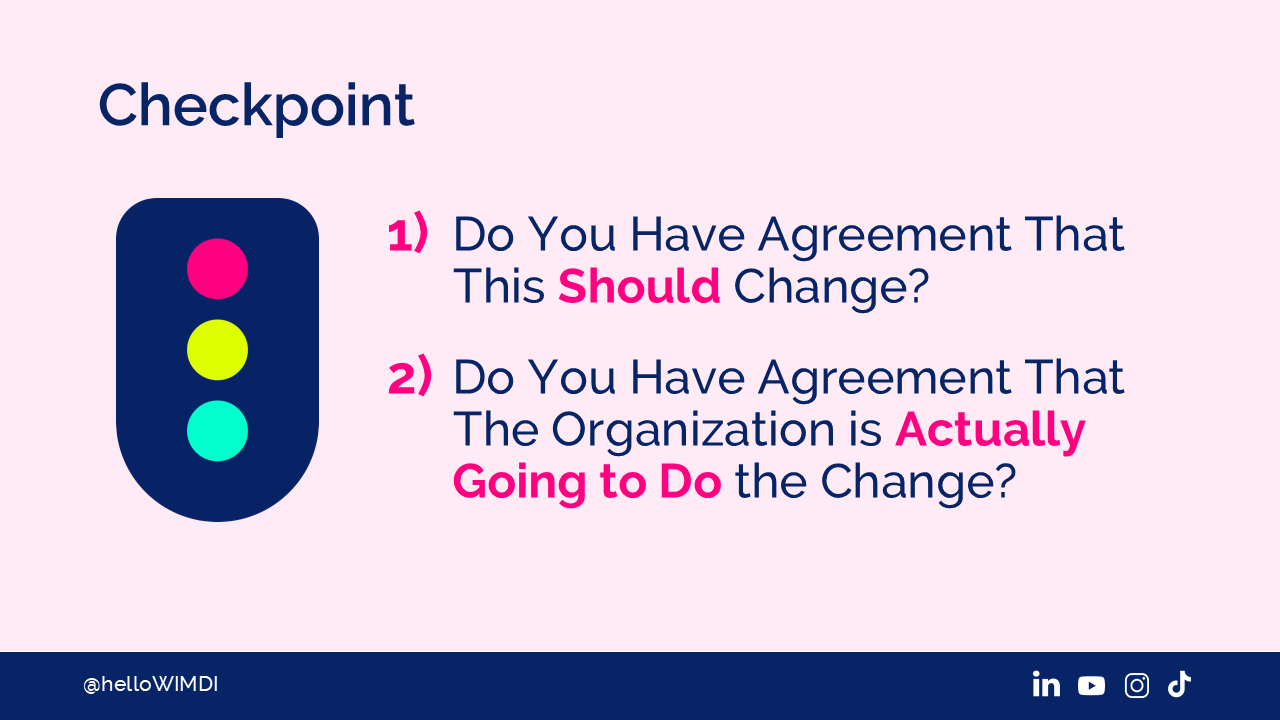
Before moving on to the next stage, Amina needs to make sure that there are two things; agreement from the C-suite that there is a problem, they want it to get it fixed, and from all the stakeholders that the organisation is on board with this change.
If she can get that, then she can move on to the next stage.
Part Two: Design
The second phase is now the design phase. Amina will continue to use this framework that includes the to-do list, the major challenges, her communication plan, and the checkpoints.
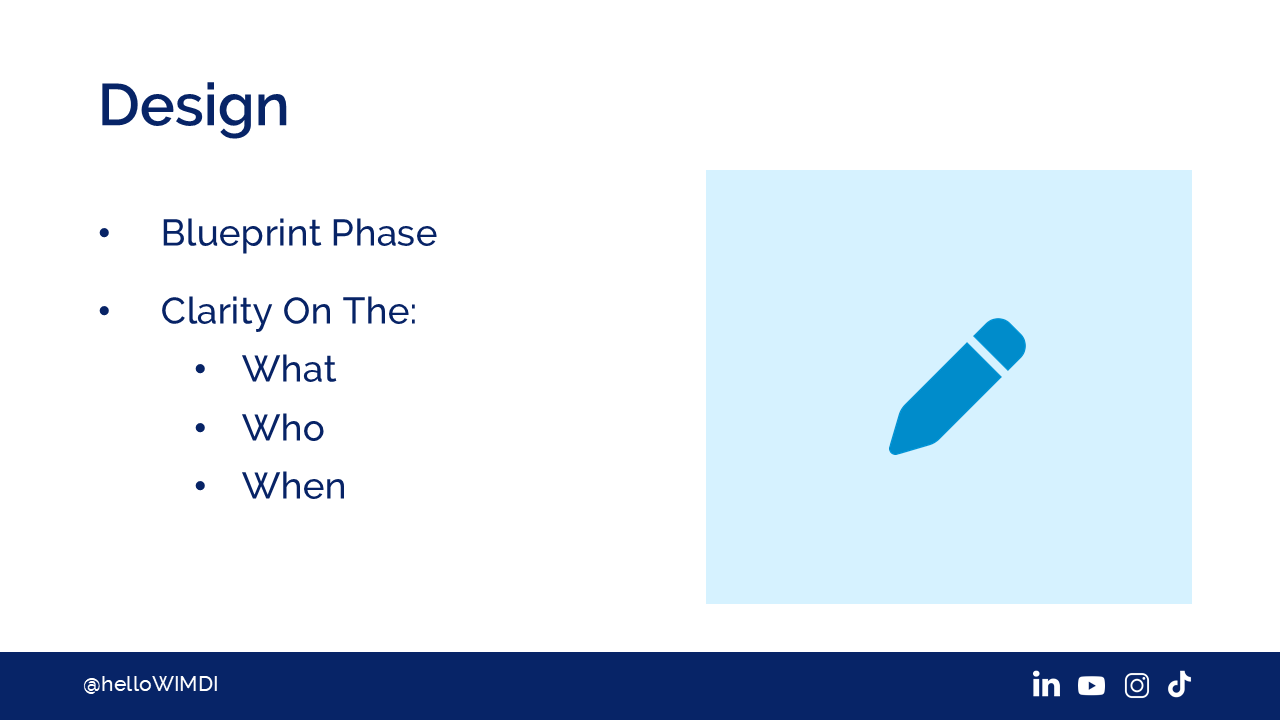
Why is this phase important? So, if you think of the design phase, like the blueprinting phase, just like how when you want to build a house, you need to have a design plan.
Before you do anything, that blueprint is so important. You need to have that clarity on what's in scope. Who are the people involved in making the change and who are the people that will be impacted by the change. They may or may not be the same team.
When are we going to have that change implemented, what’s the timeline. These are the critical pieces for successful change and it needs to happen in the design phase.
Design: The To-Do List
Now, let's take a look at the to-do list that Amina has in this design phase.
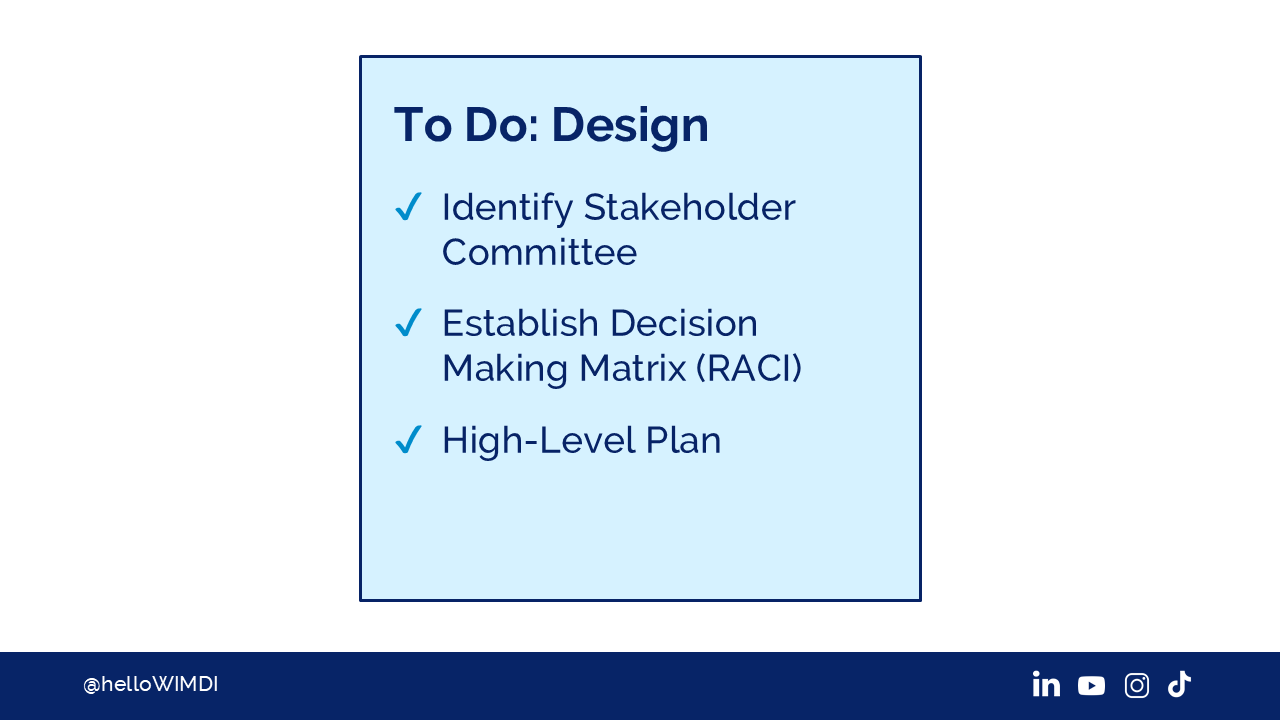
First, identify the committee of stakeholders. For example, it should include finance becuase everything has a cost. Finance needs to understand how it will impact their overall budget for the year, perhaps, if this is happening, or this coming mid-year.
Who else is involved? The sales team? For sure, because they will probably need to automate the invoicing process, and the proposal process. The accounting team. How do they automate that invoice upload process?
How about the sales finance? Now that they can get more data and information, they can do better forecasting. There's a new system that they might need to work on and learn how to use.
How about the legal team? Also, the service team who fulfil the automated orders. They won't have to wait for emails, or if they forget to check the emails, but they will get the system alerts automatically once there's a quote signed by the customer.
Next, Amina will need to establish a decision-making matrix, which is called a RACI. So, R stands for Responsible, A is Accountable, C is Consulted, and I is Informed. This diagram is to help to avoid any misunderstanding, miscommunications, misdemeanours that can throw you off course.
This helps you to define the roles, expectations, and the responsibilities in those processes.
- Who is actually responsible for a specific task or decision-making?
- Who's accountable for that overall project?
- Who should be consulted for input on the task or overall project?
- Who should be informed of the ongoing status of the project?
They should be getting alerts and be aware of the change that is happening, so they can raise any anomalies or unexpected issues when they occur.
The third thing on the to-do list for Amina in this design phase is the scope. The scope of this change needs to be even clearer in the design phase. The stakeholder list should be clear now, who needs to know, who needs to get involved, who needs to be responsible, and so on.
And the overall timeline. When is the change going to happen? Is it going to be over this year? Is it this quarter? Is it going to be next year? How long might it take?
The overall approach, will it be done all in-house or is there a need to hire consultants and have other vendors involved?
The technology piece, what is going to be new that they have to bring in? If there is any change with the infrastructure, who needs to be informed and who needs to be involved in that next phase?
At this point, we should also have a rough cost of making that change or that project happen.
And clarity on what are the major success metrics that we want to use? What are the objectives? What needs to be defined early in this phase? Will they be using OKRs or KPIs?
So, for Amina, she wants to propose adding more automation to the sales, finance and also the services processes, to speed up closing the deals, getting paid, and delivering the services, so that the revenue can increase.
Design: Potential Concerns & How to Mitigate Them (with Examples!)
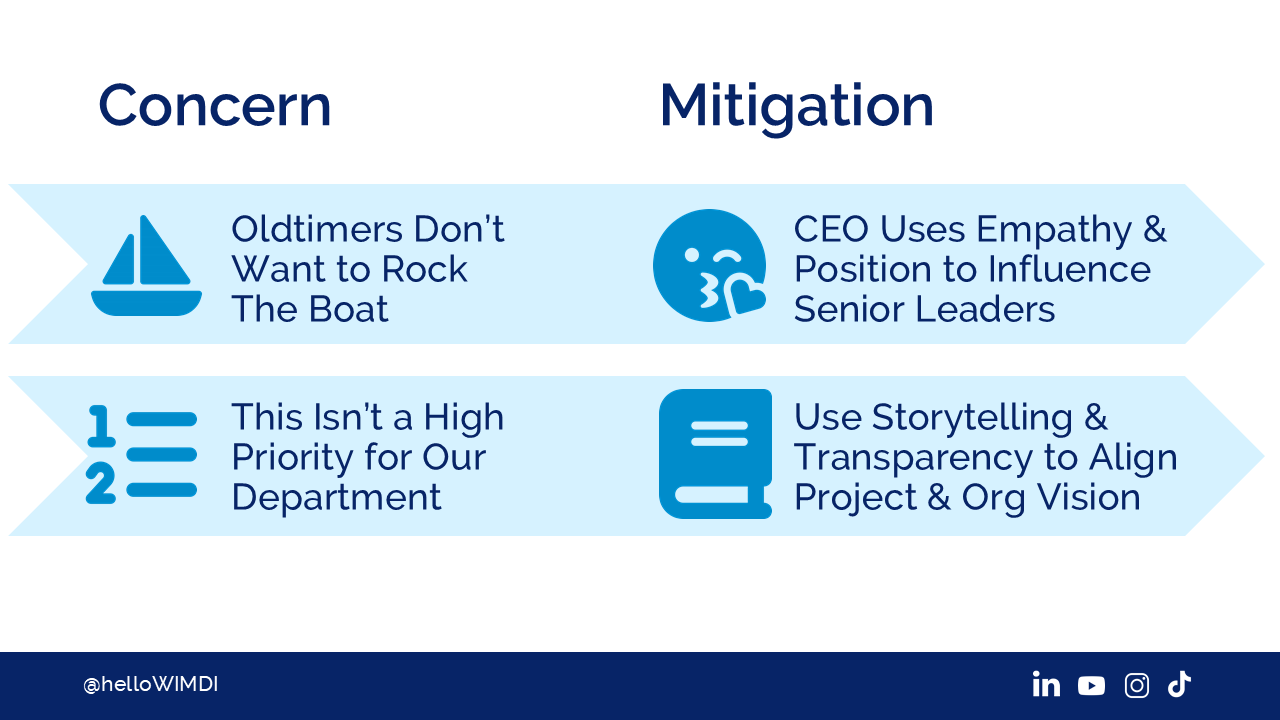
In this phase, there's two major concerns that could cause this change to fail. Number one, people who don't want to rock the boat. Those long-term, long-tenure employees that might be in senior positions that don't want to make any changes, because they're near retirement. How do you mitigate that?
The CEO needs to use empathetic leadership to influence those who don't want to come on board. Really listening to their concerns and provide support on how they can still contribute using their experience during a transition from the old to the new process.
The other concern is this might not be a priority for some departments, the legal team might not think it’s a high priority from their point of view.
Amina needs to use storytelling techniques to align the vision of the organisation and make it relatable to each of the different departments so they can better understand the benefits of this change.
Design: What Should Be Communicated and To Who?
There needs to be open and transparent communication, sharing and allowing feedback from people at every level about their concerns, what they are thinking, what's actually in their mind from the beginning.
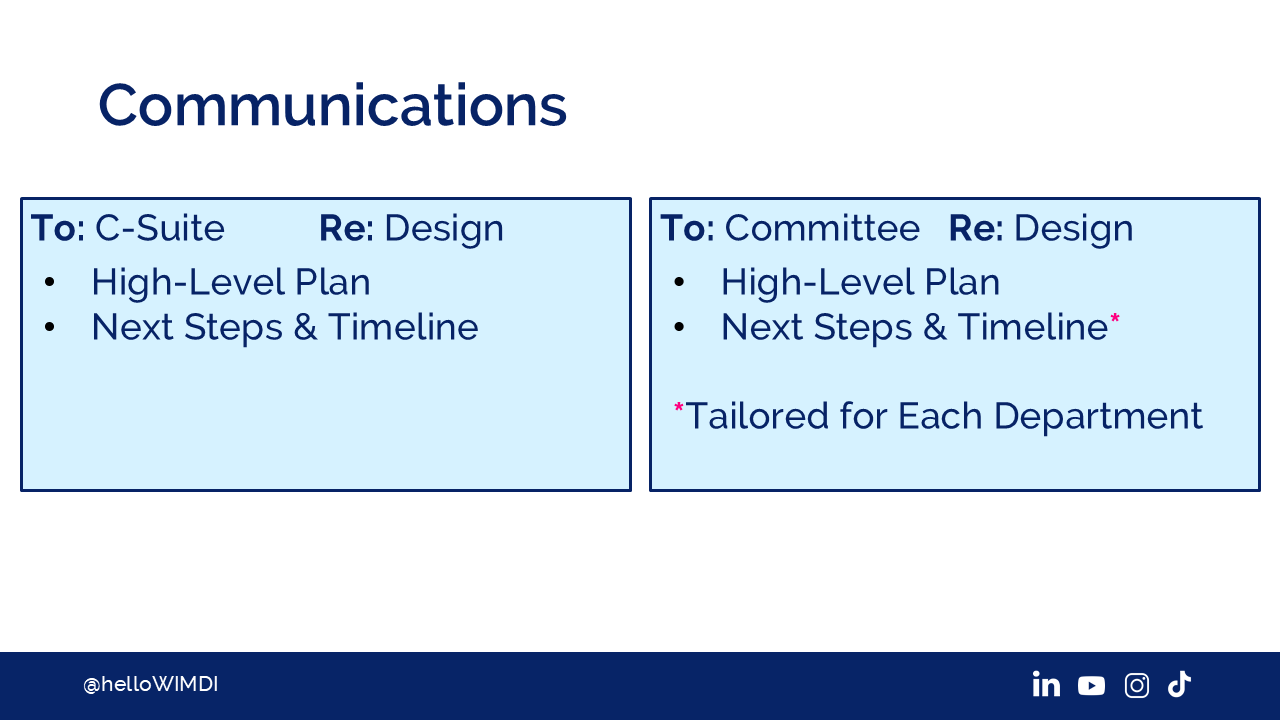
What communication does Amina need in this phase? The entire high-level plan needs to be approved by the C-suite, the timeline and when is the next phase going to happen?
That entire high-level plan, a timeline, and phase changes needs to have a tailored story for each department. Clearly communicate how the changes impact them. They need to have understanding, to get their buy-in to this change.
Design Checkpoint: Are You Ready to Move Onto the Next Phase?
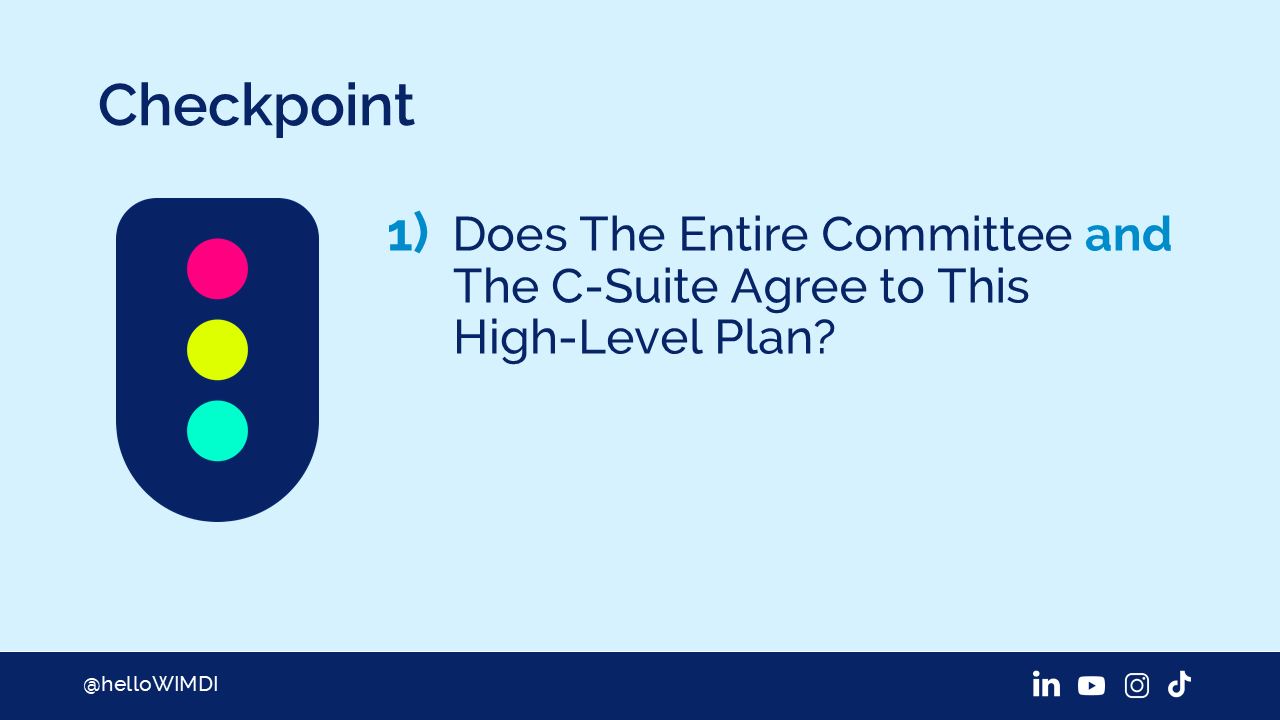
With all that, the checkpoint before Amina can move on to the next phase, ask, does the entire committee, and C-suite, agree to this high-level plan?
At this point, we don't have a lot of detail yet, but at least a high-level timeline, high-level cost, the high-level understanding what's involved should be there and getting commitment from the C-suite and the committee. Now Amina can move on to the next phase.
Part Three: Detailed Planning
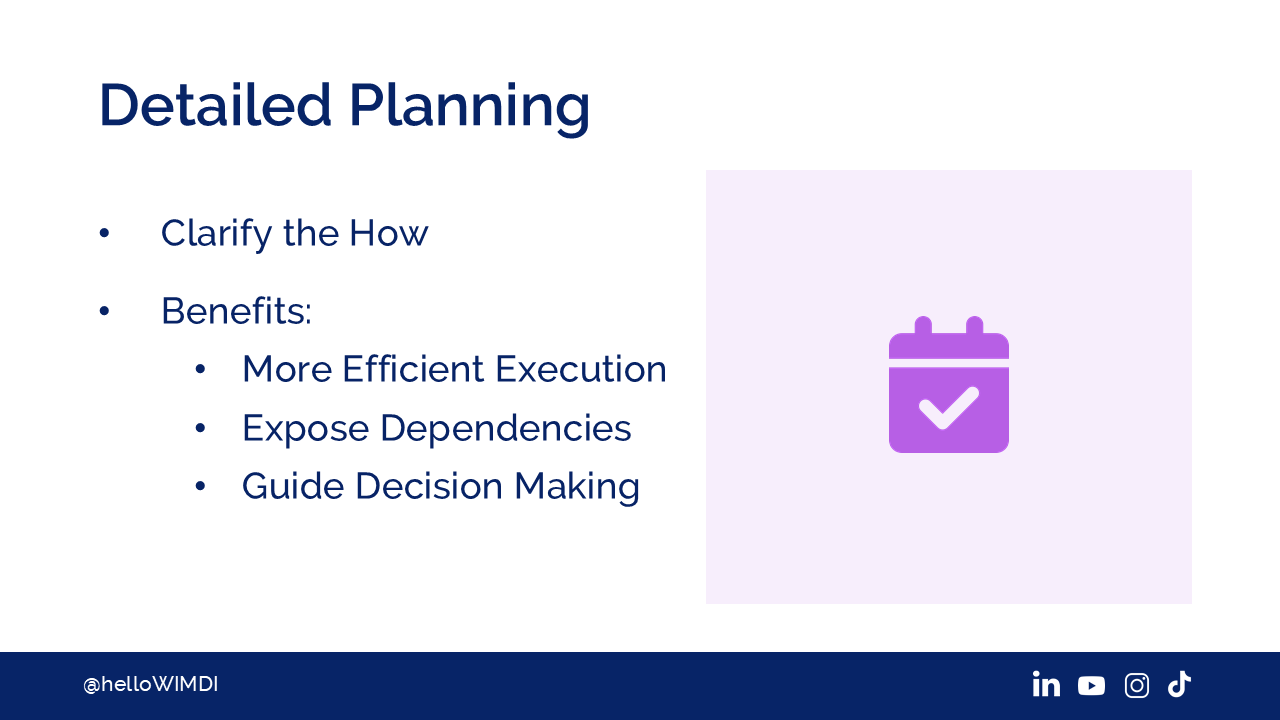
The third phase is the detailed planning. Once we have the high-level plan, we can now go deeper. So, why is this important?
We need that clarity on the "How" now. How will this change be carried out, and how to make the execution process as efficient as possible.
It will also expose the critical dependencies and conflicts early, so we have that mitigation plan to reduce any negative impact on the overall project.
This will be the plan we refer back to during the execution phase, and should a situation arise, will avoid unnecessary arguments and potential projects delays that could impact the cost.
You want to keep control of the cost. You don't want it to skyrocket because of deviations during the execution phase of the plan.
Detailed Planning: The To-Do List
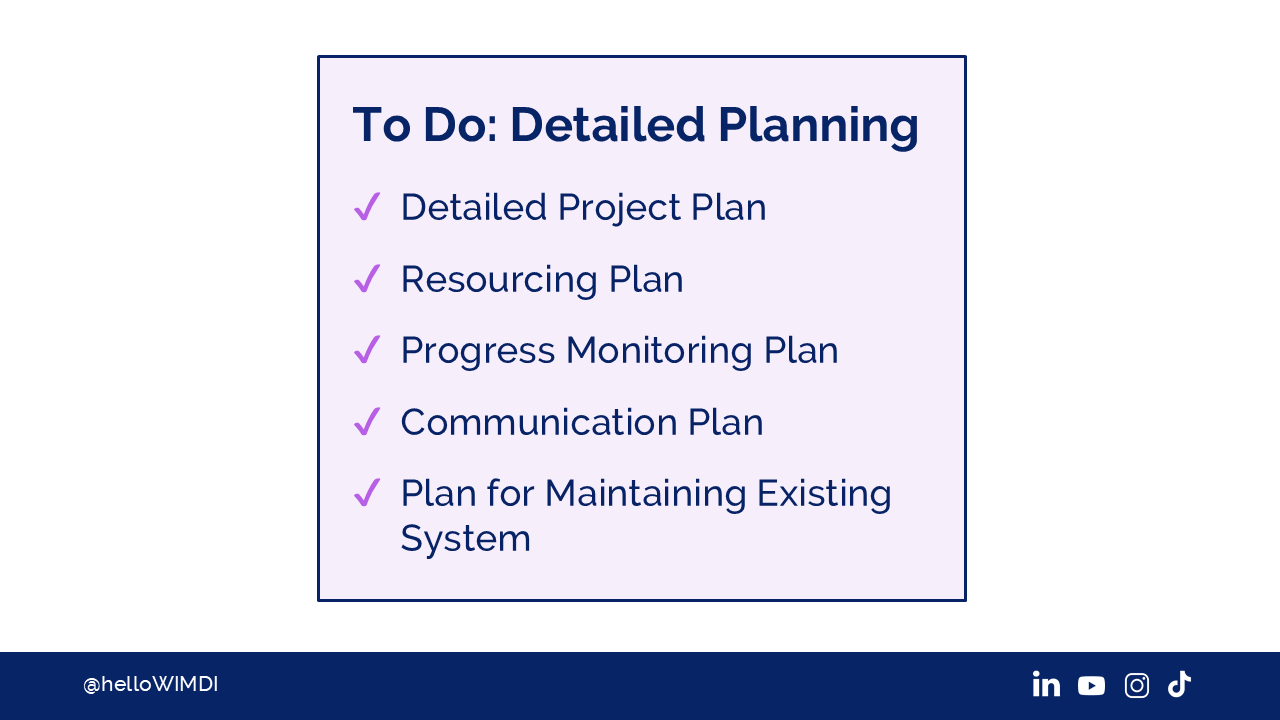
Let's take a look at Amina's to-do list for the detailed planning phase. While planning the timeline, the focus will be two-fold.
First, they still need to keep the lights on because the sales team will continue selling, the delivery team, the service team still need to get the work done, for existing customers. But they need to start carrying out the project to make sure that the change is going to happen.
It's important to consider how to balance the two, are the same people doing both, keeping the lights on and implementing the project? Or, when will people need to get involved on the project precisely, so they can make sure that daily operations are still functional and the projects can move ahead according to the timeline.
In the detailed project plan, there needs to be the scope of the project execution, details of the budget, the timeline; the milestones, the individual steps needed and the success metrics for each of those milestones or phases.
There also needs to be a testing plan and perhaps also a cutover plan. And, there should be a go, and no-go decision at some point.
Amina will also have to look at the resourcing plan.
Identifying the people who are going to be impacted by the change and create a pathway for any people that need to be reskilled or upskilled. Some people may choose to leave the organisation at this time too.
The third thing is the progress monitoring plan. What needs to be monitored is the timeline, the budgets, the people challenges. Amina could use pulse surveys for this monitoring.
Understanding how people are feeling, how are daily operations being impacted, if any, and how they can be involved in driving positive change. Providing the feedback mechanism open and two-way dialogue is encouraged.
In terms of the communication plan, we're now in that detailed phase. Amina will need to know what’s going to be communicated at every stage and how it's going to be communicated.
Will it be by email, the media platform the organisation uses? Or is it by meetings, and will each department host their own meetings (all-hands), or will it be the entire organisation? Who is going to get the information and when? How frequent will it be?
The maintenance of the old system also needs to be part of the plan as they transition over to the new one.
They need to keep the lights on, so that the old system can still be maintained during the process, because there will be phases of implementation. Not everything is going to be switched on all at once. So, how do you make sure that there's a maintenance plan in place?
Detailed Planning: Potential Concerns & How to Mitigate Them (with Examples!)
In this detailed planning phase, there are two concerns that Amina needs to consider, to make sure the change doesn’t fail.
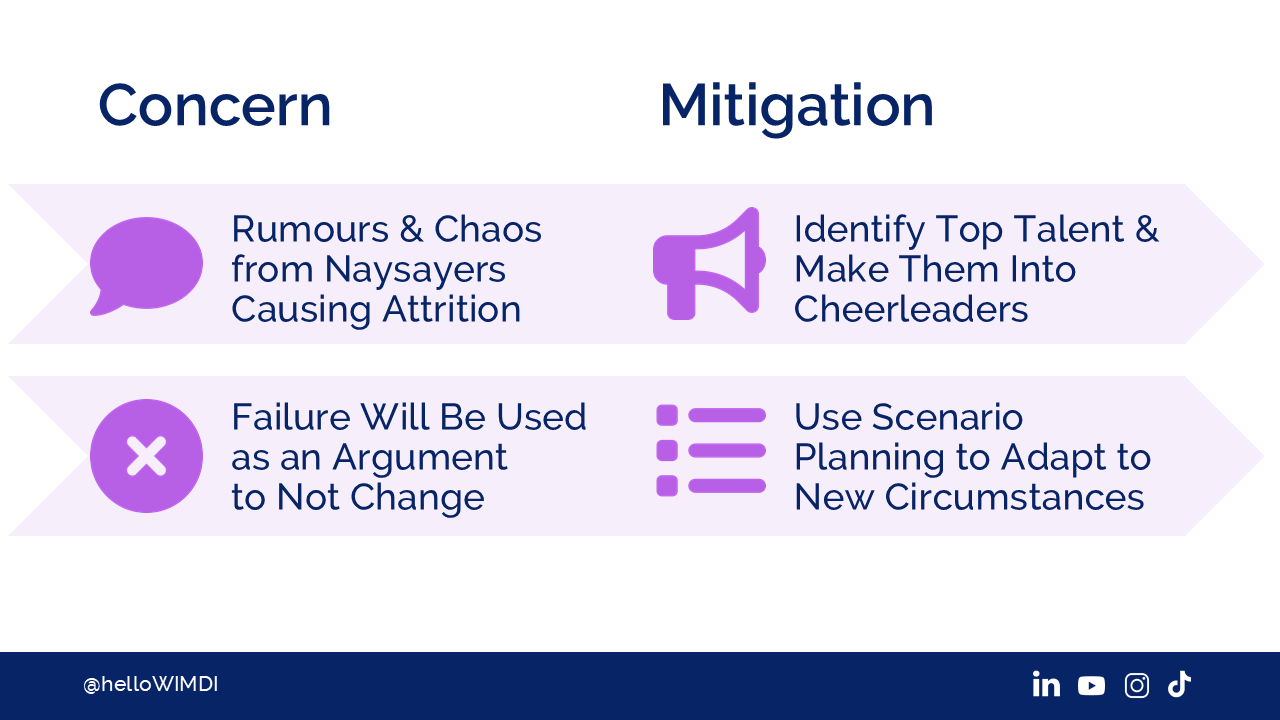
The first is to address rumours and chaos. There will be people wanting to leave the organisation. There’s always going to be naysayers.
We are kidding ourselves if we think that everybody is happy and on board. There might be a few that really don't like the change for whatever reason, and they aren’t necessarily convinced by any of the earlier communications.
They still want to spread rumours that the sky is falling, and everybody should leave. That can really cause an issue for the project to be delayed or even paused.
In order to mitigate that, first, identify early on your top talents at every level so they’re not lost. Amina has done that, and these will be her cheerleaders for the project.
She should ensure they’re getting upskilled or given re-skilling opportunities and make sure that’s done early in the project phase, not waiting until the last minute.
Not everybody will want to stay for the change, and we need to be realistic about that. The attrition rates will probably be a little bit higher than usual and she should be prepared with a strategy to backfill those people.
The second concern is any failures during the transition or maybe things that doesn't go as well as planned, could be used to justify not moving forward with the change.
Those things will be amplified by the naysayers, and they will use it as a go-to, "Okay, let's stop everything and not change at all. Let's reverse everything."
You could use scenario planning to mitigate that, and that's what Amina does to allow flexibility during the execution phase, should any of those potential scenarios occur.
So, whether it's external or internal circumstances, it could be staffing, could be other reasons, just like how we saw COVID.
But if we have now that some scenario planning in place, we can predict some of the things that could potentially happen and plan for it, so then you have adaptability throughout the change process.
Detailed Planning: What Should Be Communicated and To Who?
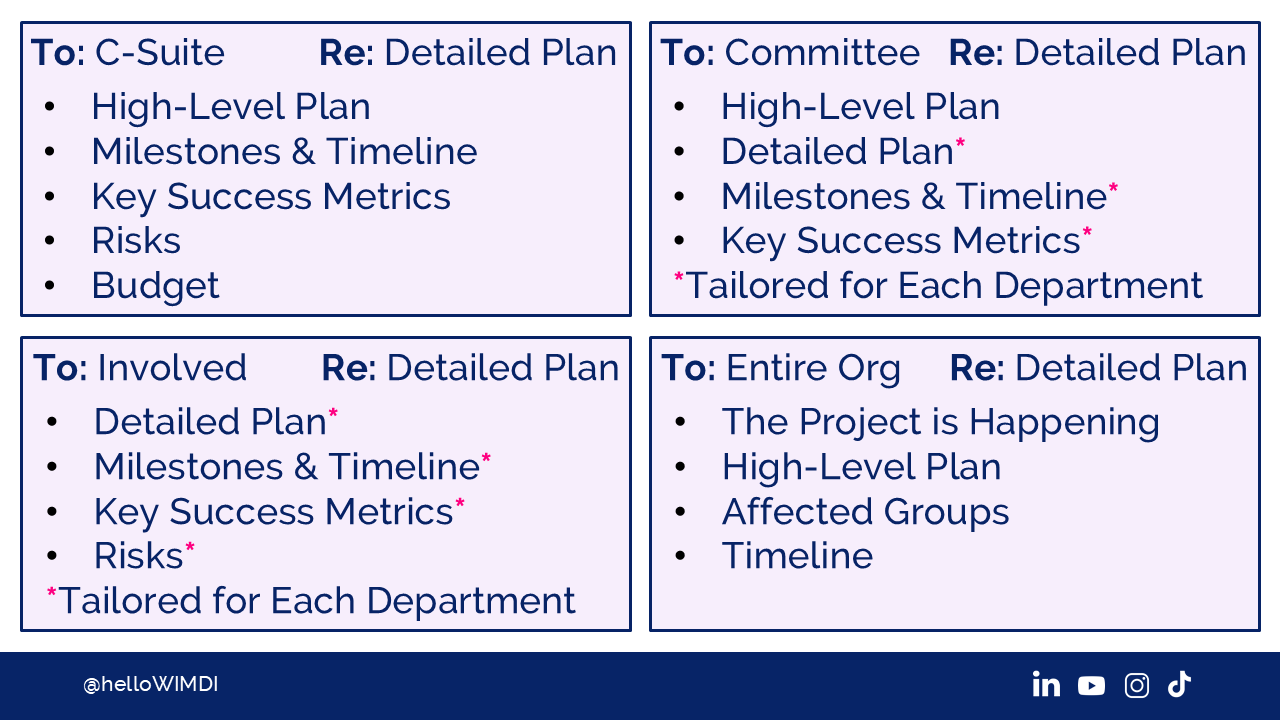
The communication definitely needs to go to the C-suite now. They need to understand what the milestones are, what are the potential risks? What are the key success measures being used and what is the overall cost, the timelines, and when each stage or phase is going to occur.
The committees and heads of the departments who are involved or impacted, will also need to understand the entire plan at a detailed level.
Some of these details can really affect their teams, so they need to know ahead of time. Then they can plan for any adjustments or backfilling needed in order to provide resources for the project.
They need to understand the timeline so they can communicate with the people on their teams who will be directly involved and impacted. They need to know the milestones, what the measurements of success are, what risks that they might face, and anything in the timeline that could really affect them. Also, when each stage or phase is due to start, so that they can plan ahead of time.
Communicating the roll-out to the entire organisation. You might think, "Well, we only have to inform the ones that are directly impacted. The others are not touching the system so they might not need to know."
But that's not true, because whenever a project or change happens, the entire organisation should be aware this is happening. They at least need to know the bigger picture, the groups who are affected, the timeline and what the phases are, what could happen to those teams.
Now, the whole organisation is aware. So, when they are talking to the people in the teams that are involved, they can share empathy and understand what they might be facing. Because the change could directly impact their work and cause some uncertainty.
Detailed Planning Checkpoint: Are You Ready to Move Onto the Next Phase?
What needs to happen before Amina can move on the last phase?
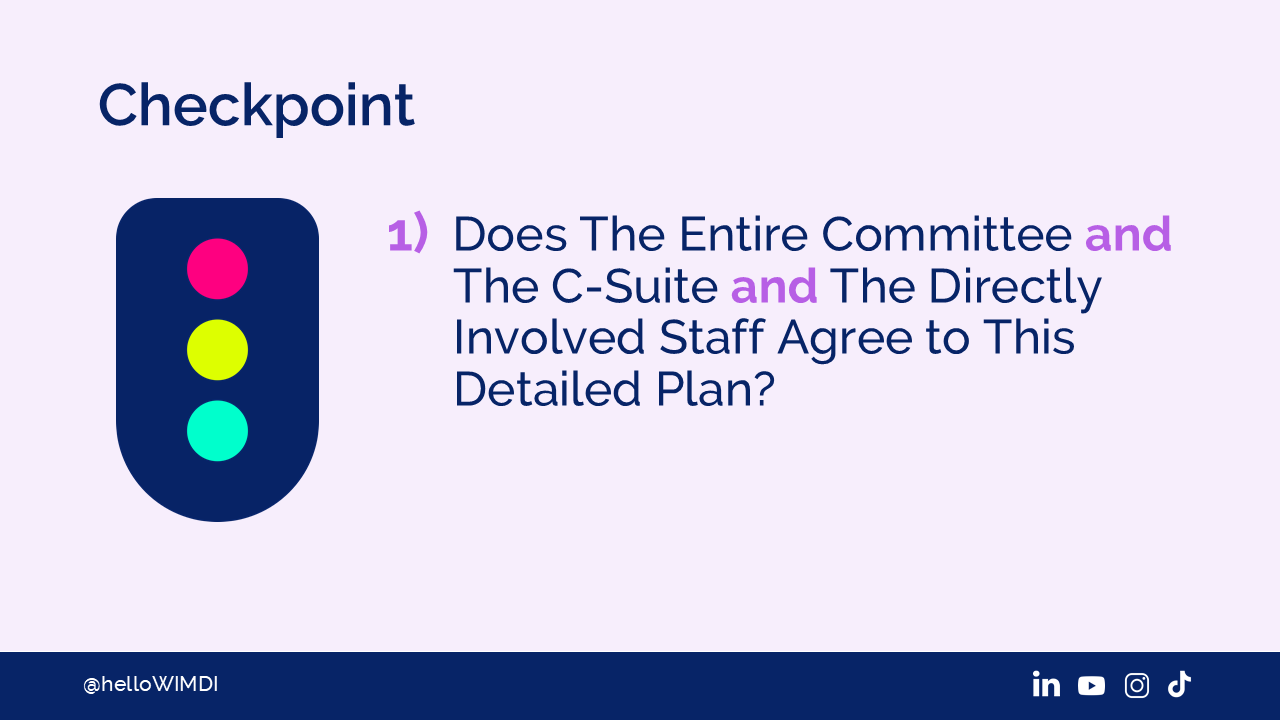
In this checkpoint, Amina will need to ask the C-suite and all the committees directly involved if they agree to the detailed plan. If she gets yes from everyone, we’re at the last phase, which is the execution phase.
Part Four: Execution
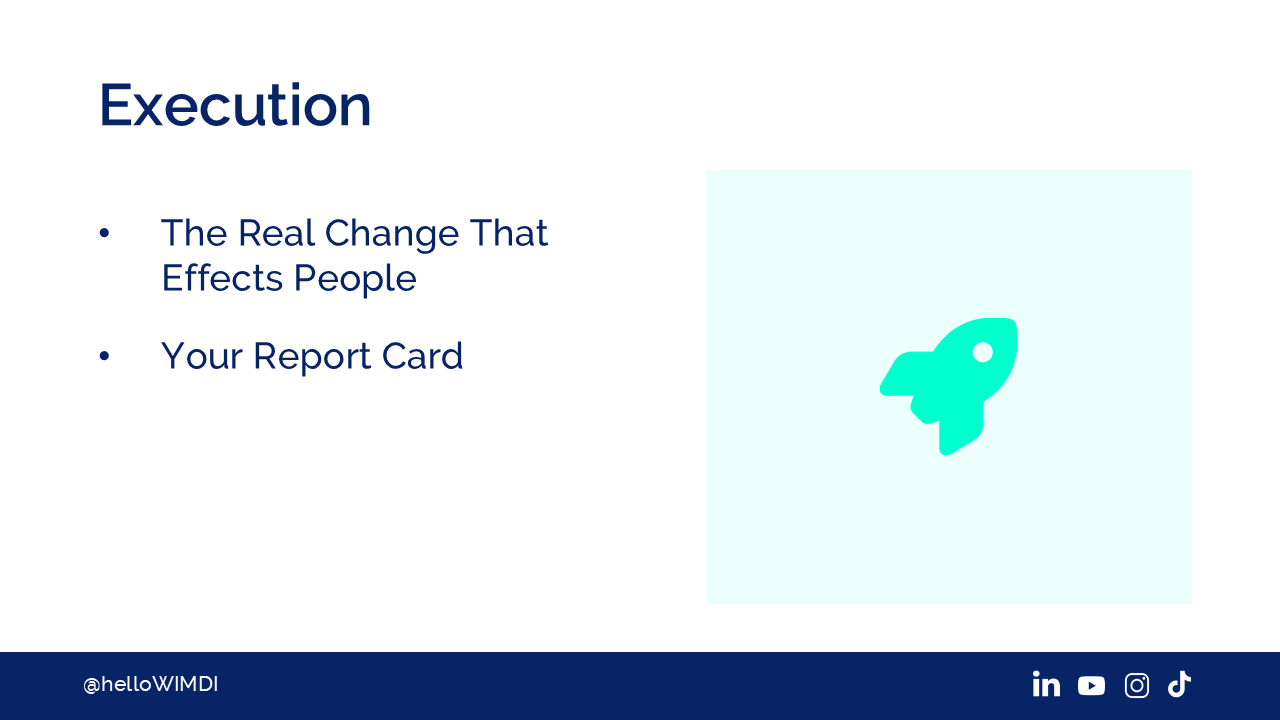
The reality now hits, everyone's experiencing the change. And the perception of the success of that change is now key.
The change leader report card is in this phase. That's how they can be written, and it determines what goes onto the scorecard. How will the project be assessed at the end? And was it successful or not?
Execution: The To-Do List
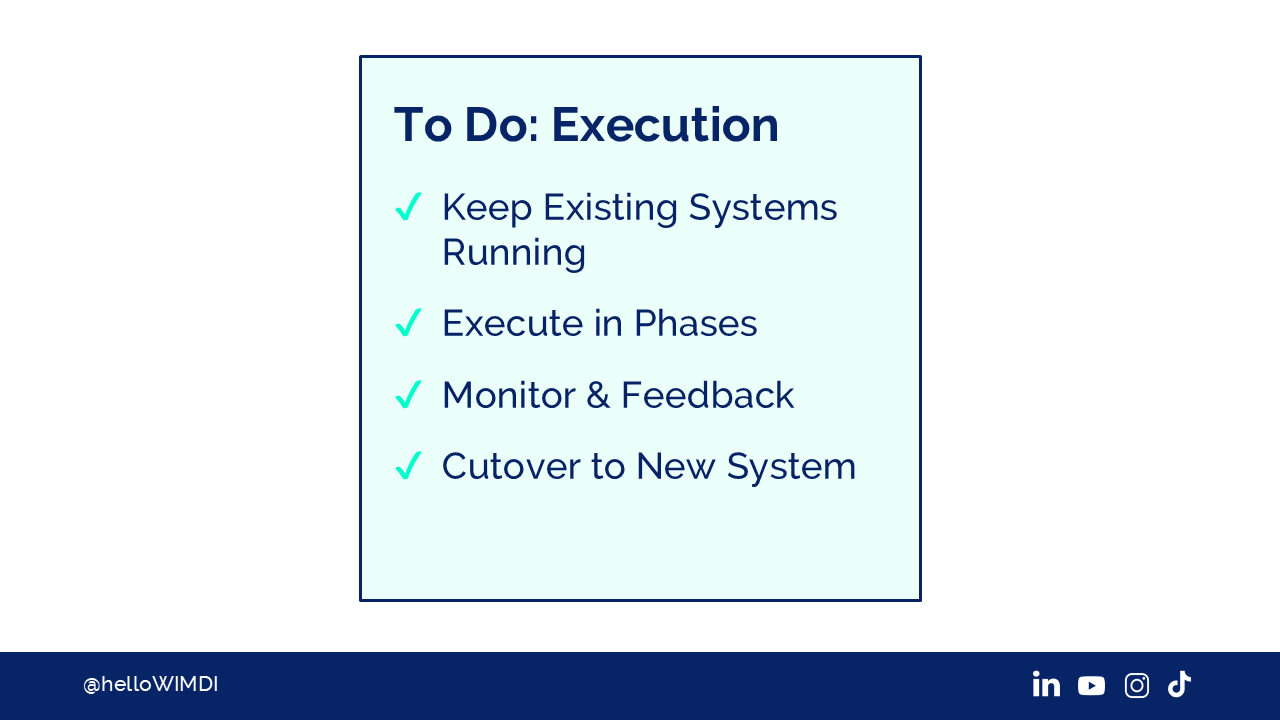
During this phase, Amina still has a number of to-dos to work on. One, the teams need to keep existing things running. Keeping the lights on is key. Two, executing that whole change in staggered phases, according to the milestones as defined in the detailed plan, including communications and checkpoints.
Who is being trained? And what are they being trained on? Amina and the team need to closely monitor feedback mechanisms. They need to make sure the feedback mechanisms are in place for ongoing support and for all employees at every single level.
The feedback should also be sent to the folks executing the project, plus they need to record any key learnings at each of these stages within the execution phase.
Lastly, the cutover to the new system and processes will need to be done at the right time when everyone involved is ready for it.
Execution: Potential Concerns & How to Mitigate Them (with Examples!)
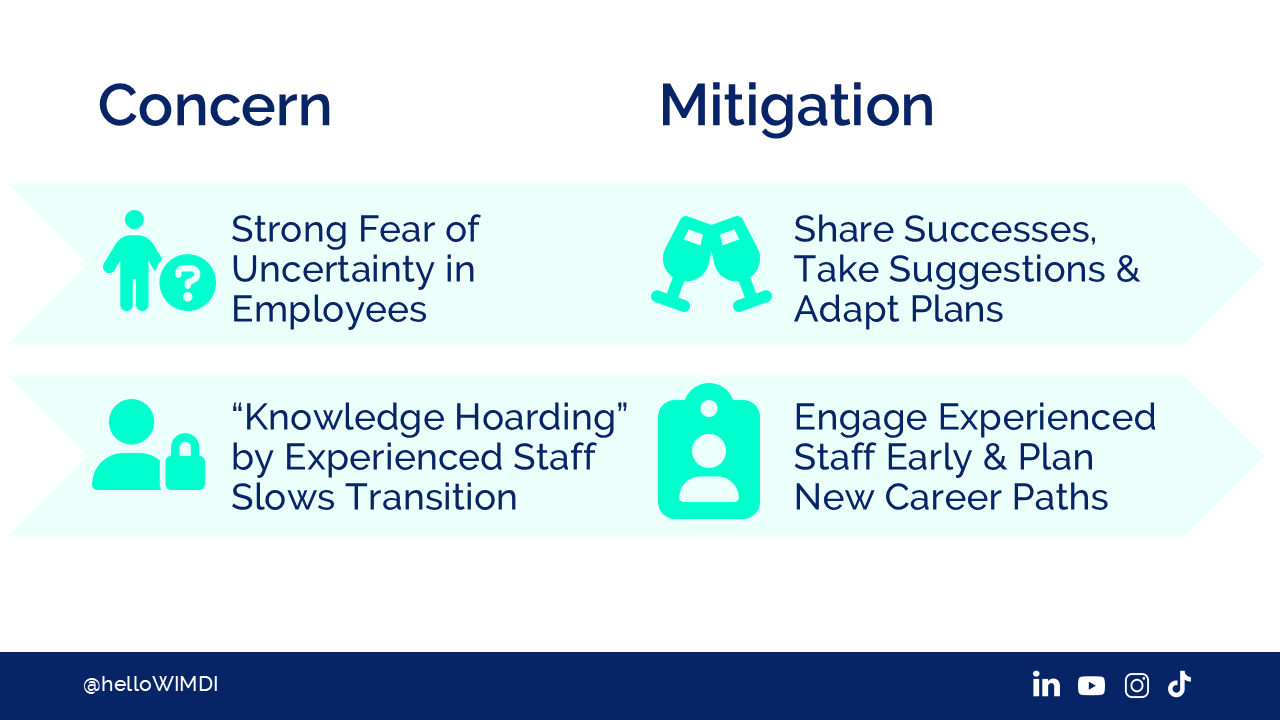
There are some major concerns that Amina needs to consider in this phase, so she can avoid any potential failures. Number one is the fear of uncertainty. It will be very strong as the execution phase goes on and people are seeing the impact of the change.
There might be in-between stages that people might not fully understand, so they feel like there is some uncertainty ahead of them. How do you mitigate that?
First is to know that you can still adjust the plans to reflect whatever circumstances come about during this phase. There could be improvements made to the plan itself as you figure out how to materialise the change that is going to happen.
Measures of success should be shared regularly, so employees understand that they have input onto the success and how it’s perceived.
You can use the metrics to measure how successful the change is, but also how people are feeling if that change is actually successful.
Be open to suggestions for fine tuning as well throughout the project.
The second concern is knowledge hoarding. Sometimes there's a couple of people who have deep knowledge of systems or process. If they don't see or understand how they can be part of the change, they might not be willing to share their knowledge which then can cause delays and issues with transitions.
In order to mitigate that, Amina should incentivize people with this experience and knowledge, ensuring they are involved early on in the process.
They can support on how the new process should be, and also help to craft their new career plan or the career path if that's necessary -- if they go to a new role in the new organisation or operation.
And provide fair treatment for both those who will be staying and those who might be leaving the organisation. Watch out for the potential that these staff may not have a new role.
Amina cannot say too much about it until the time that is arrived, that is the right timing.
She could also provide other options for staff impacted. Don't forget these experienced people also have knowledge about the industry and they have transferable skills.
There is a lot of potential for these people to be re-skilled, they could be useful within the new organisational structure, maybe under a different part of the department.
Execution: What Should Be Communicated and To Who?
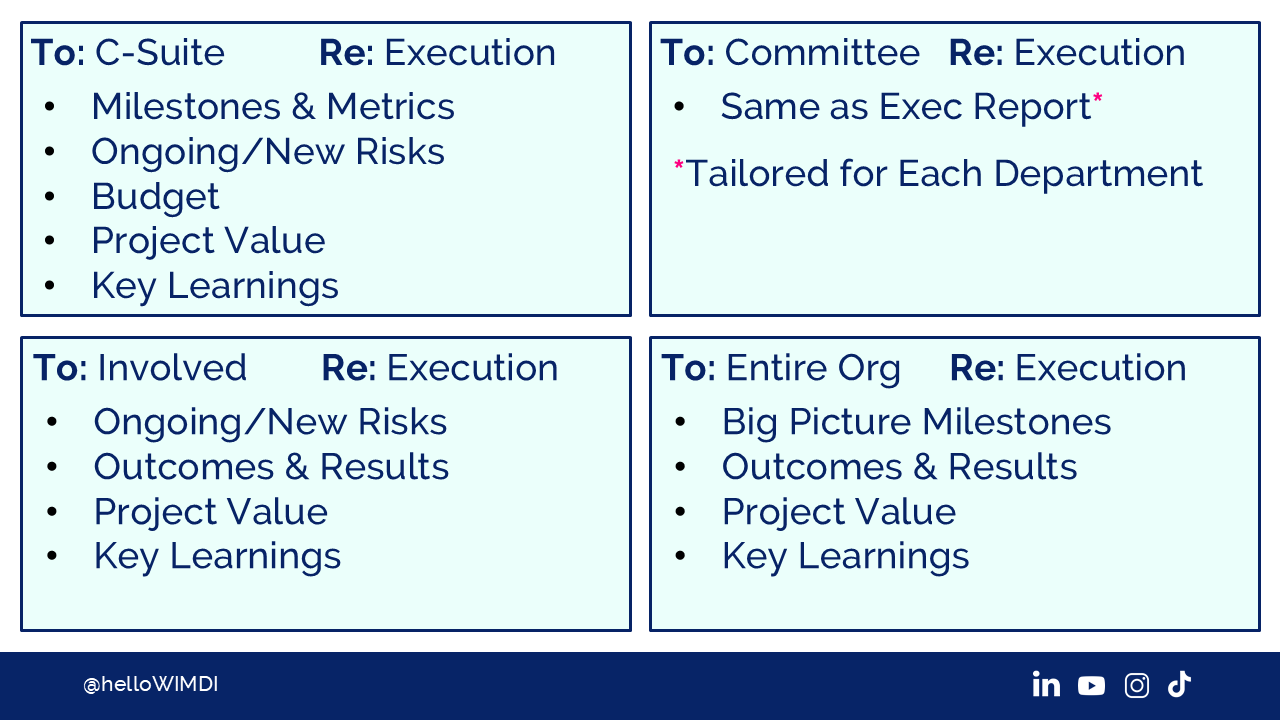
In the communication parts of this phase, Amina will have to consider four groups. First of all, the C-suite needs to receive regular reporting on the progress of the execution.
They should be alerted of any risks or changes that have come up. Are there any budget updates to consider, are they over, under or on budget?
As the change is executed, at each stage what is the value that has been materialized, are there any benefits coming in?
Things might not go according to plan. What are the key learnings in each stage? Can these things be avoided in the next stage or in the next project?
The committee and the heads of the departments also need to know the specifics of the impact on their department. It maybe doesn’t need to be as detailed as cost or other metrics that don’t concern them, but it should still be part of the communication.
Does Amina need to communicate anything to the people or teams directly involved or impacted. Are there any risks, or things they should be on the look-out for? Will they need to adjust or pivot the new process as unexpected circumstances occur or in relation to feedback?
They also need to have the overall feedback report with the results. Has the customer's satisfaction gone up because of the change and by how much? So, has it been 10%, 20% since they made the change?
Why is this project valuable? What's the worth of the time and the attention to this project? What are the key learnings?
And then, for the entire organisation are the periodic updates so they can see it’s worth their time to pay attention to this.
- What's working well? What's incomplete?
- What's still outstanding? And what are the major deviations from the detailed plan?
- Why is this project valuable?
- What is driving it?
- What are the key learnings at a high-level perhaps, for the next project that they might get involved in.
Execution Checkpoint: Reflection and Reporting
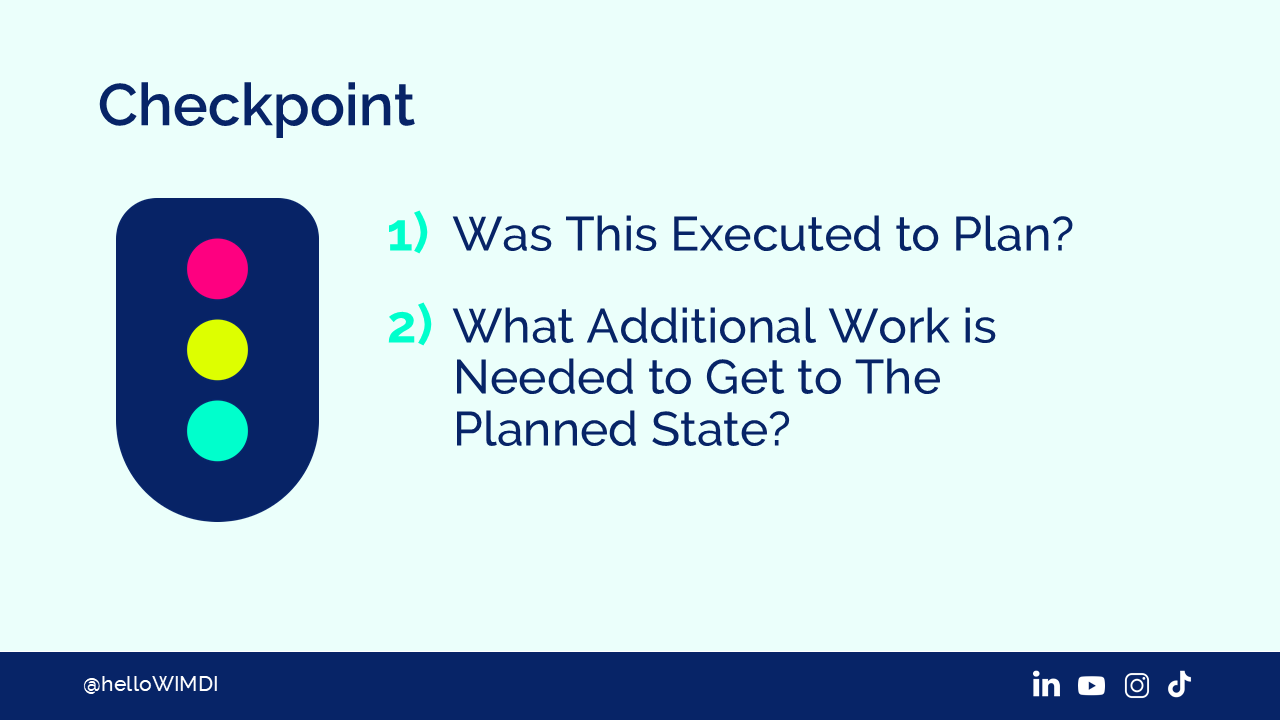
The last checkpoint that Amina and the team will need to know, has execution been carried out the way it was planned? What, if any, additional work or adjustments needed to be put in place, so they could get to the original desired plan.
Once Amina understands all this, there could be a potential draft of the project follow-up.
Alternatively, she can just close off the project with the success and also the metrics that indicate how the people are satisfied or the customer satisfaction rate has increased, according to what they have estimated from the beginning.
The report is generated so that the C-suite and all the stakeholders understand how the plan has come about.
Now, let's take a look at Amina's case and recap what she did, the awareness phase, the design, the planning, and the execution.
As a result, the company now has a faster and simplified process, from quoting to contracting, signing, invoicing, and fulfilling the delivery of the website work for the customers.
Their revenue actualized within the terms and increased by 30%. So, all those advantages that we mentioned at the beginning were fulfilled, right? They're faster, they’ve been simplified, and there are fewer opportunities for error.
Payments are also now made on time. There are more data points now that everything's automated. So, forecasting is much more accurate. They can use trend analysis for their strategic planning. And they deliver faster to the customers, so they've got happy customers.
The Finance department can free up the hours of work in the week for other projects as well, perhaps more strategic planning.
Now, imagine, your next up-and-coming change project has no mutiny and everyone is on board. How would you feel? Wow!
Summary & Key Takeaways
I know this is a lot of information that I shared with you today and you're probably thinking, "Okay, how might I remember all of this?" But don't worry. Let me share the following key points.
In the awareness phase, just remember: Involve people early.
In the design phase: Clearly establish the RACI diagram for decision making process.
Again, RACI is about who's Responsible, who's Accountable, who will get Consulted, and who will get Involved during the project?
At the detailed planning phase, create a comprehensive communication strategy, who needs to know and when?
And during the execution phase, follow the plan while being flexible and adaptive.
Finally: Embrace the change and enjoy the ride.
I believe in you. You will have a successful change.
Thank you for staying engaged with me the whole time and I'd love to connect with you all. Here's where you can find me on LinkedIn, Facebook, my email, and also my website.
Whether you are challenged to lead and drive change for your company or a team or for yourselves, let's have a chat on how our partnership can lead to a transformative experience. Let's stay in touch.
More Fun Stuff!
If you loved reading this transcript, you might like to watch the video or learn more about our amazing speaker! Check it out: