Identify, Shift & Own Your Triggers at Work –…
transcript
Transcript
Identify, Shift & Own Your Triggers at Work
Here to read instead of watch? Click through the headings to a section of the full transcript, or scroll away!
- Trigger Warning
- Identifying Your Triggers
- What Is a Trigger?
- Jennie’s Story: Triggering Experience #1
- Jennie’s Story: Triggering Experience #2
- Jennie’s Story: Triggering Experience #3
- Identifying the Pattern in Jennie’s Experiences
- You Need to Uncover What Your Triggers Are
- The 3 Key Moments During a Trigger Response
- Key Moment #1: The “Aha” Moment
- A Guide to Labelling Emotions
- Solo Exercise #1: Reflect On a Moment Where You've Been Triggered & Label the Emotion
- Get to Know Your Feelings
- Solo Exercise #2: Did You Notice The Emotion Rules in Action?
- The Belief Systems That Drive Your Emotions
- Solo Exercise #3: Reflect on The Beliefs Driving Your Emotions
- Jennie’s Story: Finding & Investigating Her “Aha” Moment
- Key Moment #2: The Healing Moment
- Humanise & Get to Know The Person Who Triggers You
- Clearing Conversations: What are they?
- How to Prepare for a Clearing Conversation
- How to Ask for a Clearing Conversation (With a Script!)
- Jennie’s Story: Her Healing Moment
- Key Moment #3: The Growth Moment
- Red Flags & Green Flags for Finding Your Next Place to Grow
- How Do You Want to Feel in Your Growth Moment?
- Jennie’s Story: Her Growth Moment
- Summary of The Three Key Moments
(Edited for length and clarity)
The topic tonight is around identifying, owning, and shifting your triggers at work.
Today we'll go through; how to identify your personal triggers at work, explore the role you play in your workplace dynamics in these experiences, the three key moments that will help you unpack the triggers, and how to find a workplace that supports your need for personal and professional growth.
A bit about me. I'm an executive coach to women, to ambitious women. I've had a coaching practise since 2017, and most recently, six months ago, I founded a community for ambitious mums and mums-to-be called Chief Mama Officer.
I'm also a former HR executive as well as customer success leader in tech. I have over 15 years of experience as a strategic operator.
A fun, personal fact about me is that I'm just getting started on the mountain bike. I used to be a triathlete, I did two triathlons, and I recently picked up mountain biking, and I love it.
I much prefer it over road biking and tri-biking because of it being on trails versus the road. I feel a lot safer on the trails.
My land acknowledgement is for the Salish and Kalispel people. I live in Missoula, Montana, in Western Montana, and many people here move here because we do feel very connected to the land.
We are nestled in between five valleys, and I am friends with a few indigenous folks here. So, it's meaningful to me that Holly asked me to include a land acknowledgement.
Trigger Warning
It would be remiss, before we dive in, if I didn't include a trigger warning for a talk about triggers.
Some of the stories that I might share or the solo activities that I'm prompting may bring up some emotions, distressing memories, or experiences.
I appreciate all of you showing up here tonight. It shows a commitment to your dedication, to your own inner work and wellbeing.
If any of the content or solo activities become too much, you are more than welcome to step away, go outside, take a breather, just do what you need to do to be able to be present here in the moment.
What are you hoping to learn today from today's talk? What compelled you to come here and spend your time with me learning about identifying, owning, and shifting your triggers?
[Jennie reads comments from the chat]
"I want to know I'm not alone in my triggers."
J - Yes.
"How to feel more agency in situations that have caused me to shut down."
J - Yes.
"Greater awareness to identify the triggers so we can have the reflection space later to understand them on a deeper level."
J - Great. Amazing. Thank you so much for sharing.
"Learning how to deal with unnecessary comments at the workplace professionally."
J - Yes, absolutely.
Identifying Your Triggers
Identifying triggers is the first component to the talk and it would be remiss if I didn't actually define what a trigger is.
It's a person, place, thing or situation that elicits an intense or unexpected emotional response. It causes an individual to possibly relive a past trauma consciously or unconsciously.
Today's talk is going to focus specifically on internal triggers. These are the personal emotions, past wounds, or insecurities that resurface, such as feelings of shame, feelings of rejection, guilt, imposter syndrome.
What Is a Trigger?
It might not even be a trigger from someone's behaviour. It could also be sensory stimulus, like your environment. It might elicit a reaction like smells, crowded places, body-based responses.
As an example, here, environmental stimuli, I still feel the impacts of the pandemic, where if I'm in a crowded space inside, I start to contract and get really anxious. That is an example of environmental stimuli.
Any behaviour, experience, or sensory stimulus can be a potential trigger and lead to a fight or flight response, right? Getting into that fear space to keep you safe.
I do want to say that internal triggers are different than external triggers. Situations or societal factors that activate a response such as blatant discrimination or cultural media messages.
Unfortunately, I imagine that many of us have experienced blatant discrimination in male-dominated industries.
I personally have, and so just centering us that the talk tonight is about internal triggers, about our own emotional reactions, past wounds that arise in these moments.
The reason why we're focusing on that is because we have the most agency over internal triggers.
Which brings me to a core belief that I have, which is,
"Our outer experience is a mirror reflection of our inner world."
In other words, whatever internal beliefs we create about ourselves based on our experiences, our external reality will mirror them, we will reflect them.
Luckily, we have agency addressing those internal beliefs that no longer serve us in our wellbeing going forward.
Jennie’s Story: Triggering Experience #1
For context, I'm going to share three distinct and recurring triggers that happened across my career, and then how it led to three key moments in how I uncovered those triggers.
My first story is when I was a management consultant in 2012.
I was on-site at a client’s conference room, and I had 10 teammates at the table, including our managers, and we were at the wit's end with this project.
The night before, I remembered that there were a few colleagues of mine, and we were up until 4:00 AM wrapping up a current state deliverable, and we hadn't received much direction or support from our senior manager on the project.
The next day we thought that deliverable was complete, and I just started working on a future state deliverable.
In front of everyone, the senior manager asked me what I was working on. She called me out. I told her, "I'm working on the future state deliverable. No one else is, so I just went ahead and did it."
She redirected me in front of the entire group, "Hey Jennie, I really need you to be working on that current state deliverable and wrapping that up. You shouldn't be working on this future state deliverable."
In that moment, I felt my heart racing, my face blushing, my eyes welling up with tears. I remember I couldn't hold the tears in any longer. I got up from my seat and rushed out to the bathroom to cry it out.
I paced in the bathroom back and forth, looking at myself in the mirror, and thinking to myself, as tears are streaming down my face, "What did I do wrong here? She didn't give us any direction. I went ahead doing what I thought would've been helpful for the team."
I felt totally ashamed that the work that I was doing on this project would never be enough, even though I was spending 80 to 100-hour weeks pouring my blood, sweat, and tears into this work.
That afternoon felt like it lasted forever, and I couldn't accept that had just happened. The way I reacted and had to run out of the conference room, it was so embarrassing, and in fact, I felt regret that I reacted that way and wish I could have controlled my reaction. I thought that it was a career-limiting move.
Jennie’s Story: Triggering Experience #2
Fast forward two years to 2014, I was at a new company. I made a transition from management consulting into tech. I wanted to get my foot in the door.
I took a job with a manager who seemed like he might be an asshole during the interview process. And unfortunately, a month in, he proved that to be true.
We were in a team meeting where I shared a client deliverable and he called me out in front of the team, it was a small team, a few guys and myself. He said, "Jennie, this analysis is rudimentary."
Again, I felt the heat rising on my face and body, heart racing, and started to feel the tears well up in my eyes, and on my way to the bathroom, I tried to control the tears from running down my face as co-workers were walking by.
Once I got to the bathroom, it was such a cathartic release, I just cried it out silently. There were other people in the bathroom, I felt horrible, I felt embarrassed that I didn't meet his expectations, even though I thought that the analysis was completely fine, especially since he failed to give me his time, direction, and coaching around it.
Unfortunately, it still led me to feel like a complete failure as a new hire on the team. And guess what his gaslighting advice was later that day? It's never as bad or good as it seems.
Huge eye roll, right? In retrospect, I didn't last at that job very long, only nine months.
Jennie’s Story: Triggering Experience #3
Fast forward two years to 2018. I'm at a revenue leadership team offsite. This is a new company, this is my third tech startup that I'm at. We're talking about customer churn. That's my area of ownership as the customer success leader.
My style of leadership is to listen first and then respond. I'm a little bit more introverted in that sense.
I was listening to the team talk about the problems at hand, and our boss, the chief revenue officer, calls me out, "I need to hear from you on this, Jennie, you need to have an opinion."
So, as you might guess, the same shame came up. And this time I tried to sit with it at the table with my team. I tried to hold the tears back, and yet again, the tears just became overwhelming.
Guess what I did? I got up and ran to the bathroom again. I literally was about to speak up and share my point of view. And he called me out. It was such a fricking disaster.
Identifying the Pattern in Jennie’s Experiences
So, I'm curious here. You probably clearly see the pattern here, right? Across the course of six years, a similar scenario happened three times. And in fact, it happened a couple other times as well.
The behavioural trigger here was being called out by an authority figure, by my boss in a group setting. What that led to internally, this internal trigger of shame, "I've done something wrong, I've been bad, I'm not good enough, I'll never be good enough, my work will never be good enough, I'm a failure."
What was the consequence of all of this? Actually, it was depression. I got in a really bad spot mentally and also physically, I was languishing as a human.
You Need to Uncover What Your Triggers Are
These career experiences kept happening and happening and happening. And this really led me to explore my triggers. I had to do something different here, to dig them up and look at them. Because anytime that I went to a new place, a similar thing happened.
Here's the inner work at hand. You need to uncover your triggers so that you can own and shift your response to them at work.
Why? Why is that important? Well, there really isn't a cure for triggers. They happen, we all have our unique human experiences, and all we can do is to identify when we're reactive and having a negative emotional response.
Then try to understand it better, why this is happening, and then to manage our own emotional reactions.
At its heart, triggers are a reaction to past experiences, and our emotions. Our emotional triggers alert us to perceived threats in our environment.
The 3 Key Moments During a Trigger Response
In my own exploration, I found that there are three key moments in the journey of identifying, owning, and shifting your triggers.
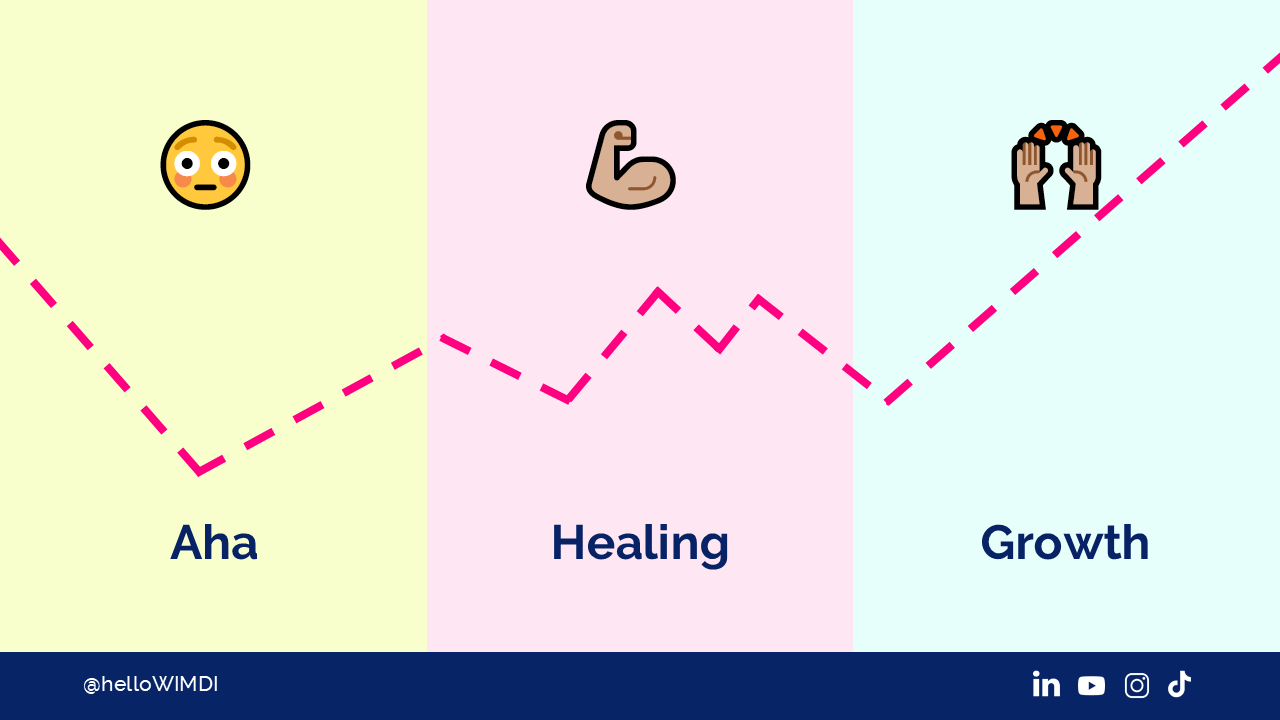
The three key moments are the "Aha" moment, where you have that rock bottom and then the epiphany; the "Healing" moment, which is sort of an up and down, peaks and valleys; and then this "Growth" moment where you do improve and get clarity on how to move forward.
Key Moment #1: The “Aha” Moment
I'll share my own "Aha" moment related to the three stories I just shared. I've realised that my work environment is a mirror reflection of my childhood family dynamics.
This is the blush emoji, really expressing like, oh my gosh, whoa, mind blown.
Those toxic bosses were a representation of my parents. I was called out at the dinner table for bad behaviour. Also, I would say the toxic bosses also equaled teachers or coaches throughout my childhood, or even in high school or college, right, who would call me out in front of a group. It just continued to repeat in all these different scenarios.
Another "Aha" moment is that I perceived authority figures as perpetrators and bullies. I was the victim, right? I was at the mercy of the bully and the perpetrator.
How did I arrive at these conclusions? I started to look, inquire, and investigate my own emotions.
A Guide to Labelling Emotions
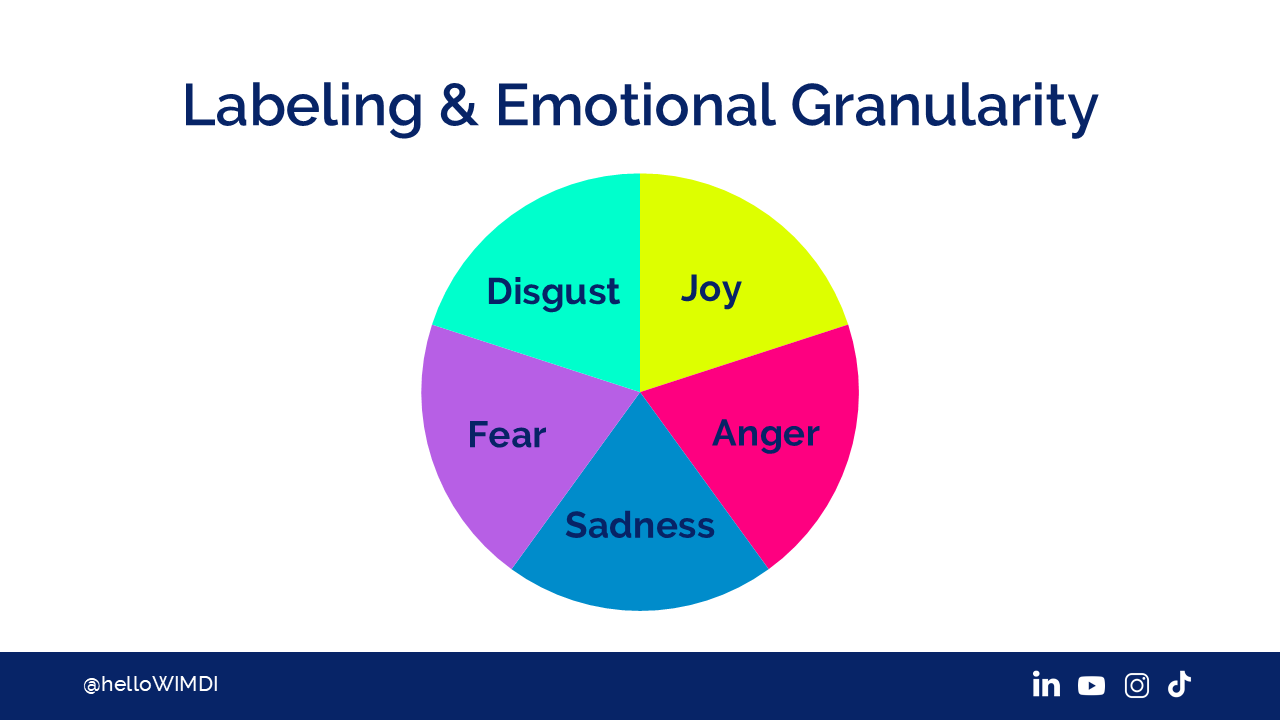
The five universal emotions here, where all humans, no matter where we were raised, we all have these emotions in common.
If anyone here has seen the Pixar movie "Inside Out" they will be familiar with the little characters, Joy, Anger, Sadness, Fear, and Disgust. They all keep us safe and sometimes they will take control, right?
However, research shows that even just naming our emotions helps us deal with stress, and awareness of our emotions and mindfulness around them. They're also key to understanding why we feel threatened and how we can deal with those triggers in a healthier way.
Solo Exercise #1: Reflect On a Moment Where You've Been Triggered & Label the
Emotion
Here's the first activity. I invite you for the next two minutes to reflect on an emotionally charged situation from work, from the last week or so, and label the emotion.
Was it disgust, fear, sadness, joy? You can even get a little bit more granular with the emotion, was it overwhelm, frustration, embarrassment, shame, guilt?
Get to Know Your Feelings
When we think about, and reflect on these emotionally charged situations, the key here is to accept the emotion. To accept that anger, right? It is okay to feel angry right now to accept that fear.
Did you know that feelings and emotions only last 90 seconds? The onset of an emotion to the arc of the emotion to the tail end of the emotion, 90 seconds.
Research suggests that that is the length of the biochemical response cycle of an emotion and the actual physiological reaction. However, our subjective experience of emotions can feel much, much longer for several reasons.
The same emotion may be re-triggered through our thoughts and our own interpretations, our stories, our narratives, our beliefs about ourselves.
Emotions can also transform into moods which are longer lasting, but less intense states than emotions. And then emotions also vary significantly in duration based on the specific emotion.
Sadness tends to last longer than anger, as an example, individual differences in emotional processing, the significance of the triggering circumstance and our own coping mechanism and emotional regulation skills.
I just wanted to preface that emotions last 90 seconds, and actually the Latin root of emotion is to move out, so these emotions are expressed through us.
The key here is letting go of the need to control your emotions or repress them. Because sometimes, like in my own experience, when I repress the emotions, it's like a kettle pot, and then it eventually explodes, and we have a moment of rage.
It's being able to allow yourself to express the emotion, allow it to last 90 seconds. Notice any thoughts, interpretations, stories or narratives that are arising around it as well.
Solo Exercise #2: Did You Notice The Emotion Rules in Action?
So, following up on that last activity, the emotionally charged situation. I’m curious if you notice the emotion itself lasting 90 seconds.
As you're bringing it up, I invite you to notice any thoughts about yourself or narratives about the other person, or whatever the situation is, beliefs about yourself or the other person, what's arising in these 90 seconds.
And inviting all of us to take a deep and big exhale together (blows) and releasing that experience.
The Belief Systems That Drive Your Emotions
If you're taking note of any of those thoughts and narratives and beliefs about that emotionally charged situation, the last step in investigating your emotions is to examine your beliefs that drive that emotion, to examine the beliefs around the anger.
What is leading me to have this experience of anger or shame?
Beliefs operate at both conscious and unconscious levels, and they fundamentally shape how we interpret and respond to situations.
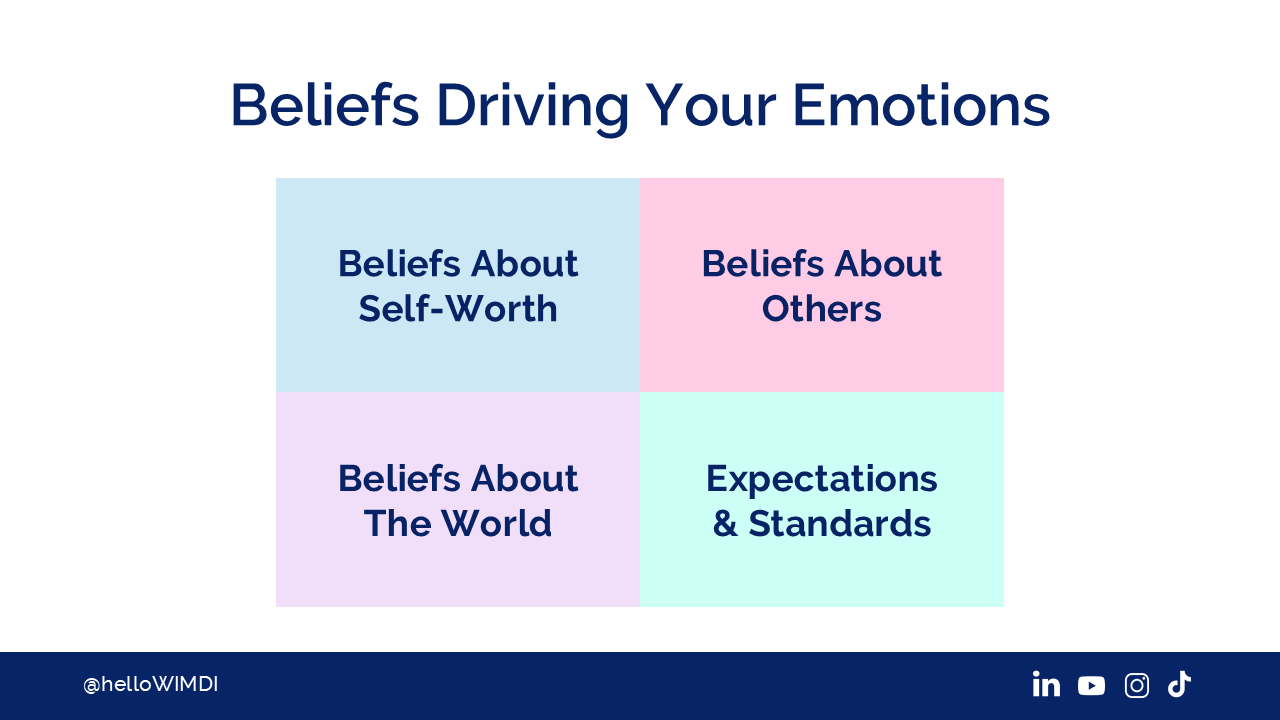
Here are some key belief systems that influence our own emotional experiences: core beliefs about our own self-worth, such as I am worthy or unworthy of love and respect, such as I am competent or I am incompetent, or I am fundamentally good or bad.
Beliefs about others such as people can be trusted or cannot be trusted, others are judging me or others are accepting me, or people are generally helpful, or people are generally harmful.
There are beliefs about the world, whether the world is fair or unfair, or life is meaningful or meaningless, the future is hopeful or threatening.
Then there's expectations and standards, such as I should always succeed and be perfect or bad things shouldn't happen to good people, or others should treat me with respect.
And there's also beliefs about emotions themselves. Negative emotions are dangerous and harmful. They should be controlled, not expressed. Expressing vulnerability is a strength, or vulnerability is a weakness.
Emoting is a weakness. That was a belief about emotions that I had growing up, that being sad was bad. It was not okay, stop crying.
So, these belief systems create cognitive frameworks through which we interpret events, and ultimately determine whether we experience joy, anger, shame, pride, or other emotional states in response to similar situations.
Often becoming aware of these underlying beliefs is the first step to addressing persistent emotional patterns and triggers.
Jennie’s Story: Finding & Investigating Her “Aha” Moment
I wanted to wrap up the "Aha" moment, the first of three moments around my own personal story here where I examined the triggers I experienced with both my Mum and Dad and the beliefs driving my emotions around those triggers.
Rather than reflecting on the experience that I had in the workplace, I went direct to the source of where I inherited this trigger and the pattern and those unproductive beliefs about myself.
That I'm unworthy, that I'm a failure, that I'm an embarrassment, all of that. I explored the triggers with my dad, the triggers with my Mum. I did all this inner work within myself, and not actually interpersonally with them, but I did all of that reflection within myself.
So how did working on my own personal history play out in the workplace?
Key Moment #2: The Healing Moment
That leads me to the second moment of the "Healing" moment. What the "Healing" moment is when you start to equip yourself with skills to cope within these toxic workplaces, or with colleagues who don't understand the impact of their behaviour or actions or non-actions.
Humanise & Get to Know The Person Who Triggers You
A simple tool to start out with here is to go out for a coffee chat with the person whose behaviour triggered you, understand their story, it humanises them beyond their role at work.
I do want to say you shouldn't go beyond your level of own personal safety here as well, right? If your system really feels unsafe with this person, this is not necessarily a tool that you would use.
Just using your own judgement here, can I build a foundation of relational hygiene with this person? Or just a baseline level of relationship.
Some questions that you could ask are, "What's something about your upbringing that shaped you?" Or "What brought you into this field?" "What's your favourite part about your career journey?" Or "What do you love to do outside of work?"
Because sometimes when you start to humanise the other person, it's less transactional and more relational. Some of the benefits here are that it might reduce misinterpretations, and misunderstandings, increase empathy, increase trust, create stronger relationships, and encourage more open dialogue.
Clearing Conversations: What are they?
The next tool that I'm going to share with you is actually the game changer here, and I'll share with you my own case study at the end of this section. This tool of clearing conversations.
When you experience a negative reaction to someone's behaviours or actions, you can use a clearing conversation. What is this?
It's a dialogue that you initiate with someone whose behaviour triggered you. And the goal is to share your truth, own your experience, and co-create a new path forward.
I will share a disclaimer here is that this is not the tool to use if it has been blatant discrimination or harassment. That is an escalation immediately to whatever your HR protocols are, reporting it to HR and/or your manager.
These clearing conversations, for me, were very important to the growth of my own career, and I will share with you the exact steps here.
How to Prepare for a Clearing Conversation
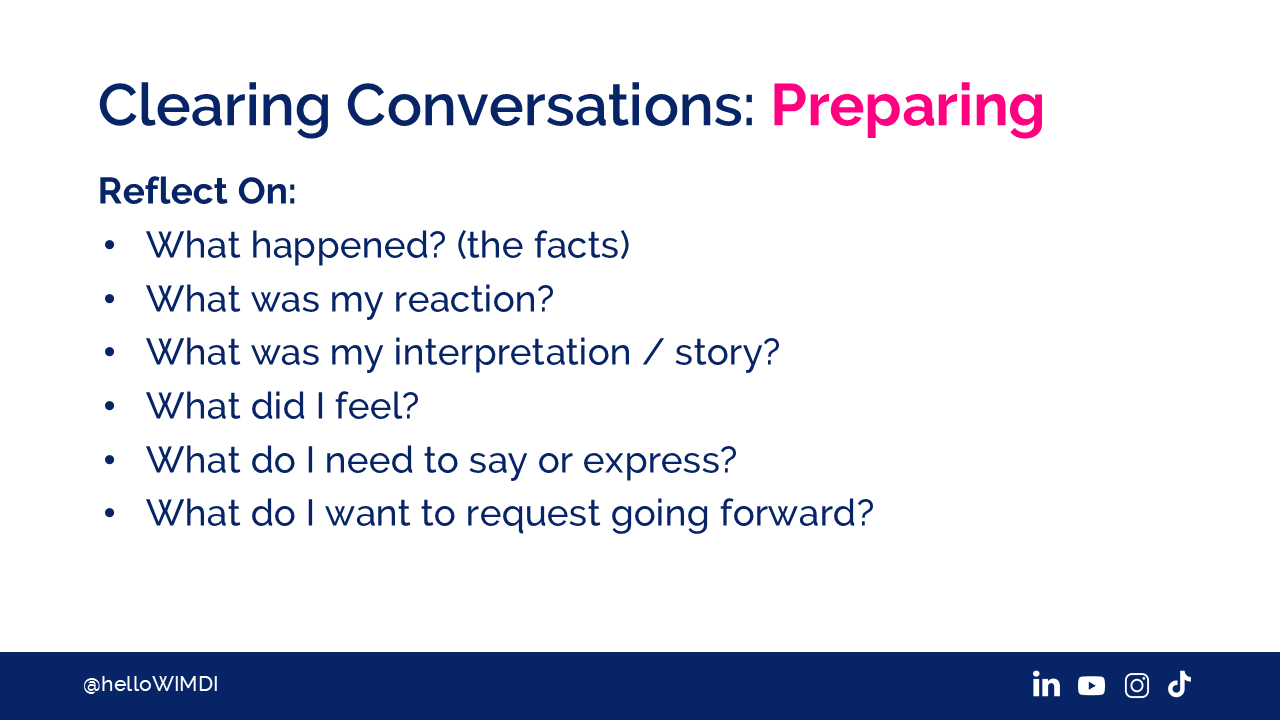
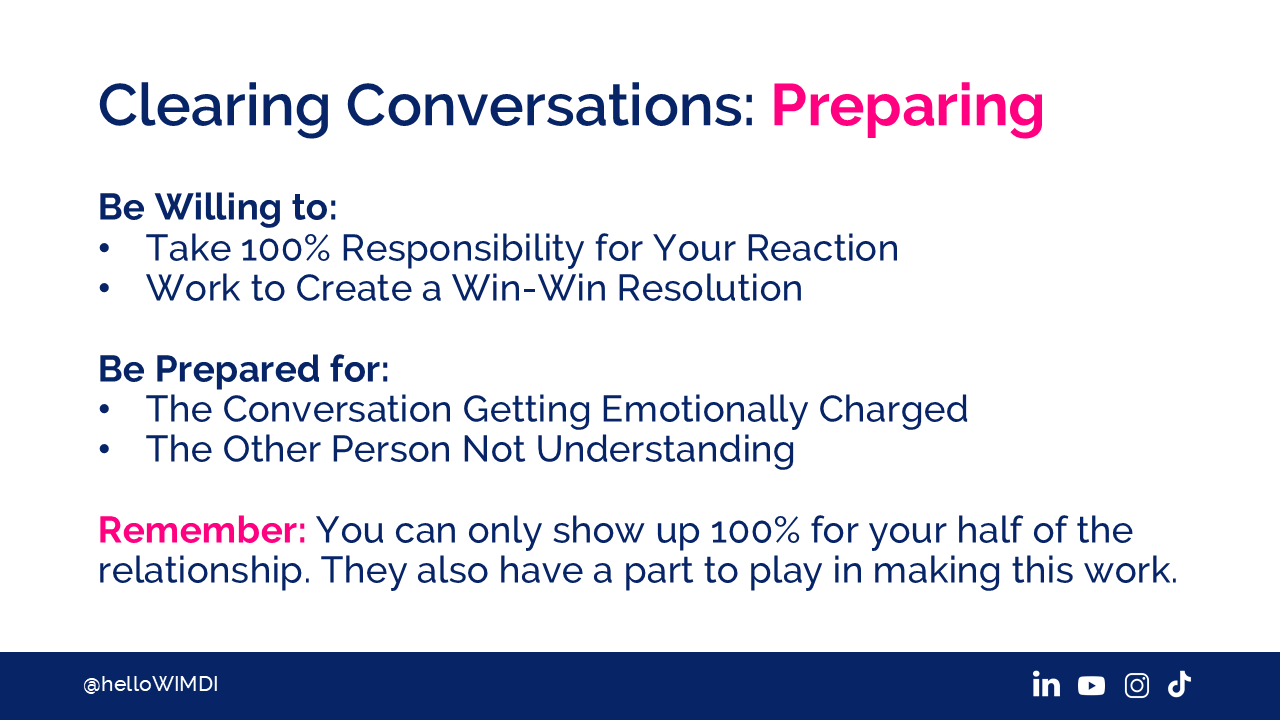
Preparing for a clearing conversation requires reflection. Reflect on what happened, what were the facts of what happened, and what was my reaction to the facts? What was my story about it? What was the interpretation of it? And what did I feel? What was the negative emotional reaction.
Then, if I were to say anything to this coworker, what would I need to say? What would I need to express to them? And what do I want to request going forward?
Honestly, this is the most important part of the conversation, making an ask at the end of how you would like to see how they show up or to shift their behaviour.
This clearing conversation is being able to take 100% responsibility for your own reaction. There were a few comments in chat earlier during the talk about this, right? Of being able to own our own reaction versus blaming the other person.
Also, the frame of mind going into this clearing conversation is wanting a win-win resolution between the two of you. What would a win look for you, and what would a win look for them in this relationship?
Something else to be mindful of going into the conversation is that it might get emotionally charged, on your end, on the other person's end. Usually when I prepare for a clearing conversation, I have my entire script written down.
I don't usually deliver it virtually or, but if it's in person, I've already reflected on it and read through it a few times, and I ground myself before the conversation. There might be some nerves that arise, so as much grounding as possible, and then also be prepared for the person just not getting it.
In my own experiences, I've had hundreds of clearing conversations with my colleagues and 80% of the time they've worked, and 20% of the time they haven't. So just be prepared for that.
The point of a clearing conversation is that it's okay if they don't work. It's you showing up a hundred percent for your half of the relationship. This is your desire to repair the relationship, both with yourself and with the other person.
How to Ask for a Clearing Conversation (With a Script!)
The first part of it is to give them a mental heads up asynchronously, whether it's through Slack or Microsoft or text,
"I have something I want to clear with you. I'd like to have a conversation with you about what happened the other day." Or, "I'd like to have a conversation about something you did and I had this reaction to it. When's a good time to connect?"
It gets them into a mental state where they don't feel that they're getting caught in the blue with this conversation that you want to initiate.
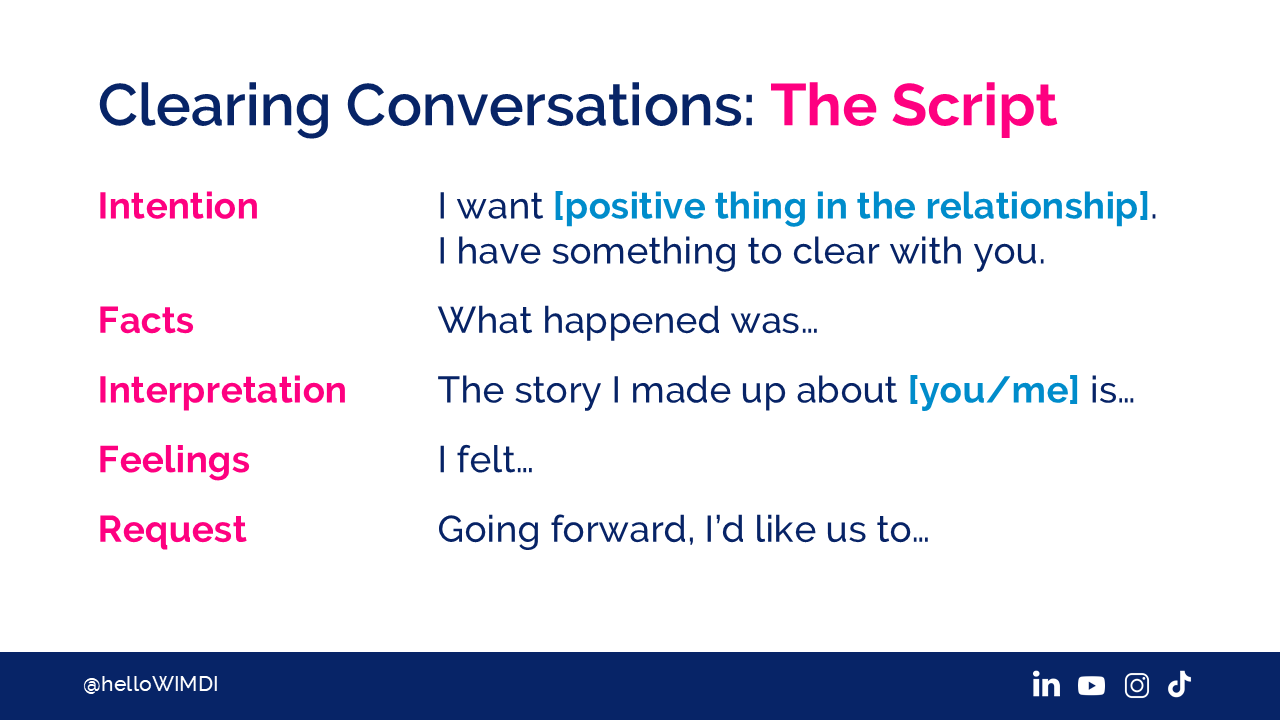
Here's the script. It starts with an intention. It goes into the facts, the interpretation, and the feelings and the request.
I want this positive outcome in this relationship. I have something to discuss with you, or I have something to clear with you. What happened was, dot dot dot, the story I made up about myself is, or the story I made up about you was, I felt this when that happened. And going forward, I would like us to dot, dot, dot.
One of the questions here:
“Is it important or necessary to have difficult conversations in person or do video calls work.“
J - Yes, yes. I think it also depends on your working environment, right? If you're in person, hybrid, or remote.
A practise that I also appreciate doing is asking how they like to receive feedback at the beginning of the relationship. Just asking, "How do you want to receive feedback?"
Then you might be able to address that feedback or the clearing conversation right in the modality that they like to receive feedback or prefer to receive feedback.
I will share an example of the script, and then I will repeat the question here and then address it. Here's the sample script here that I have used in one of the example scenarios from before.
My intention: "I want us to have an honest working relationship, so I have something to clear with you."
Before that I gave them a heads up, we need to talk.
Here's the fact: "In the meeting earlier today, you called me out in front of the rest of the team", fact.
"The story I made up about myself is that I did something wrong, and I felt a lot of shame." Though this is the interpretation as well as the feelings.
And "Going forward, could you please give me feedback directly instead of in front of the group," request.
This particular clearing conversation had a positive outcome. He didn't realise that I preferred receiving feedback directly one-on-one versus in a group setting.
So that made expectations and how we can work together clear. Clearing conversations have actually accelerated and supported my career growth.
A question here, "Curious if you've had a clearing conversation that made the situation relationship worse in the end? Or have you found them to only have neutral to positive effects?"
This is so relevant for this group, for WIMDI. So, majority of the time, the clearing conversations, 80% worked, and I guess, so possibly the 80/20 rule here, but there was one person, an executive, who happened to be a man, who just didn't get it.
When I initiated a clearing conversation with him, his response was,
"Jennie, that didn't happen. That wasn't true."
So really it was this experience of me getting gaslit, “Oh, so you're saying that my own emotional reaction or my own experience of what happened isn't true, isn't fact."
"Yes."
I had to stop that conversation at that moment and say “Let's stop this. I'm going to leave this conversation now. I don't think it's productive."
I attempted again a month or so later, and it again, had a similar response. In that moment, I just had to set a boundary and make a decision that I'm just not going to collaborate with this person. This was a person who was repeatedly reported to HR for his behaviour.
Unfortunately, there’s going to be people who just don't get it, even though the intent is that I really want us to crush it at work together, and I want us to build incredible things together to drive client outcomes. Or to drive this business forward, and then it just falls flat sometimes.
So that's where the facts are really important. If someone can't respect it, then that's on them and that's them failing their half of the relationship.
Jennie’s Story: Her Healing Moment
I want to share, I was at this company for six and a half years, and I started out as a director of their customer success team. I had over a hundred clearing conversations with my colleagues there, I would say, probably 90% of them were with men about their behaviour that impacted my experience at work.
If I hadn't had that tool, I would say that scenario that I shared with you earlier about how my chief revenue officer called me out in that team meeting, I probably would've left the company.
If I didn't have that tool, I would've just run away again. That fight or flight response, "I'm going to flee," like, "Screw this company, I'm going somewhere else."
It takes a lot of courage to have these clearing conversations. And so, I garnered up the courage and said, "Okay, I'm going to talk to my boss about this, this authority figure about this and give him feedback about that experience"
I had to have it multiple times with my male bosses. It led to my career growth because of where I was able to like share my truth and the feedback, and we could work together to create better outcomes for the company, and not let the interpersonal dynamics slow us down.
I was laterally moved into HR given my passion for coaching, I was running the talent development function, then I got promoted to vice president to oversee the people team, and then eventually I left the company as a senior vice president.
So, I share this tool with you because it can be transformative not only for yourself, but also for the wellbeing of your relationships at work. And yes, it can feel very exhausting after the conversation.
Priming yourself that it could be emotionally charged. Then there's exhaustion and a little bit of vulnerability hangover, a bit of relief. And is this person going to follow through on this co-created agreement.
I will share though that I think, this led to more trust in those relationships where the clearing conversations did work, where we could go to each other when these situations happened.
It's hard to initiate though at first, but once you get into the practice, it becomes second nature.
Key Moment #3: The Growth Moment
The growth moment here is the third and final moment. This is when you realise that you've outgrown people and/or workplaces.
If you hit a wall or breaking point with your current company, you'll probably want to find a new company that supports you and your values or just start your own.
The consideration for you is to really reflect on is, what does respect look like and feel to you, how would you like to be treated? Is this an expectation that you have of your other colleagues? Or is it spoken about, is this an agreement?
So really getting clear on the feeling state of respect. What scenarios have you felt respected? Are there people in your life that treat you really well? And what does that feel like? This is how you find your next place to grow.
Red Flags & Green Flags for Finding Your Next Place to Grow
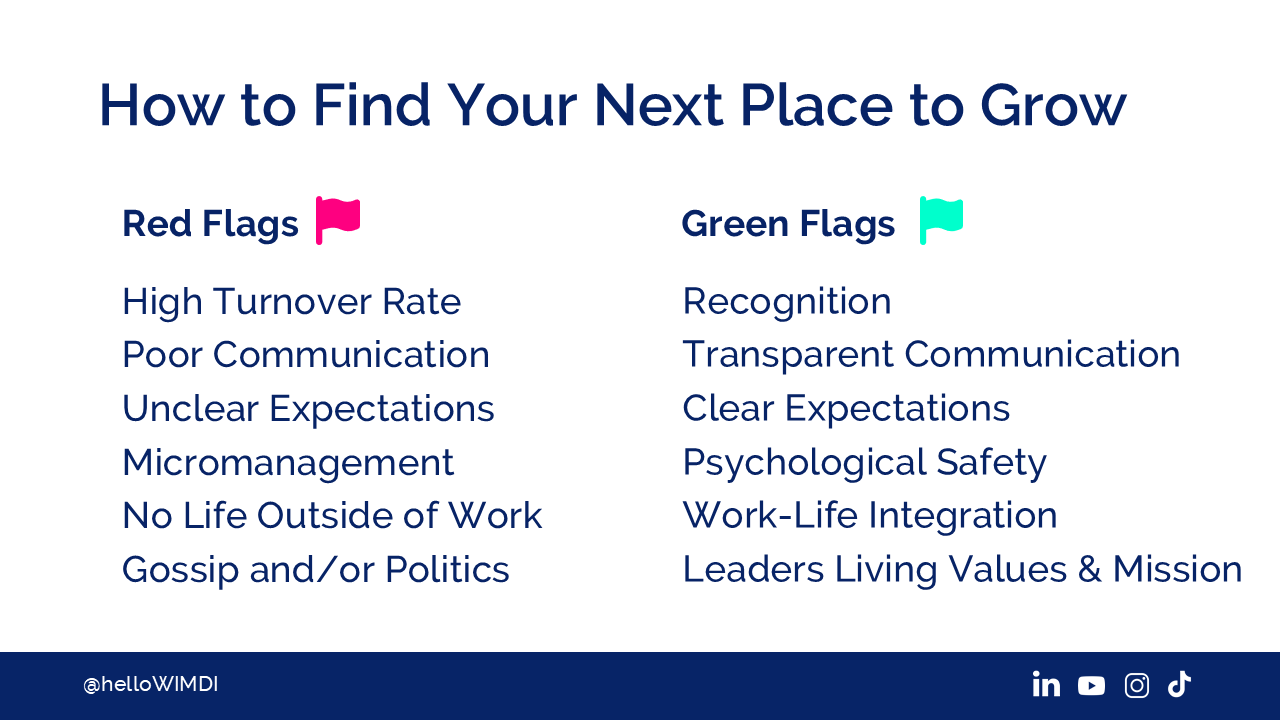
Here are the red flags, where you're possibly looking and searching for your next gig? On Glassdoor, people talk about high turnover, it's a keyword in their Glassdoor reviews. There's poor communication, unclear expectations, micromanagement, all of these are keywords that come up in Glassdoor reviews, no life outside of work, gossip and/or politics. And they might have a lower Glassdoor rating.
For green flags, places that recognise their people. Transparent communication, clear expectations, psychological safety, work-life integration, leaders living values and the mission. Again, you’ll see these keywords in Glassdoor reviews and usually a higher Glassdoor score and a higher approval rating of the CEO.
How Do You Want to Feel in Your Growth Moment?
What I'll leave you with here is the most important thing for you to get clarity on is how do you want to feel?
This is the key part of the "Growth" moment is, do you want to feel appreciated? Do you want to feel valued, seen, heard, recognised, fulfilled? What's that desire core feeling state?
And whatever it is, what would you have to believe about yourself to experience that fulfilment, to experience feeling appreciated? That you are worthy of recognition and appreciation? So how do you want to feel, and what would you have to believe about yourself to have that experience?
Jennie’s Story: Her Growth Moment
My "Growth" moment story is that in 2017, I quit my job and became a certified coach. I went through this intensive coaching programme and the desired feeling state here was feeling freedom, flexibility, authenticity, fulfilment, feeling worthy.
What I had to believe about myself is that I am worthy and capable and I have every right to share my voice and opinion.
Then in 2024, last year, I outgrew my HR executive role and then I decided to jump corporate ship and become my own business owner and expand my coaching practise into full-time coaching.
It's my joy, it's my passion, it's my calling. And so that's again, the similar feeling state of aliveness, freedom, flexibility, authenticity and fulfilment.
I had to believe that, yes, I'm capable as an entrepreneur. That even though the corporate handcuffs, the income handcuffs, I'm worthy even though I'm not making what I was making in my corporate role at this moment.
Summary of The Three Key Moments
So I wanted to share some of my own personal journey there, and to recap the three key moments here that helped me get there, and I want to help you get there too, are;
The "Aha" moment in phase where you identify your triggers through emotional intelligence and mindfulness, remembering that emotions only last no longer than 90 seconds. To label the emotion and to understand the beliefs driving your emotions.
Then the "Healing" phase, which is practising relational hygiene by getting to know your colleagues and turning expectations into agreements, facilitating clearing conversations.
And finally, the "Growth" phase where you get clear on how you want to feel in a workplace and what you would have to believe about yourself to have that experience.
You are worthy and deserve to be treated with respect. That is a truth, that is a birthright for all of us.
So grateful for your time and attention and engagement, and really grateful for you all sharing so beautifully, so vulnerably, and appreciating Holly for having me. Thank you so much.
More Fun Stuff!
If you loved reading this transcript, you might like to watch the video or learn more about our amazing speaker! Check it out: